Quranic Answer
The Holy Quran places profound emphasis on the concept of guarding one's gaze, highlighting a crucial aspect of behavior that affects both the individual and society at large. The teachings found in this sacred text provide not only ethical guidelines but also a framework for maintaining chastity and purity within communities. This article aims to explore the significance of this doctrine, particularly focusing on the teachings found in Surah An-Nur. At the heart of these teachings is the directive from Allah to the believers in Surah An-Nur, verse 30: "Tell the believing men to lower their gaze and guard their chastity; that is purer for them. Indeed, Allah is Acquainted with what they do." This verse serves as a potent reminder that the act of lowering one's gaze is not merely a suggestion, but rather a divine command designed to protect both personal integrity and social morality. By urging individuals to avoid looking at non-mahrams—those who are not closely related—this directive seeks to diminish temptations that could lead to immoral thoughts and actions. The rationale behind this injunction goes beyond personal benefit; it is about creating a safe and respectful environment within society. When individuals respect this command, it fosters a culture of dignity and morality, where relationships are governed by mutual respect rather than objectification or desire. This awareness encourages a society that prioritizes ethical interactions, thus ensuring a wholesome community environment. In verse 31 of the same surah, Allah extends this guidance to women, advising them to lower their gaze as well and to refrain from displaying their adornments publicly except to close relatives. The underlying principle of both verses is clear: the protection of the gaze serves as a mechanism to prevent lustful inclinations and maintain societal decency. This mutual approach, where both genders are encouraged to observe their gaze, signifies the importance of collective responsibility in nurturing a moral society. The teachings of the Quran concerning the gaze are extensively logical when examined through the lens of contemporary societal issues. In today's world, with the pervasive influence of media and digital platforms, the challenge of guarding one's gaze has become even more critical. Inappropriate gazes and behaviors can lead to a degradation of ethical values, further exacerbated by the constant exposure to provocative content. Such environments can nurture immoral behaviors, triggering cycles that perpetuate negativity and ethical deterioration. By adhering to the principles laid out in the Quran, individuals can take proactive steps to mitigate these societal issues, fostering an atmosphere of respect and morality. Additionally, the act of consciously managing one's gaze is not merely about refraining from looking; it is also about fostering an inner sense of discipline and self-control. This vigilance becomes a form of worship, reinforcing one’s faith and connection to Allah. By practicing this discipline, individuals often find themselves feeling spiritually uplifted, leading to a greater sense of tranquility and fulfillment. In essence, the effort to guard one's gaze can serve as a pathway to enhance one's overall spiritual well-being. Islam teaches that maintaining chastity goes hand in hand with respecting the dignity of others. By following these guidelines, individuals develop a deeper appreciation for the sacredness of relationships and the sanctity of private matters. The advice to lower one's gaze acts as a safeguard against the exploitation of others and promotes an understanding that every individual deserves respect, irrespective of their gender. Such practices can help to curb objectification, foster compassion, and cultivate genuine human connections based on mutual respect rather than superficial judgments. Moreover, the directives relating to guarding one's gaze extend to various aspects of life, including one's interactions, thoughts, and the choices one makes. When individuals commit to nurturing a pure gaze, it becomes a catalyst for overall moral conduct. The influence of one’s gaze often resonates with one’s thoughts and actions; thus, being vigilant about what we observe helps in shaping a more ethical inner narrative. As one focuses on virtuous seeing, there is a tendency to engage in virtuous thinking and ultimately virtuous actions. Community leaders and educators also hold a significant role in promoting the importance of these teachings, by incorporating discussions about the significance of guarding one's gaze into their furtherance of moral education. Community programs can help encourage individuals to recognize the relevance of these teachings in their everyday lives, cultivating safe spaces where individuals can express their struggles and successes in maintaining this aspect of their faith. In conclusion, the Islamic teachings surrounding the guarding of one's gaze profoundly contribute to creating a moral and ethical society. These guidelines, as articulated in the Quran, emphasize that managing one's sight is vital not only for personal integrity but also for promoting a harmonious existence within communities. By steadfastly adhering to these principles, individuals can foster a culture rooted in respect, dignity, and morality while also enhancing their spiritual growth. The journey towards safeguarding one's gaze is indeed a noble pursuit, one that promises numerous benefits for individuals and society alike. Embracing these teachings not only aligns with the divine guidance provided in the Quran but also plays a pivotal role in ensuring a just and virtuous community for generations to come.
Related Verses
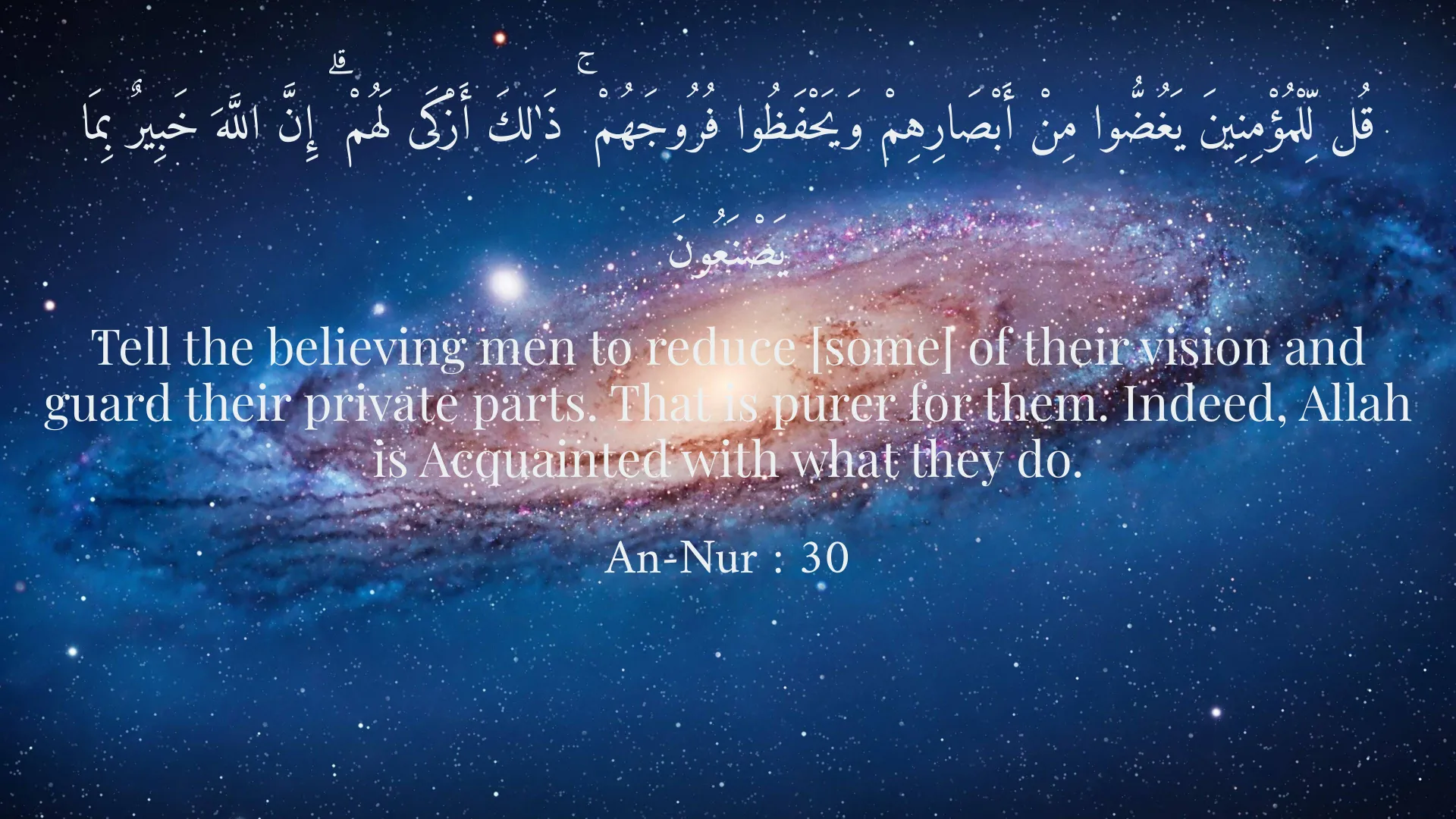
قُل لِّلْمُؤْمِنِينَ يَغُضُّوا مِنْ أَبْصَارِهِمْ وَيَحْفَظُوا فُرُوجَهُمْ ۚ ذَٰلِكَ أَزْكَى لَهُمْ ۗ إِنَّ اللَّهَ خَبِيرٌ بِمَا يَصْنَعُونَ
Tell the believing men to reduce [some] of their vision and guard their private parts. That is purer for them. Indeed, Allah is Acquainted with what they do.
An-Nur : 30
وَقُل لِّلْمُؤْمِنَاتِ يَغْضُضْنَ مِنْ أَبْصَارِهِنَّ وَيَحْفَظْنَ فُرُوجَهُنَّ وَلَا يُبْدِينَ زِينَتَهُنَّ إِلَّا مَا ظَهَرَ مِنْهَا ۖ وَيَضْرِبْنَ بِخُمُرِهِنَّ عَلَى جُيُوبِهِنَّ ۚ وَلَا يُبْدِينَ زِينَتَهُنَّ إِلَّا لِبُعُولَتِهِنَّ أَوْ آبَائِهِنَّ أَوْ آبَاءِ بُعُولَتِهِنَّ أَوْ أَبْنَائِهِنَّ أَوْ أَبْنَاءِ بُعُولَتِهِنَّ أَوْ إِخوَانِهِنَّ أَوْ بَنَاتِ إِخوَانِهِنَّ أَوْ بَنَاتِ أَخَوَاتِهِنَّ ۚ وَالَّتِي تَسْتَخْفِينَ مَا هُوَ مِنَ الزينة أَحَقٌّ الأَثِيمُ
And tell the believing women to lower their gaze and guard their private parts and not expose their adornment except that which [ordinarily] appears thereof and to wrap [a portion of] their headcovers over their chests and not expose their adornment except to their husbands, their fathers, their fathers' fathers, their sons, their husbands' sons, their brothers, their brothers' sons, and their sisters' sons.
An-Nur : 31
Short Story
Once upon a time, a young man named Subhan lived in a city. He participated in inappropriate activities with his friends and had a habit of looking at the world inappropriately. One day, while passing by a mosque, he noticed a verse from the Quran. 'Tell the believing men to lower their gaze.' He thought about what this verse meant. After reflecting for some time, he decided to guard his gaze and began practicing modesty that summer. Gradually, he found that this act not only calmed his spirit but also helped those around him to live better.