Quranic Answer
The Holy Quran serves as a foundational text for millions of Muslims around the world, guiding their beliefs, behaviors, and moral frameworks. As a religious and spiritual guide, it is replete with lessons and principles that encourage believers to live righteous lives. Among these principles, compassion and kindness toward others are especially emphasized through numerous verses, which not only define the essence of a good life but also encourage believers to build a society founded on respect, understanding, and mutual aid. This article aims to explore the significance of compassion and kindness as delineated in the Quran, with a particular focus on selected verses that encapsulate these values. Compassion in the Quran is not merely an ideal; it is presented as the essence of righteousness. In Surah Al-Baqarah, verse 177, Allah delivers a powerful message that redefines the concept of righteousness, stating: 'Righteousness is not that you turn your faces toward the east or the west, but [true] righteousness is in one who believes in Allah, the Last Day, the Angels, the Book, and the Prophets and gives his wealth, in spite of love for it, to relatives, orphans, the needy, the traveler, those who ask [for help], and for freeing slaves...' (Al-Baqarah: 177). This verse serves as an essential reminder that genuine faith in God transcends mere rituals or acts of worship; it is manifested through tangible action and generosity towards those in need. The emphasis on giving in this verse illustrates that true believers cannot detach their spirituality from their social responsibilities. Helping others, especially those who are vulnerable—like orphans and the needy—is presented as an integral component of faith. This direct correlation between faith and acts of kindness lays down a powerful framework for believers: compassion is as vital as belief itself. The Quran thereby establishes that the mere performance of religious duties is insufficient without corresponding ethical conduct that includes charity, care, and support for others, particularly the marginalized in society. Moreover, Surah Al-Imran reinforces the importance of compassion by advocating for generosity in both favorable and adverse circumstances. Allah states, 'And those who spend [in the cause of Allah] during ease and hardship and who restrain anger and who pardon the people - and Allah loves the doers of good.' (Al-Imran: 134). Here, the message is clear: compassion is not confined to singular moments of generosity or periods of ease. Instead, it requires believers to go beyond their comfort zones, maintaining their generosity even during hardship. This calls for a sustained commitment to altruism, emphasizing an exemplary standard of character marked by patience, forgiveness, and kindness, even when faced with difficulties. This verse is particularly relevant in a world often characterized by division, anger, and conflict. The Quran's teaching encourages believers to cultivate self-control and turn toward forgiveness—qualities that are essential for peaceful coexistence within diverse communities. By fostering a compassionate outlook, believers can better navigate interpersonal conflicts and contribute positively to the moral fabric of society. The sanctity of human life is another vital theme in the Quran that aligns with compassion and kindness. In Surah Al-Ma'idah, verse 32, it is mentioned: 'Because of that, We decreed upon the Children of Israel that whoever kills a soul unless for a soul or for corruption [done] in the land - it is as if he had slain mankind entirely...' (Al-Ma'idah: 32). This powerful verse not only underscores the dignity of human life but also reinforces the moral obligation to protect and value it. The Quran asserts that taking a life unjustly equates to the destruction of all humanity, highlighting the interconnectivity and inherent value of each individual life. Thus, compassion extends beyond mere charitable acts or concern; it encompasses the respect for life itself and a commitment to preserving it. Understanding and internalizing such messages sets up a belief system where the welfare of others is viewed as critical, leading to actions that foster safety, security, and happiness within communities. Such perspectives are essential for those endeavoring to create a more inclusive and compassionate society, especially in times of strife and unrest. In summary, compassion and kindness are not merely peripheral attachments in the worldview of Islam as presented in the Quran; rather, they form the core of what it means to be a believer. The sacred text intricately weaves together the themes of faith and action, urging followers to embody love, generosity, and charity towards others. The verses discussed illustrate that true righteousness involves a comprehensive understanding of both spiritual and social dimensions of life. Through these teachings, the Quran advocates for a community where individuals are held accountable not just for their personal piety but also for their ethical dealings and contributions to the welfare of others. Ultimately, by embracing these teachings, individuals can foster an environment conducive to harmonious coexistence within diverse societies. The principles of kindness and compassion championed in the Quran are timeless and universal, bearing relevance across different cultures and contexts. In a world that often struggles with conflict, these teachings serve as a beacon of hope, encouraging us to prioritize love, understanding, and assistance for one another as we collectively navigate the complexities of the human experience.
Related Verses
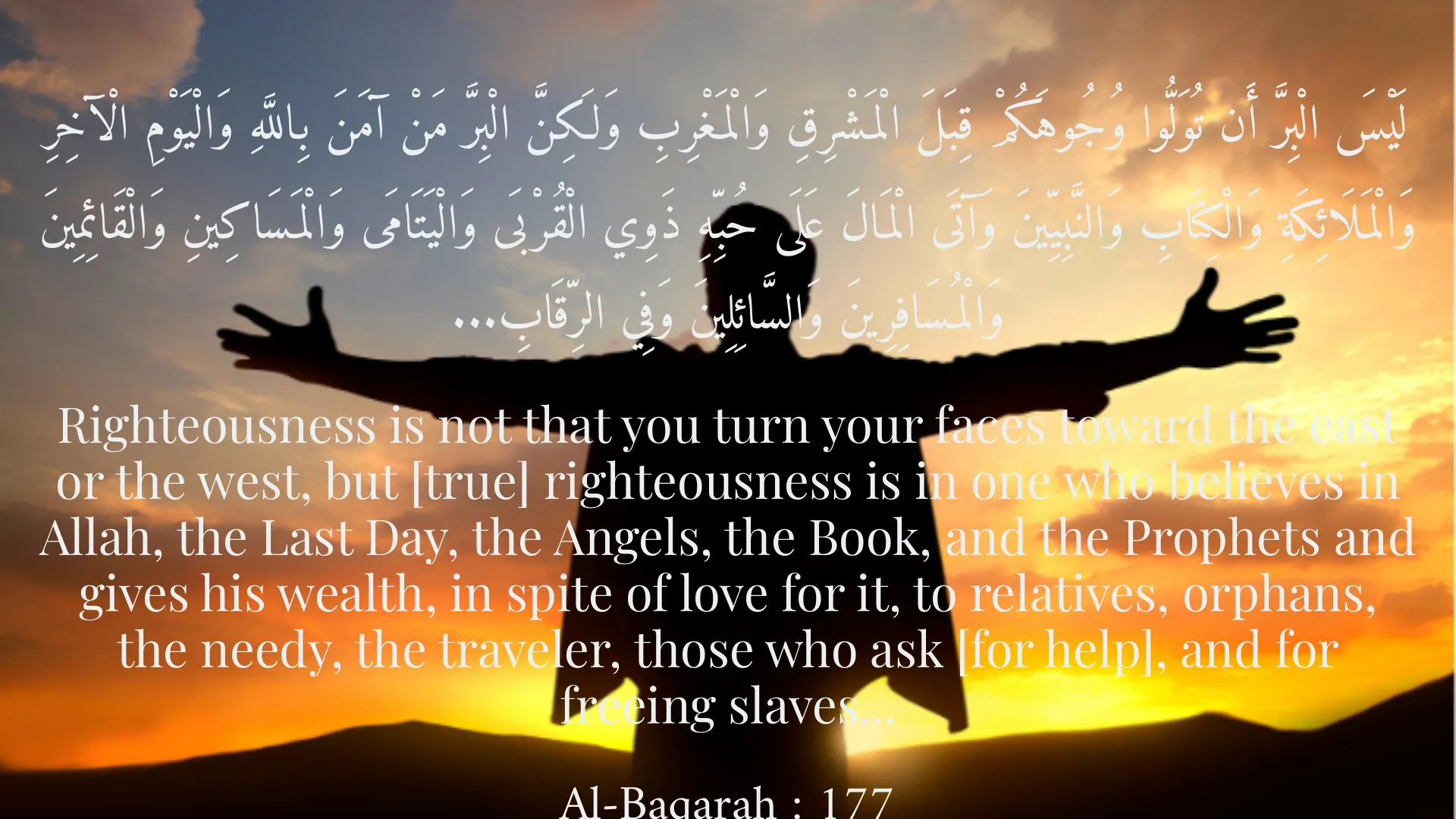
لَيْسَ الْبِرَّ أَن تُوَلُّوا وُجُوهَكُمْ قِبَلَ الْمَشْرِقِ وَالْمَغْرِبِ وَلَكِنَّ الْبِرَّ مَنْ آمَنَ بِاللَّهِ وَالْيَوْمِ الْآخِرِ وَالْمَلَائِكَةِ وَالْكِتَابِ وَالنَّبِيِّينَ وَآتَى الْمَالَ عَلَى حُبِّهِ ذَوِي الْقُرْبَى وَالْيَتَامَى وَالْمَسَاكِينِ وَالْقَائِمِينَ وَالْمُسَافِرِينَ وَالسَّائِلِينَ وَفِي الرِّقَابِ...
Righteousness is not that you turn your faces toward the east or the west, but [true] righteousness is in one who believes in Allah, the Last Day, the Angels, the Book, and the Prophets and gives his wealth, in spite of love for it, to relatives, orphans, the needy, the traveler, those who ask [for help], and for freeing slaves...
Al-Baqarah : 177
وَالَّذِينَ يُنفِقُونَ فِي السَّرَّاء وَالضَّرَّاء وَالْكٰظِمِينَ الْغَيْظَ وَالْعَافِينَ عَنِ النَّاسِ ۗ وَاللَّهُ يُحِبُّ الْمُحْسِنِينَ
And those who spend [in the cause of Allah] during ease and hardship and who restrain anger and who pardon the people - and Allah loves the doers of good.
Al-Imran : 134
مِنْ أَجْلِ ذَٰلِكَ كَتَبْنَا عَلَى بَنِي إِسْرَائِيلَ أَنَّهُ مَن قَتَلَ نَفْسًا بغير نَفْسٍ أَوْ فَسَادٍ فِي الْأَرْضِ فَكَأَنَّمَا قَتَلَ النَّاسَ جَمِيعًا...
Because of that, We decreed upon the Children of Israel that whoever kills a soul unless for a soul or for corruption [done] in the land - it is as if he had slain mankind entirely...
Al-Ma'idah : 32
Short Story
One day in a town, a man named Hassan always helped those in need. He had read many verses from the Quran about compassion and knew that it had great rewards with God. One day, while helping an elderly woman who was walking alone in the street, he realized the importance of being compassionate to others. Hassan helped her with kindness and respect, feeling a great blessing in his life.