Quranic Answer
The Holy Quran, regarded as the eternal word of God by Muslims, places significant emphasis on the concepts of charity and altruism. These principles are deemed fundamental not just for individual moral development but also for the betterment of the community at large. While the Quran encourages acts of charity, it also presents crucial guidelines regarding the nature and intention behind these deeds, particularly emphasizing the need to avoid putting others in our debt following a charitable act. This notion is vividly captured in Surah Al-Baqarah, verse 264, which states: 'O you who have believed, do not invalidate your charities with reminders or injury.' This verse, along with many others in the Quran, serves as a guiding principle, cautioning believers against the potential pitfalls that can accompany charitable giving. To fully appreciate this guidance, it is essential to explore the broader implications of charitable acts, the spirit of genuine giving, and the detrimental effects of expecting repayment or recognition. The act of giving, when performed with sincere intentions, is viewed as an essential aspect of one's faith. However, it has also been noted that the spiritual essence and societal value of such acts can be severely diminished if they are followed by reminders or any sense of superiority. The prohibition against reminding others of past favors or expecting acknowledgment highlights the importance placed on humility and sincerity in Islamic teachings. This principle encourages individuals to perform good deeds purely for the sake of seeking God's pleasure rather than for social validation or personal gain. The Quran explicitly warns against actions that may contaminate the purity of charitable intents. The act of reminding others of our kindness or imposing our goodwill can lead to feelings of indebtedness and resentment, undermining the original spirit of the act and potentially leading to mistrust or conflict in relationships. In Surah Al-Muddaththir, verse 38, the Quran states: 'Every soul, for what it has earned, will be retained.' This verse serves as a reminder that each individual is responsible for their actions and will face the consequences of their deeds. Here, the concept of justice is interwoven with the act of giving; it reminds believers that every action should be motivated by a genuine desire to aid others without any ulterior motives. When acts of kindness are performed with expectations of repayment, they lose their value and essence, as these actions are then attached to conditions rather than coming from a pure heart. Moreover, the adverse impact of harboring expectations regarding acknowledgment can also have repercussions on interpersonal relationships. While one may feel momentarily satisfied by performing a good deed, the potential for negative feelings toward either the recipient or oneself can rise in the absence of gratitude or recognition. This expectation may lead to bitterness, and feelings of injustice when one feels their kindness is overlooked or unappreciated. This cycle can create a wall between friends and family, as it undermines the original intent of fostering goodwill. The misunderstandings surrounding charity are often perpetuated by cultural practices that deviate from Islamic teachings. In many communities, the concept of 'putting others in our debt' can manifest in various forms—from social media posts highlighting charitable donations to public displays of generosity to garner recognition. Such practices undermine the fundamental teachings of the Quran, which advocate for humility, discretion, and the intrinsic value of charity. In contrast, the Quran encourages believers to view charity as a means of spiritual ascension and self-purification. The act of giving is not merely a transaction but a means of fostering a deeper connection with the Creator, allowing believers to cleanse themselves of material concerns and develop a spirit of empathy and compassion. When approached with the right intentions, charity can serve not just as a means of assisting others but also as a significant pathway towards personal growth and enlightenment. Additionally, the concept of selflessness in giving invites believers to cultivate an attitude of gratitude and awareness regarding their blessings. By recognizing that every person possesses their trials, this understanding can help one remain grounded and compassionate toward others, fostering a sense of community and togetherness. When one gives purely for the sake of Allah, it carries immense spiritual rewards that will be honored in this life and the next. Furthermore, the focus on performing acts of kindness without expectation can serve as an antidote to the often transactional nature of modern relationships. In a world that frequently emphasizes individualism and material gain, the principles of generosity and selflessness championed in the Quran offer a powerful counter-narrative. By embodying the essence of true charity, believers can inspire others, creating an environment that cultivates goodwill, trust, and mutual respect. Thus, living out these principles can forge deeper connections, not just with friends and family but also within the broader community. In conclusion, the teachings of the Quran regarding charity and the inherent dangers of putting others in debt necessitate a profound understanding of our intentions and actions as believers. By recognizing the value of good deeds devoid of expectations or conditions, we can embrace the spirit of generosity that the Quran emphasizes. Ultimately, performing acts of kindness for the sole purpose of seeking Allah's pleasure allows us to enrich our lives spiritually and positively impact those around us. Therefore, as we engage in acts of charity, let us strive to align our intentions with these sacred teachings, allowing us to contribute to a more harmonious and compassionate world.
Related Verses
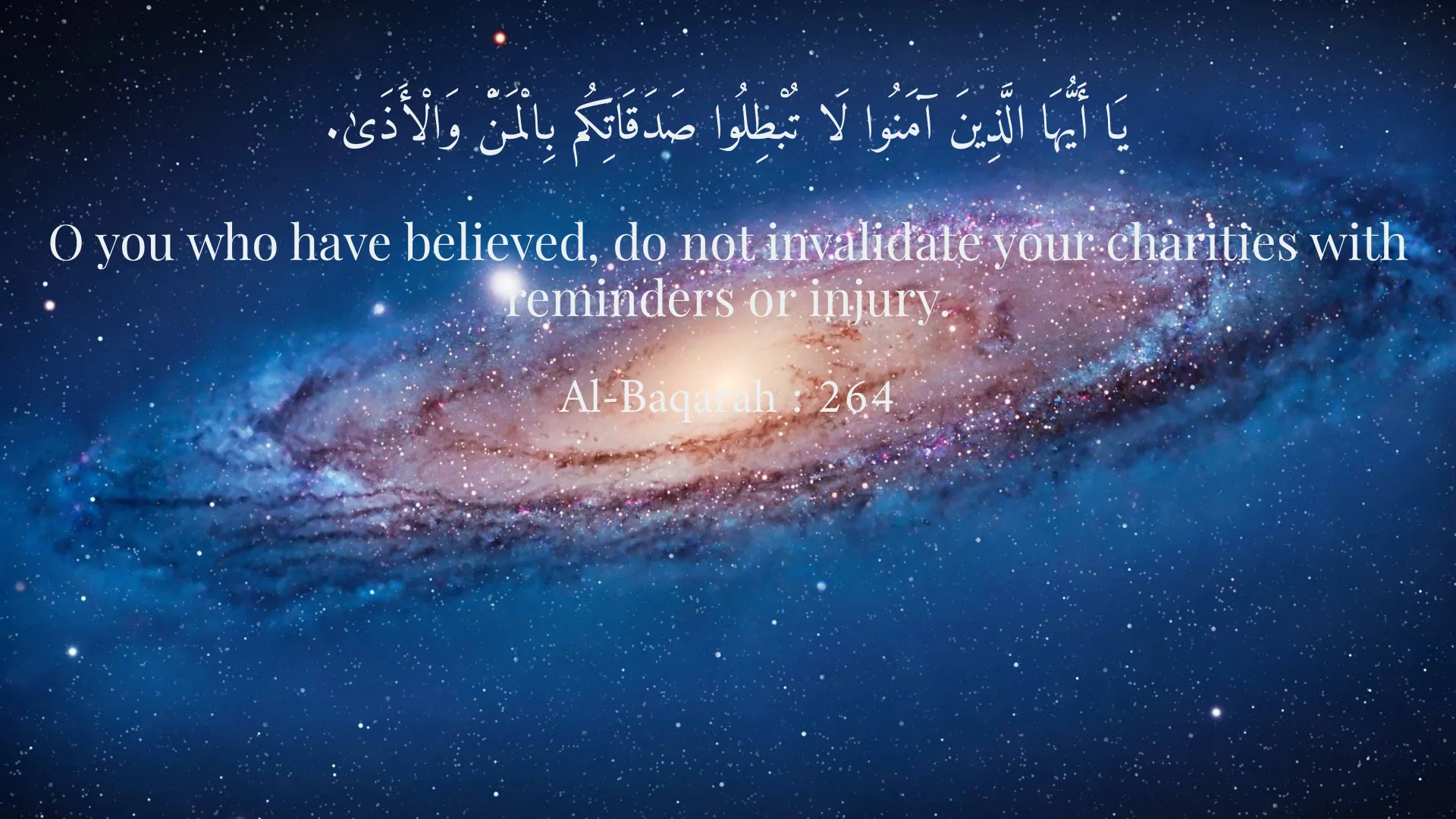
يَا أَيُّهَا الَّذِينَ آمَنُوا لَا تُبْطِلُوا صَدَقَاتِكُم بِالْمَنّْ وَالْأَذَىٰ.
O you who have believed, do not invalidate your charities with reminders or injury.
Al-Baqarah : 264
كُلُّ نَفْسٍ بِمَا كَسَبَتْ رَهِينَةٌ.
Every soul, for what it has earned, will be retained.
Al-Muddaththir : 38
Short Story
One day, a man named Ali was walking down the street and noticed an elderly woman struggling with a heavy load. Without hesitation, Ali helped her and carried her burden. After finishing, the woman thanked him, and Ali smiled, saying, 'I thank God for enabling me to help.' From that day on, Ali never spoke about this deed and learned in his heart that good deeds should be performed sincerely and without expectations.