Quranic Answer
In the Holy Quran, there is significant emphasis on the importance of helping the poor and the needy. This cornerstone of Islamic teaching is deeply rooted in the texts and has profound implications for individual behavior and societal norms. The Quran serves not only as a spiritual guide but also as a comprehensive manual for creating a just society where the welfare of all individuals, especially the disenfranchised, is paramount. The relevance of assistance to the needy transcends mere acts of charity, linking it to the very essence of righteousness and spirituality. In Surah Al-Baqarah, verse 177, we are told: 'Righteousness is not that you turn your faces toward the east or the west, but [true] righteousness is in one who believes in Allah, the Last Day, the Angels, the Book, and the Prophets and gives his wealth, in spite of love for it, to relatives, orphans, the needy, the traveler, those who ask [for help], and for freeing slaves.' This verse reinforces the idea that true righteousness is not defined solely by ritualistic observances or superficial piety but by tangible actions that reflect one’s faith and compassion. The act of giving, especially when it comes to those who are unable to repay, is held as an ultimate test of one’s character and devotion. Furthermore, the verse indicates the types of people who should receive aid — relatives, orphans, the needy, travelers, and those who are seeking help. This inclusive list urges believers to be mindful of the different facets of need within their communities. By addressing these various categories, the Quran highlights a comprehensive approach to charity and support. Helping neighbours, family members, and deliberately attending to the most vulnerable in society reflects a profound commitment to social justice. This responsibility is not limited to financial support but extends to emotional, educational, and psychological support, creating a holistic framework for community well-being. In addition, Surah Al-Ma'idah, verse 32 states: 'And whoever saves one - it is as if he had saved mankind entirely.' This profound statement places immense value on the act of saving a life, suggesting that every single effort made toward the benefit of others can have far-reaching consequences. This assertion broadens the perspective of aid, allowing individuals to recognize that small actions can culminate in significant change. It underlines the notion that engaging with the needy is not merely an act of kindness but a contribution to the collective human experience, thereby binding us with a shared responsibility toward humanity. The principles expressed in the Quran do not solely cater to the spiritual aspirations of individuals; they emphasize social obligations that must be fulfilled to cultivate a well-rounded, compassionate society. This is further substantiated in Surah Al-Hashr, verse 7: 'What Allah has bestowed upon His Messenger from the people of the town, it is for Allah and for the Messenger and for [his] near relatives and orphans, the needy, and the traveler.' Here, wealth is portrayed not as a personal entitlement but as a communal resource intended to be distributed among the members of society. This perspective challenges individuals to rethink the often pervasive mentality of selfishness and accumulation. Wealth, in this context, is a tool for social equity, meant to support and uplift the less fortunate. Moreover, reflecting on the plight of the poor inspires gratitude and humility within oneself. When individuals take the time to assist those who are suffering, they develop a better understanding of their own blessings. This reflection fosters a sense of community and connection rather than isolation. Gratitude has significant psychological benefits, often leading to increased well-being and life satisfaction. By committing to the well-being of others, we not only contribute to their improvement but also enhance our personal fulfillment and inner peace. Practically speaking, the act of helping the needy can take many forms. From supporting local food banks, volunteering at shelters, providing mentorship and education to disadvantaged youth, or merely extending a helping hand to the elderly or disabled individuals in the community, every small effort counts. It is crucial to understand that assisting the poor does not always necessitate wealth; it can manifest through time, knowledge, and compassion, all of which are invaluable resources in building a supportive community. In discussing this vital duty, it is important to recognize the broader implications of neglecting the poor. Societies that are indifferent to the needs of the less fortunate often encounter deep-rooted social issues that can lead to unrest, disenfranchisement, and fragmentation. On the other hand, communities that embrace generosity and support create stable environments where individuals can thrive, ultimately resulting in societal advancement and cohesion. Acknowledging and helping those in need is a vital aspect of our humanity. Acts of compassion and support bring people together, fostering understanding and care amidst the diverse tapestry of human experiences. By focusing on alleviating social issues surrounding poverty, we pave the way for a more harmonious coexistence, bridging the gap between different societal segments. In conclusion, the Quran's steadfast emphasis on helping the poor and the needy serves as a guiding principle for believers and non-believers alike. It invites everyone to engage deeply with the moral and social fabric of society. Compassion and support for those who are struggling is not just commanded by divine mandate, but it is also essential for our collective prosperity and well-being. By understanding and implementing these teachings in our daily lives, we can contribute to a world where justice and equity prevail, ensuring that no one is left behind. Through empathy and action, we can all do our part in creating a society that reflects our highest aspirations and shared human dignity.
Related Verses
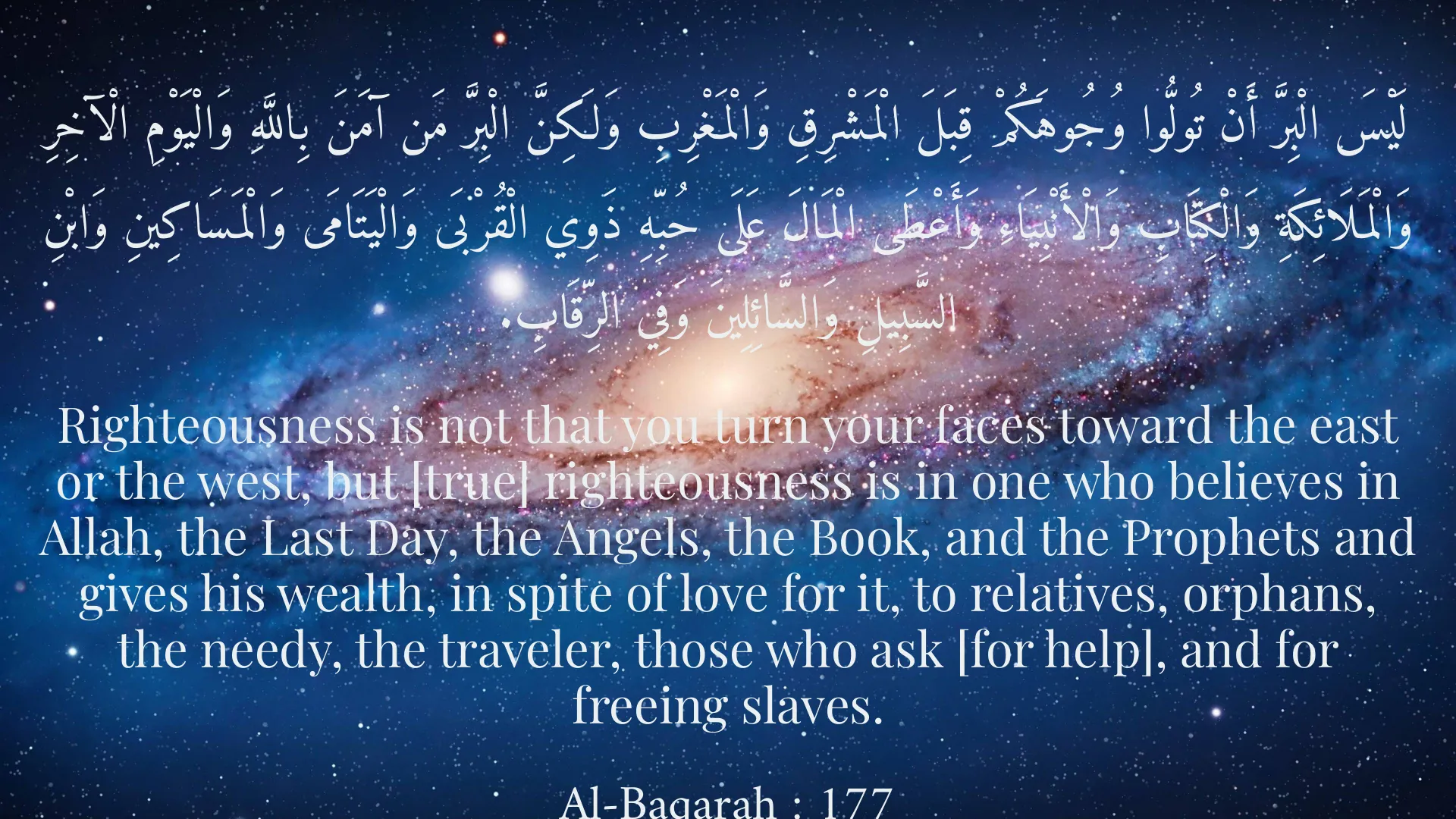
لَيْسَ الْبِرَّ أَنْ تُولُّوا وُجُوهَكُمْ قِبَلَ الْمَشْرِقِ وَالْمَغْرِبِ وَلَكِنَّ الْبِرَّ مَن آمَنَ بِاللَّهِ وَالْيَوْمِ الْآخِرِ وَالْمَلَائِكَةِ وَالْكِتَابِ وَالْأَنْبِيَاءِ وَأَعْطَى الْمَالَ عَلَى حُبِّهِ ذَوِي الْقُرْبَى وَالْيَتَامَى وَالْمَسَاكِينِ وَابْنِ السَّبِيلِ وَالسَّائِلِينَ وَفِي الرِّقَابِ.
Righteousness is not that you turn your faces toward the east or the west, but [true] righteousness is in one who believes in Allah, the Last Day, the Angels, the Book, and the Prophets and gives his wealth, in spite of love for it, to relatives, orphans, the needy, the traveler, those who ask [for help], and for freeing slaves.
Al-Baqarah : 177
مَن أَحْيَاهَا فَكَأَنَّمَا أَحْيَا النَّاسَ جَمِيعًا.
And whoever saves one - it is as if he had saved mankind entirely.
Al-Ma'idah : 32
مَا أَفَاءَ اللَّهُ عَلَى رَسُولِهِ مِنْ أَهْلِ الْقُرَى فَلِلَّهِ وَلِلرَّسُولِ وَلِذِي الْقُرْبَى وَالْيَتَامَى وَالْمَسَاكِينِ وَابْنِ السَّبِيلِ.
What Allah has bestowed upon His Messenger from the people of the town, it is for Allah and for the Messenger and for [his] near relatives and orphans, the needy, and the traveler.
Al-Hashr : 7
Short Story
Once upon a time, there was a kind man who was sleeping in his home. He dreamt that he was on the Day of Judgment surrounded by the poor who told him, 'We remembered you while you were in the world, and now you should remember us too.' He woke up and decided to dedicate a portion of his income to the poor every week. This act brought blessings to his sustenance and joy to his spirit.