Quranic Answer
In the Holy Quran, the significance of time and its value are clearly articulated, forming a crucial aspect of the teachings within this sacred text. Allah invites people to make the most of their time, highlighting its unlimited potential for growth, improvement, and spirituality. The importance of dedicating time towards striving for goodness and righteousness resonates throughout various verses, providing both guidance and wisdom for believers. This article examines the profound significance that the Quran places on time, its intrinsic value, and its impact on human life. To begin with, Surah Al-Ankabut, verse 69, serves as an essential focal point: 'And those who strive for Us, We will surely guide them to Our ways. And indeed, Allah is with the doers of good.' This verse teaches us that whenever we strive in the path of God, He will guide us to the best paths. Such guidance is not arbitrary; it requires or encourages individual effort and conscious dedication to lead a purposeful life. The relationship between effort and divine attention not only establishes a sense of agency but also emphasizes the role of time in that agency. Each moment spent striving towards goodness and righteousness is thus a moment invested in receiving Allah's guidance, a powerful incentive to use our time wisely. This idea aligns seamlessly with the broader concept of time in human life. In Islamic teachings, time is sacrosanct. It is often compared to wealth, as both are limited resources. Those who squander their time may find themselves regretting lost opportunities. The Quran does not merely emphasize the importance of time; it individualizes this concept by calling on people to reflect on their own lives. The notion that individuals can improve themselves and their circumstances through the proper use of time serves as an empowering message for humanity. Moreover, in Surah Al-Asr, Allah strongly emphasizes the value of time, asserting: 'By time, indeed, mankind is in loss' (Surah Al-Asr, verses 1 and 2). This verse presents a stark reality; human beings are in a state of loss unless they perform righteous deeds and advise one another to truth and patience. What does this mean for individuals navigating daily life? It signifies a call to consciousness about how time is spent. The essence of Al-Asr reminds us that not only is time a finite resource, but it is also a vessel of potential. Engaging in righteous actions can transform time from a mere passage of moments into a rich tapestry of character-building experiences that contribute positively to society. In the light of these Quranic teachings, one may realize that time is not merely an element of our existence; it is a vital opportunity to make an impact, enhance our lives, and fulfill our spiritual obligations. To recognize the sacredness of time is to embrace a broader purpose—to grow individually while contributing positively to our communities. With this understanding, one is encouraged to consider where to direct their energy and efforts. This requires a sense of reflection and mindfulness about daily activities and interactions, suggesting that a thoughtful approach to time can lead to greater personal development. The implications of these Quranic insights stretch far and wide. By valuing time, individuals foster the necessity to engage in worship, strengthen social interactions, and dedicate time towards self-improvement. This ability to balance such significant areas in life reflects the comprehensive nature of Islamic teachings that encourage holistic development grounded in righteous actions. The knowledge that Allah is with the doers of good inherently emphasizes the importance of teamwork, for through mutual support in endeavors, communities can foster environments that truly honor the sanctity of time. Furthermore, the awareness of the value of time contributes to the cultivation of patience, a cornerstone of spiritual growth in Islam. Patience is critical for both personal challenges and communal responsibilities, as it teaches individuals to endure hardships while maintaining focus on righteous deeds. It directly correlates with the actions of advising one another to truth, nurturing a community committed to positive change. In a world where distractions are rampant, and time management can be a constant struggle, these Quranic teachings serve as aligners to realign one's priorities. They challenge the believer to self-assess how they spend their time and encourage the development of habits that relate back to spiritual and communal well-being. Successfully managing one's time not only creates a structured routine but fosters an atmosphere where meaningful interactions and growth are welcomed and promoted. The reminders offered by the Quran regarding time should serve as motivation for individuals to actively seek productivity through righteous actions and relationships. Ultimately, Allah’s words provide the assurance that undertaking such efforts will lead to divine guidance and support, transcending every moment spent and transforming it into purposeful contributions to ourselves and those around us. In conclusion, the teachings of the Holy Quran regarding time resonate deeply within the Islamic faith. The verses for which this article draws upon illustrate how time is precious and should be acknowledged as a vital resource. As believers, there is an obligation to allot time for worship, improve oneself, engage with the community, and foster connections that encourage personal growth and perfection in good deeds. Such awareness and utilization of time create a foundation for a successful and fulfilling life—one that earns the guidance of Allah and contributes positively to the world at large. The Quran's messages serve not only as reminders but as calls to action, urging individuals to respect the gift of time and to make the most of every precious moment granted to them.
Related Verses
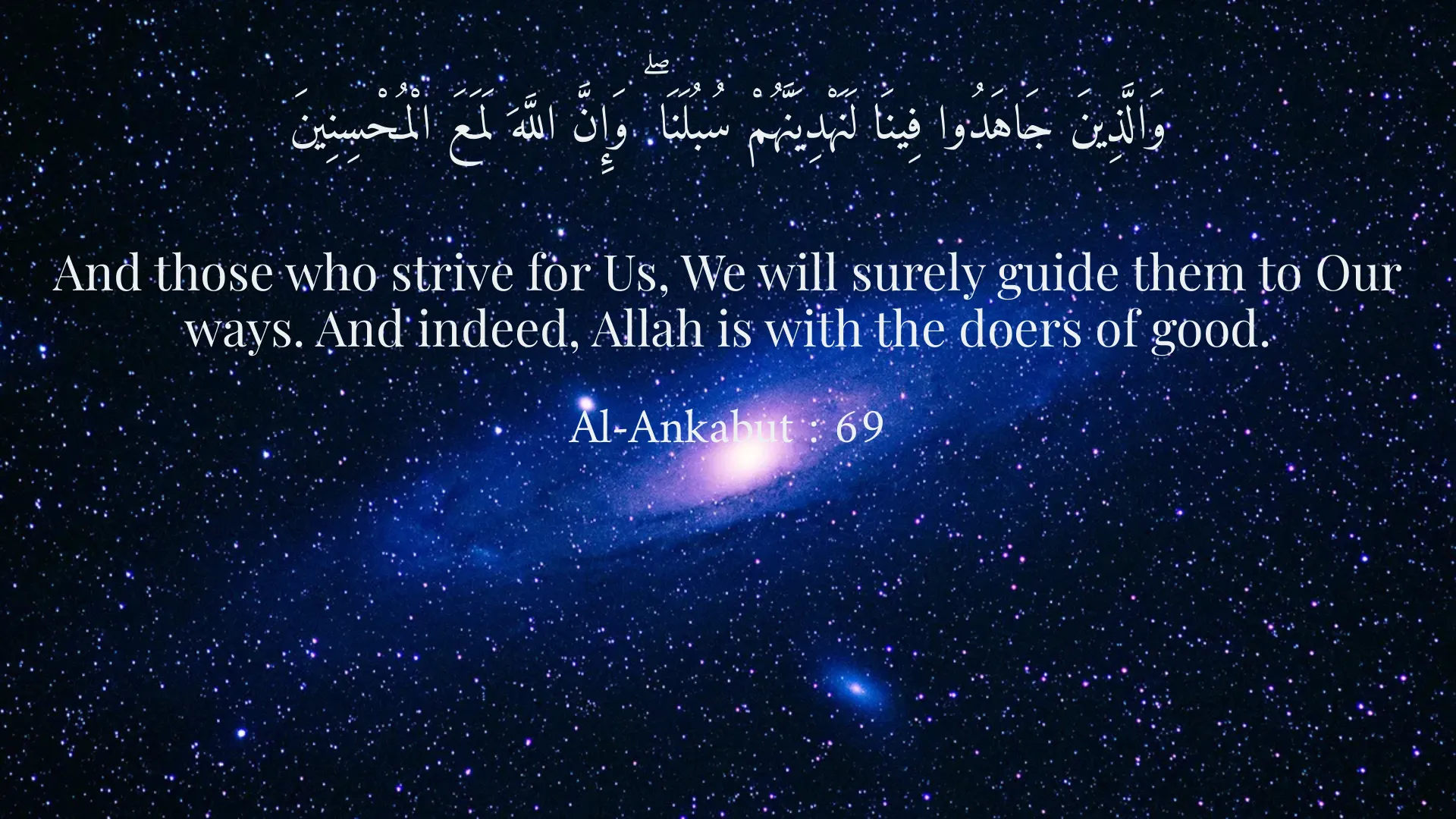
وَالَّذِينَ جَاهَدُوا فِينَا لَنَهْدِيَنَّهُمْ سُبُلَنَا ۖ وَإِنَّ اللَّهَ لَمَعَ الْمُحْسِنِينَ
And those who strive for Us, We will surely guide them to Our ways. And indeed, Allah is with the doers of good.
Al-Ankabut : 69
وَالْعَصْرِ، إِنَّ الْإِنْسَانَ لَفِي خُسْرٍ
By time, indeed, mankind is in loss.
Al-Asr : 1
Short Story
Once upon a time, there was a man named Ahmad who always endeavored to make the most of his time. He used to tell his friends: 'Don't waste time, or you will regret it later!' As time passed, his friends realized how true Ahmad was and they too decided to value time and use it wisely.