Quranic Answer
From the perspective of the Holy Quran, the answer to the question of whether humans can truly change is unequivocally positive. The Quran not only affirms the possibility of change but regards it as an essential and purposeful path for human growth and evolution. Contrary to common perceptions, humans are not static or fixed beings; rather, they possess an infinite potential for transformation and metamorphosis. This potential stems from the free will and choice that God has bestowed upon them; humans have the ability to choose between the path of good and evil and can, by their own will, alter the course of their lives. One of the most fundamental Quranic concepts emphasizing the human capacity for change is that of 'Tawba' (repentance). Tawba signifies a return from sin and error towards obedience and submission to God. This return is not merely a superficial regret but demands a profound inner transformation and a change in one's conduct. In the Quran, God explicitly invites His servants to repent and promises acceptance and forgiveness, even for the greatest sins. This invitation to repentance demonstrates that no sin is so great that it closes the door to return and change, and no individual is so steeped in corruption that they cannot return to the light. Verses such as "Say, 'O My servants who have transgressed against themselves [by sinning], do not despair of the mercy of Allah. Indeed, Allah forgives all sins. Indeed, it is He who is the Forgiving, the Merciful.'" (Surah Az-Zumar, 39:53) are clear examples of this mercy and the possibility of change. Beyond repentance, the Quran also emphasizes the concept of 'Jihad an-Nafs' or the struggle against the lower self (Nafs al-Ammarah). This struggle entails a continuous effort to overcome carnal desires and unruly passions that divert humans from the path of truth. Jihad an-Nafs is a lifelong process that leads individuals towards self-purification and spiritual refinement. Through this struggle, one can abandon undesirable habits and cultivate positive moral qualities within themselves. This change is not only internal but also manifests in one's behaviors and actions. For instance, a person who was previously angry or envious can, through practice and struggle, transform into a gentle and forgiving individual. This transformation is a sign of spiritual growth and the human pursuit of perfection. The Quran also articulates the fundamental principle of 'change from within'. The famous verse, "Indeed, Allah will not change the condition of a people until they change what is in themselves." (Surah Ar-Ra'd, 13:11) explicitly states that God does not alter the state of any people until they themselves change what is within their souls. This verse places the responsibility for change squarely on the individual and emphasizes that external and societal transformations originate from internal shifts within people. It is an invitation to self-improvement and awakening, urging humans to take the first step and cultivate the will for change within themselves. This will alone is not sufficient; it must be accompanied by action and perseverance. God only assists those who embark on the path of change and improvement. Furthermore, the concept of 'guidance' (Hidayah) in the Quran also points to the human capacity for change. God has shown humanity the paths of guidance and misguidance, leaving the choice to them. By choosing the path of truth and adhering to divine commands, humans can change the course of their lives from error to light and salvation. This guidance is not a one-way process; by seeking guidance and striving to attain it, individuals expose themselves to divine mercy and direction. The more a person walks on the path of truth, the softer and more receptive their heart becomes to accepting divine light, leading to deeper transformations within them. These changes can encompass shifts in beliefs, values, attitudes, and personal behaviors. Quranic examples of human change are abundant; from the magicians of Pharaoh who repented and believed in God upon witnessing Moses' (PBUH) miracle, to many individuals who transitioned from disbelief and polytheism to faith and monotheism. These stories serve as living proof that change is possible at any stage of life and for anyone. Therefore, the Quran emphasizes that change is a dynamic and continuous process that requires self-knowledge, self-improvement, struggle, patience, and reliance on God. By adhering to these principles and utilizing the opportunities God provides, humans can transform into their best selves and achieve their desired perfection.
Related Verses
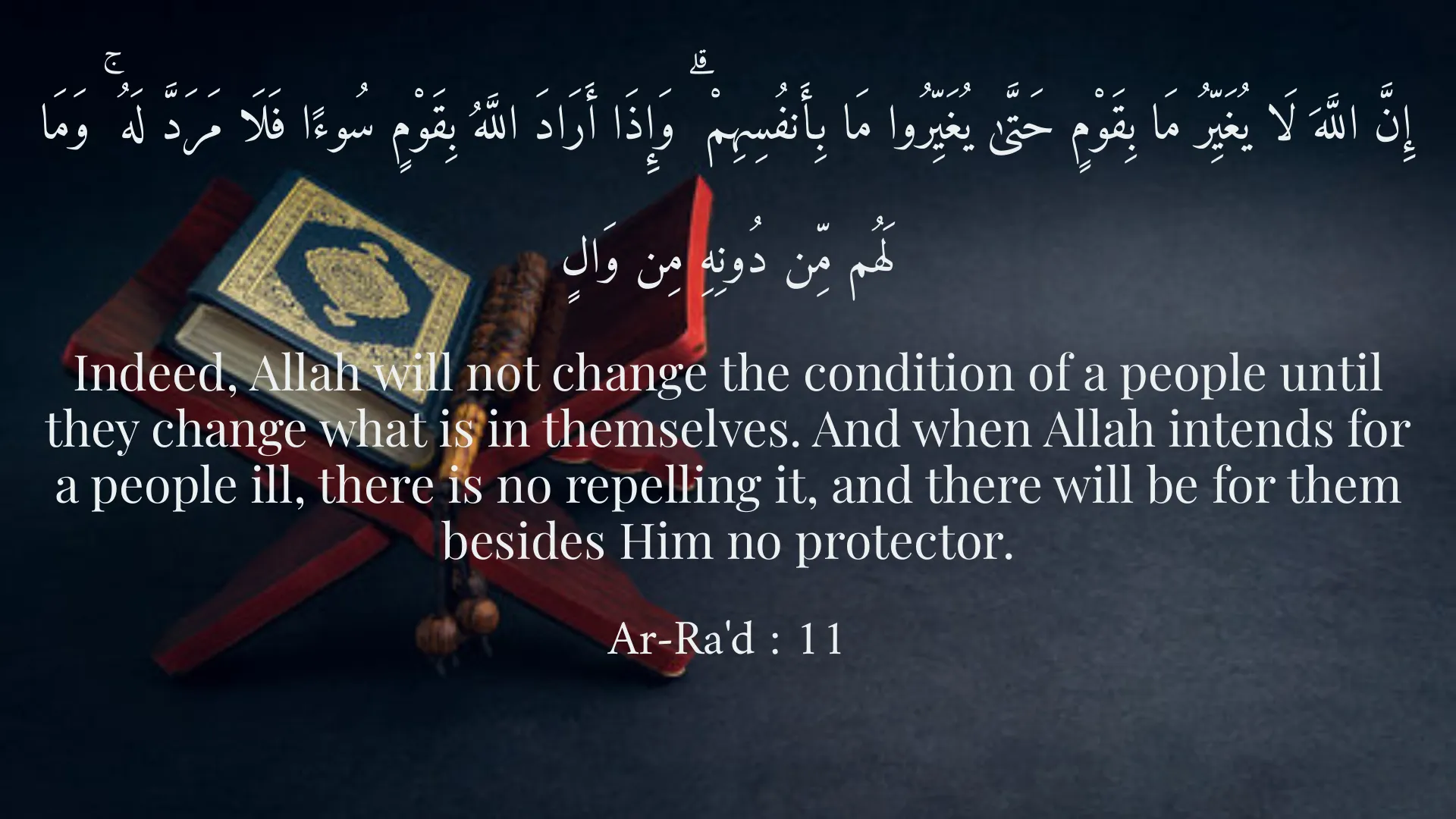
إِنَّ اللَّهَ لَا يُغَيِّرُ مَا بِقَوْمٍ حَتَّىٰ يُغَيِّرُوا مَا بِأَنفُسِهِمْ ۗ وَإِذَا أَرَادَ اللَّهُ بِقَوْمٍ سُوءًا فَلَا مَرَدَّ لَهُ ۚ وَمَا لَهُم مِّن دُونِهِ مِن وَالٍ
Indeed, Allah will not change the condition of a people until they change what is in themselves. And when Allah intends for a people ill, there is no repelling it, and there will be for them besides Him no protector.
Ar-Ra'd : 11
قُلْ يَا عِبَادِيَ الَّذِينَ أَسْرَفُوا عَلَىٰ أَنفُسِهِمْ لَا تَقْنَطُوا مِن رَّحْمَةِ اللَّهِ ۚ إِنَّ اللَّهَ يَغْفِرُ الذُّنُوبَ جَمِيعًا ۚ إِنَّهُ هُوَ الْغَفُورُ الرَّحِيمُ
Say, 'O My servants who have transgressed against themselves [by sinning], do not despair of the mercy of Allah. Indeed, Allah forgives all sins. Indeed, it is He who is the Forgiving, the Merciful.'
Az-Zumar : 53
قَدْ أَفْلَحَ مَن زَكَّاهَا
He has succeeded who purifies it,
Ash-Shams : 9
وَقَدْ خَابَ مَن دَسَّاهَا
And he has failed who corrupts it.
Ash-Shams : 10
Short Story
In Saadi's Golestan, it is recounted that a just king had a vizier who, at the beginning of his service, was very wise and virtuous. However, over time, due to associating with ill-doers, his character changed, and he deviated from the right path. The king, saddened by the vizier's condition, summoned him and said: "O Vizier, you who drank from the fountain of wisdom, how is it that you now emit the scent of corruption?" The vizier, ashamed, replied: "My Lord, it was these associations that changed me." The king wisely responded: "Look closely! Although bad company can have an effect, a noble root never dries up. The will of a person is stronger than any companion. If you had a strong will within yourself and clung to purity, no treachery could divert you from the right path." The vizier took heed of the king's words, repented, and with firm resolve, freed himself from those contaminations, returning to his former state of morality and virtue. The king rejoiced at his return and said: "Indeed, as long as a human desires, they can change and return from the well of darkness to the light." This story teaches us that although environment and companionship influence a person, the power of true change lies within one's own will and heart; repentance and return are always possible.