Quranic Answer
Undoubtedly, the Holy Quran is not only a divine guide for human life but also an unparalleled and profound source for achieving true self-knowledge. Self-knowledge holds immense importance in Islamic and Quranic culture; to the extent that traditions attributed to the Prophet Muhammad (PBUH) and the infallible Imams state: “Man ‘arafa nafsahu faqad ‘arafa Rabbahu” – meaning “Whoever knows himself has certainly known his Lord.” This noble hadith clearly demonstrates that the path to Ma’rifatullah (knowledge of God) passes through Ma’rifatun-Nafs (self-knowledge). By elucidating human creation, our position in existence, the divine nature (fitra), strengths and weaknesses, responsibilities, and the ultimate purpose of life, the Quran provides a clear path to understanding our existential dimensions. This knowledge is not merely intellectual but a profound understanding that leads to inner transformation and spiritual growth. The Quran approaches the understanding of human beings from various perspectives. One of the most crucial aspects is the discussion of human creation. In numerous verses, God refers to the manner of human creation from dust, the breathing of the divine spirit into them, and their exalted position among creations. For instance, in Surah At-Tin, verse 4, Allah says: “Lacad khalaqna al-insana fi ahsani taqweem” – meaning “We have certainly created man in the best of stature.” This verse indicates the inherent dignity and infinite potential of humanity. Recognizing this dignity and position frees a person from heedlessness and low self-esteem, guiding them towards discovering their divine talents. Furthermore, the Quran introduces humans as “Khalifatullah” (God’s vicegerent) on Earth (Al-Baqarah, verse 30), a role that implies responsibility towards oneself, others, and the environment. Understanding this role helps individuals find a noble purpose for their lives and align their existence with this divine objective. The Quran also delves into the various aspects of the human soul (nafs). This divine book considers the soul to have different dimensions: from the nafs al-ammara (the commanding soul) that incites evil, to the nafs al-lawwama (the self-reproaching soul) that blames a person for their mistakes, and finally, the nafs al-mutma’inna (the tranquil soul) that achieves divine peace and assurance. This categorization provides a framework for understanding human inner struggles and their path of spiritual evolution. The verses of Surah Ash-Shams, particularly verses 7 to 10, explicitly address this: “Wa nafsin wa ma sawwaha (7) Fa-alhamaha fujuraha wa taqwaha (8) Qad aflaha man zakkaha (9) Wa qad khaba man dassaha (10)” – meaning “And [by] the soul and He who proportioned it and inspired it [with discernment of] its wickedness and its righteousness, He has succeeded who purifies it, And he has failed who corrupts it.” These verses indicate that humans face two internal forces, good and evil, and their salvation lies in the purification and cleansing of their souls. This path of purification requires precise self-knowledge and awareness of inner inclinations. Moreover, the Quran encourages humans to seek God’s signs not only in the horizons (the external world) but also within themselves (anfus). In Surah Adh-Dhariyat, verses 20 and 21, it states: “Wa fi al-ardi ayātun lilmuqineen (20) Wa fi anfusikum afala tubsiroon (21)” – meaning “And in the earth are signs for those who have certainty [of faith], And in yourselves. Then will you not see?” This invitation to introspection is one of the Quran’s most powerful tools for self-knowledge. By contemplating the complexities of the human body, the functioning of the mind and heart, and inner emotions and feelings, one can grasp the grandeur of creation and divine wisdom, which is itself a significant step towards understanding one’s position and existential truth. The Quran also helps in self-knowledge by presenting a realistic picture of human weaknesses and vulnerabilities. Verses that refer to human haste, ingratitude, greed, and oppression are not meant to discourage but to enlighten and correct the path. This awareness of weaknesses invites humility, seeking forgiveness, and striving for perfection. Alongside these weaknesses, the Quran also emphasizes human capabilities for free will, patience, gratitude, repentance, and faith, and by narrating the stories of prophets and saints, it provides role models for growth and elevation. Ultimately, Quranic self-knowledge means a deeper understanding of the human relationship with God. The better a person knows themselves—as a creation dependent on the Creator, in need of Him, and accountable to Him—the closer they come to sincere servitude and divine proximity. This self-knowledge is the key to achieving inner peace and true happiness in this world and the hereafter, as it connects humanity to the source of existence and the ultimate purpose of creation. Therefore, the Quran is not merely a tool for self-knowledge but a comprehensive and flawless roadmap for traversing this blessed path, inviting every reader to reflect on themselves and the world, and to attain higher degrees of knowledge and perfection.
Related Verses
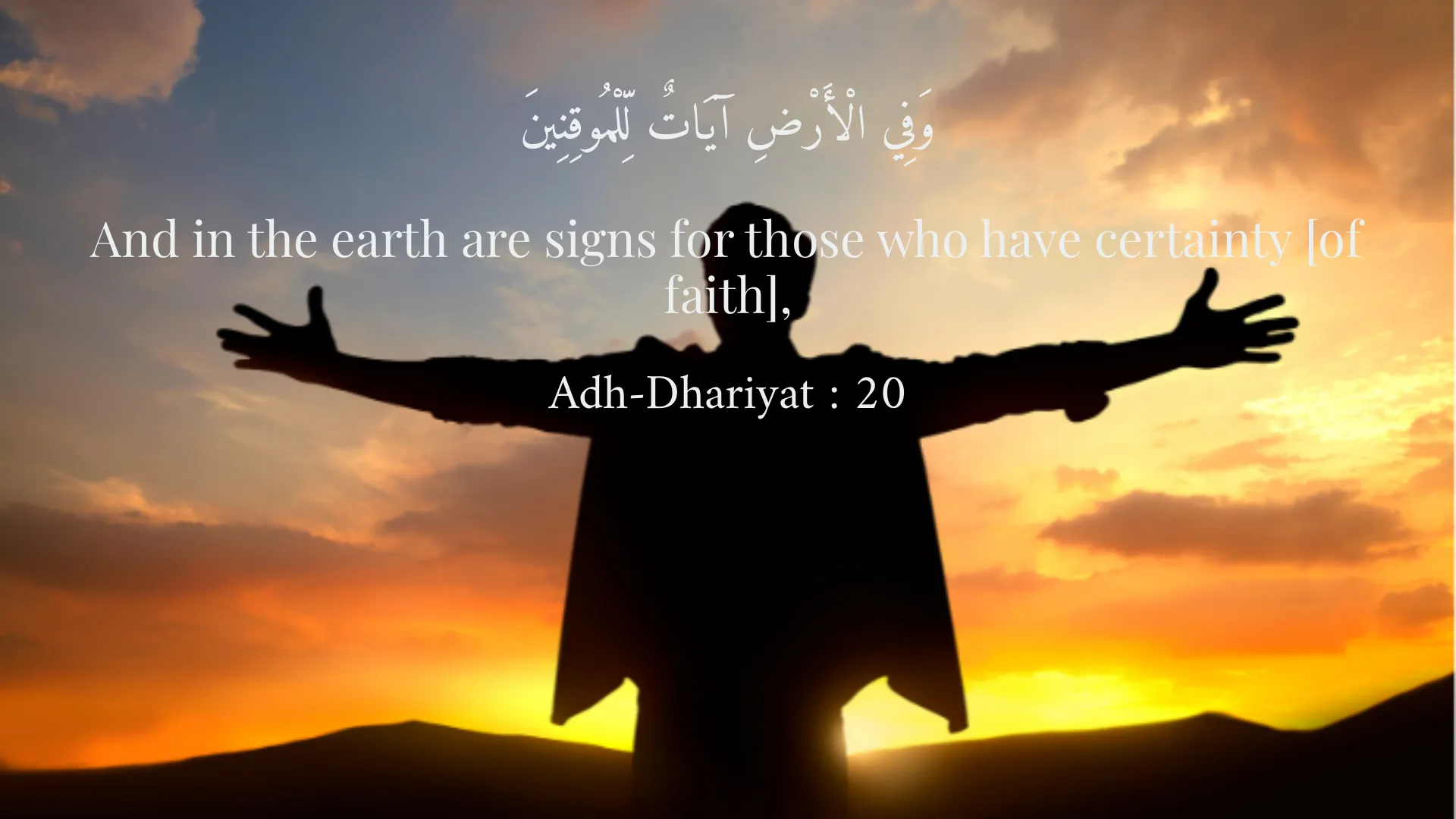
وَفِي الْأَرْضِ آيَاتٌ لِّلْمُوقِنِينَ
And in the earth are signs for those who have certainty [of faith],
Adh-Dhariyat : 20
وَفِي أَنفُسِكُمْ ۚ أَفَلَا تُبْصِرُونَ
And in yourselves. Then will you not see?
Adh-Dhariyat : 21
لَقَدْ خَلَقْنَا الْإِنسَانَ فِي أَحْسَنِ تَقْوِيمٍ
We have certainly created man in the best of stature.
At-Tin : 4
قَدْ أَفْلَحَ مَن زَكَّاهَا
He has succeeded who purifies it,
Ash-Shams : 9
وَقَدْ خَابَ مَن دَسَّاهَا
And he has failed who corrupts it.
Ash-Shams : 10
Short Story
It is narrated that a great sage had a student who was always seeking treasures and jewels in faraway lands. One day, the master said to him: “My son, you have traveled much and seen much, but have you ever journeyed within yourself?” The student asked in surprise: “Is there a treasure within?” The master smiled and said: “Yes, a treasure far greater than anything found in earth or sea. Go and spend some time in solitude with yourself; do not seek what you lack, but rather behold what you are.” The student followed the master’s advice, and by reflecting on his own soul, he came to understand his weaknesses and strengths, realizing that true peace and knowledge were not found in external pursuits, but in discovering the truth within himself. He learned that the true treasure was the knowledge of his self and his Lord, hidden deep within his being.