Quranic Answer
In today's fast-paced and bustling world, where consumerism and extravagance are often presented as symbols of success and happiness, the question "Can one live a simple life?" is not merely an intellectual query but often an existential concern for many. The Holy Quran, as the divine word and an eternal guide for humanity, not only affirms this possibility but considers it one of the fundamental principles of a believing life and a path to salvation. In essence, a simple life from a Quranic perspective does not imply deprivation or extreme asceticism; rather, it signifies a wise balance between material and spiritual needs, coupled with an avoidance of extravagance and undue greed. The Quran, by emphasizing the concept of "Wasatiyyah" (moderation) and denouncing "Israf" (extravagance), provides a clear framework for a balanced and simple life. In Surah Al-Furqan, verse 67, Allah describes the characteristics of His special servants, the "Ibad-ur-Rahman" (servants of the Most Merciful), as follows: "And [they are] those who, when they spend, do not spend wastefully nor are they stingy; but between that is a just stand." This verse clearly indicates that in spending and consumption, whether for personal needs or to help others, one must adopt a middle path. Neither excessive spending that leads to resource waste and self-corruption, nor stinginess and narrow-mindedness that hinder growth and generosity. This balance is the essence of a simple life: utilizing Allah's blessings sufficiently without adding unnecessary burdens upon oneself or society. Furthermore, the Quran explicitly prohibits extravagance in all aspects of life. In Surah Al-A'raf, verse 31, we read: "O children of Adam, take your adornment at every mosque, and eat and drink and do not be extravagant. Indeed, He likes not those who commit extravagance." This verse is a comprehensive invitation to moderation in eating, drinking, and even dressing. "Adornment" here refers to neatness and beauty, which are approved in Islam, but it is immediately followed by a warning against extravagance. This means that one can enjoy blessings, be beautiful, wear good clothes, and eat pure food, but one should never exceed the bounds of moderation. Extravagance is not only economically harmful but, from the Quran's perspective, an undesirable act displeasing to Allah, as it signifies ingratitude and a lack of proper understanding of the value of blessings. A simple life means understanding that blessings are trusts that must be utilized with wisdom and gratitude. One of the main pillars of a simple life in the Quranic view is a correct understanding of the status and nature of worldly life. The Quran repeatedly reminds us that worldly life is fleeting and transient and should not be the ultimate goal of human beings. Surah Al-Hadid, verse 20, provides a very vivid depiction of this truth: "Know that the life of this world is only play and amusement, an adornment and [cause for] boasting among yourselves and competition in [accumulating] wealth and children - like the example of a rain whose [resulting] plant growth pleases the disbelievers; then it dries and you see it turned yellow; then it becomes [scattered] debris. And in the Hereafter is severe punishment and forgiveness from Allah and approval. And what is the worldly life except the enjoyment of delusion." This verse illustrates that fascination with the world and immersion in competition for wealth and children is merely a fleeting deception. When a person views the world through this lens, they naturally avoid greed and avarice and seek tranquility and contentment in a simple life. Focusing on the Hereafter and the ultimate purpose of creation naturally distances a person from excessive consumerism. So, how can one live a simple life in today's era? This entails conscious consumption. This means asking ourselves before every purchase: "Do I truly need this? Does this purchase add spiritual or true value to my life, or is it merely following fleeting trends and social pressure?" This lifestyle does not mean not buying anything, but rather making purposeful purchases and avoiding unnecessary luxuries. Also, contentment and gratitude are essential principles. The Quran places great emphasis on being grateful for blessings. When a person is content with what they have and shows gratitude for it, they are not constantly seeking more and enjoy their possessions. This contentment strengthens the fundamental roots of a simple life. Focusing on non-material values is also crucial. In today's world, many people spend their time and energy acquiring wealth and luxuries. The Quranic simple life invites us to focus on values such as knowledge, wisdom, family, human relationships, helping others, and servitude to Allah. These are the true and lasting treasures that bring inner peace. Avoiding comparison is equally important. Social media and advertising constantly present an image of an ideal and glamorous life, which can create feelings of comparison and dissatisfaction. The Quranic simple life teaches us that the measure of human worth is not material possessions, and comparing oneself to others in this regard brings nothing but anxiety and sorrow. Strengthening spirituality also plays a key role. The deeper one's connection with Allah and the more mindful one is of the Hereafter, the lesser worldly attachments appear in one's eyes. Worship, remembrance (dhikr), contemplation of divine verses, and close association with the Quran provide a tranquility that no material wealth can offer, naturally guiding a person towards a life with fewer needs and greater satisfaction. Of course, living a simple life in the modern age presents its challenges. Social pressures, easy access to goods, and extensive advertising can be tempting. But the Quran offers guidance: with strong will, deep belief in divine promises, and continuous practice of moderation, one can embark on this path. This lifestyle not only leads to individual tranquility but also contributes to environmental sustainability and social justice, as less consumption means less pressure on Earth's resources and reduced inequalities. In conclusion, the Quranic simple life is a way to find true happiness in a world that constantly seeks to deceive us. It is a path towards freedom from material constraints and achieving a peace that is found only in closeness to the Creator of the universe and living according to His principles. Yes, in today's era, it is not only possible but highly necessary to live a simple life, because this lifestyle is not merely a personal choice, but a divine directive for a fruitful and meaningful existence.
Related Verses
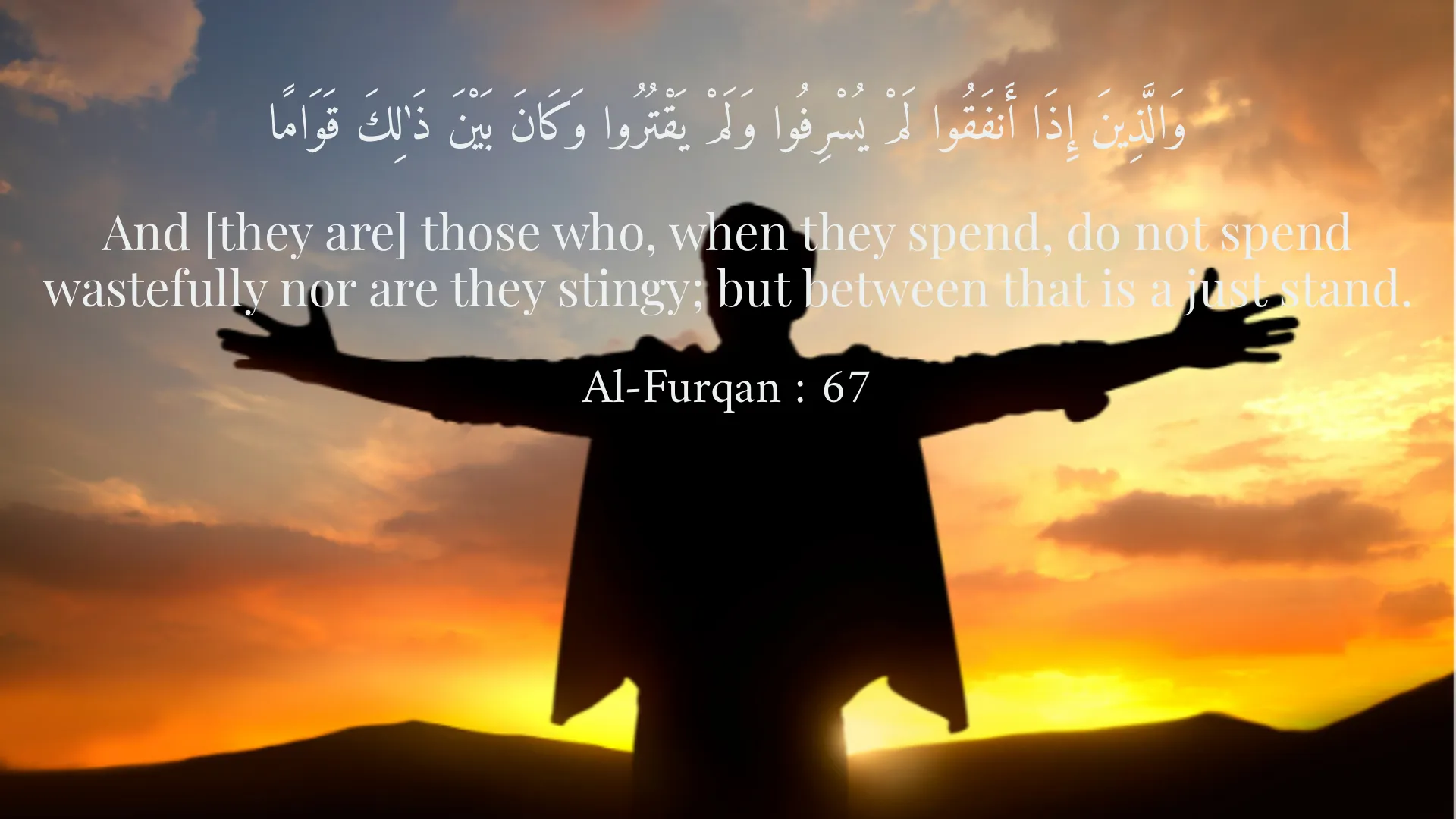
وَالَّذِينَ إِذَا أَنفَقُوا لَمْ يُسْرِفُوا وَلَمْ يَقْتُرُوا وَكَانَ بَيْنَ ذَٰلِكَ قَوَامًا
And [they are] those who, when they spend, do not spend wastefully nor are they stingy; but between that is a just stand.
Al-Furqan : 67
يَا بَنِي آدَمَ خُذُوا زِينَتَكُمْ عِندَ كُلِّ مَسْجِدٍ وَكُلُوا وَاشْرَبُوا وَلَا تُسْرِفُوا ۚ إِنَّهُ لَا يُحِبُّ الْمُسْرِفِينَ
O children of Adam, take your adornment at every mosque, and eat and drink and do not be extravagant. Indeed, He likes not those who commit extravagance.
Al-A'raf : 31
اعْلَمُوا أَنَّمَا الْحَيَاةُ الدُّنْيَا لَعِبٌ وَلَهْوٌ وَزِينَةٌ وَتَفَاخُرٌ بَيْنَكُمْ وَتَكَاثُرٌ فِي الْأَمْوَالِ وَالْأَوْلَادِ ۖ كَمَثَلِ غَيْثٍ أَعْجَبَ الْكُفَّارَ نَبَاتُهُ ثُمَّ يَهِيجُ فَتَرَاهُ مُصْفَرًّا ثُمَّ يَكُونُ حُطَامًا ۖ وَفِي الْآخِرَةِ عَذَابٌ شَدِيدٌ وَمَغْفِرَةٌ مِّنَ اللَّهِ وَرِضْوَانٌ ۚ وَمَا الْحَيَاةُ الدُّنْيَا إِلَّا مَتَاعُ الْغُرُورِ
Know that the life of this world is only play and amusement, an adornment and [cause for] boasting among yourselves and competition in [accumulating] wealth and children - like the example of a rain whose [resulting] plant growth pleases the disbelievers; then it dries and you see it turned yellow; then it becomes [scattered] debris. And in the Hereafter is severe punishment and forgiveness from Allah and approval. And what is the worldly life except the enjoyment of delusion.
Al-Hadid : 20
Short Story
It is narrated that one day, a wealthy king was seated in his garden when a simple-hearted and unpretentious dervish passed by the garden wall. The king, astonished by the dervish's tranquility and contentment despite his meager possessions, called out to him. He asked, 'O man of God, I see you cheerful and at ease with very little sustenance. Do you not harbor any envy in your heart for all my grandeur, wealth, and dominion?' The dervish smiled and replied, 'O King, I pity your condition, not you mine. For I carry my kingdom within my heart, free from every chain and servitude. I neither need tall palaces nor fear losing them. But your kingdom lies outside of yourself, and every moment you fear its loss. Are you its king, or is it your king? My freedom from worldly attachments has freed me from the bonds of anxiety, and this is the secret of my simple and good life.' The king pondered over these words and realized that true treasure lies not in wealth and and dominion, but in contentment and peace of heart.