Quranic Answer
Can the Quran help you love yourself? This question, deeply rooted in the human experience, addresses one of the most crucial aspects of spiritual and mental well-being: an individual's relationship with themselves. While the term "self-love" in its modern psychological sense may not be explicitly found in the Quranic verses, a profound study of Quranic concepts and teachings reveals that the Holy Quran provides comprehensive and deep foundations for fostering a healthy, balanced, and fruitful relationship with oneself. This relationship is not based on narcissism or arrogance, but on respecting oneself as Allah's vicegerent on Earth, taking responsibility for one's soul, and striving for its purification and spiritual growth. The Quran begins by emphasizing the inherent dignity of humanity. In Surah Al-Isra, verse 70, Allah states: "And We have certainly honored the children of Adam and carried them on the land and sea and provided for them of the good things and preferred them over much of what We have created, with [definite] preference." This verse explicitly highlights that Allah has created humans with intrinsic dignity. This dignity is bestowed upon them by the Creator; it is not something humans need to earn. This fundamental truth is the first and most crucial step towards cultivating an internal sense of self-worth. When we know that we have been created by the Creator of the universe, with all these unique attributes (intellect, free will, capacity for learning, etc.), and have been favored over many of His creations, how can we consider ourselves worthless? This perspective forms the basis for self-acceptance with all its strengths and weaknesses. Another key point is the purposeful creation of humanity. The Quran, in Surah Adh-Dhariyat, verse 56, declares: "And I did not create the jinn and mankind except to worship Me." Worship here does not merely mean performing ritual acts of worship but encompasses living according to Allah's pleasure, knowing Him, and striving for perfection. When an individual finds a noble purpose and meaning for their existence, the feelings of emptiness and meaninglessness, which often lead to low self-esteem, dissipate. Knowing that every moment of life is an opportunity to draw closer to Allah and fulfill a divine mission enriches one's life and enables them to see themselves not merely as a finite being but as a soul with infinite potential for growth and transcendence. This insight empowers individuals to love themselves not for external achievements, but for their noble intrinsic purpose. The Quran places immense emphasis on "Tazkiyah al-Nafs," or self-purification. Surah Ash-Shams, verses 9 and 10, state: "He has succeeded who purifies it, And he has failed who corrupts it." These verses indicate that true success and salvation in this world and the hereafter depend on purifying the soul from moral vices and adorning it with virtues. This process of self-purification requires recognizing one's weaknesses and strengths, striving to correct mistakes, and moving towards perfection. This approach, unlike destructive self-blame, is constructive, guiding the individual towards continuous improvement and fostering a sense of progress and capability. When one strives to be the best version of themselves, this effort naturally leads to self-esteem and a sense of worthiness. This path of purification does not imply self-rejection, but rather refining oneself to reach the highest human potential that Allah has instilled within them. Furthermore, the concept of repentance (Tawbah) and hope in Allah's mercy plays a vital role in fostering healthy self-love. Often, self-blame and guilt over past mistakes prevent individuals from loving themselves. The Quran, in Surah Az-Zumar, verse 53, states: "Say, 'O My servants who have transgressed against themselves [by sinning], do not despair of the mercy of Allah. Indeed, Allah forgives all sins. Indeed, it is He who is the Forgiving, the Merciful.'" This verse gives hope that no matter how many sins one has committed, the door of Allah's mercy is always open. This concept helps individuals forgive themselves for past mistakes and approach the future with a renewed perspective and hope for betterment. Self-forgiveness is one of the fundamental pillars of self-love, and without it, one sinks into the quagmire of regret and self-reproach. This divine solace allows individuals to lift the burden of sins from their shoulders and move towards growth and self-acceptance with a lighter spirit. Patience (Sabr) and gratitude (Shukr) are also crucial Quranic concepts that contribute to strengthening self-love. The Quran advises believers to be patient in the face of life's difficulties and adversities. Patience is not merely resilience in hardship but also acceptance of divine decree and trust in Allah's wisdom. This approach brings inner peace and enables the individual to believe in themselves and their capabilities even in challenging circumstances. Similarly, being grateful for Allah's countless blessings, including breathing, health, and talents, helps individuals focus more on what they possess rather than what they lack. This positive outlook helps them see themselves as valuable and favored by divine grace. When one is thankful for the blessings Allah has bestowed upon them (such as intellect, a healthy body, opportunities), a sense of self-worth and self-love is naturally strengthened within them. This feeling of gratitude paves the way for self-contentment and a deeper understanding of one's place in existence. The Quran also emphasizes moderation and avoiding extremes in all matters, including one's relationship with oneself. Neither arrogance and self-aggrandizement (which distances one from truth) nor self-deprecation and self-abasement (which prevents one from realizing their divine potentials) are endorsed. The correct path is moderation: understanding one's true place in existence as a servant of Allah, combined with an awareness of the capabilities and dignity bestowed upon them by Allah. This balanced perspective helps individuals deal with themselves realistically, acknowledge and develop their strengths, and humbly accept their shortcomings while striving for improvement. This balance is the cornerstone of sustainable and constructive self-love, preventing one from falling into the trap of negative thoughts or narcissism. Ultimately, the Quran teaches humanity that love for Allah, the Almighty, is the foundation of all loves. When an individual loves their Creator and makes His pleasure the goal of their life, they are in fact guided towards perfection and the highest form of their being. This pursuit of perfection is not out of selfishness but out of a desire for proximity to Allah and the manifestation of divine attributes within oneself. This path naturally leads to increased self-esteem and self-love as a vessel for the manifestation of divine light. Self-love in the Quranic view is not synonymous with narcissism but means valuing the trust Allah has placed in humanity: the body, soul, intellect, and all capabilities. Protecting these trusts, utilizing them correctly on the path of perfection and divine pleasure, and taking care of one's mental and physical health are all manifestations of Quranic self-love. Therefore, by reflecting on the divine verses and acting upon their teachings, an individual can truly achieve inner peace and love themselves wholeheartedly, knowing they are noble creations from an infinitely Merciful and Wise Creator. This deep and comprehensive perspective provides a strong foundation for a fulfilling life rich in self-confidence and hope.
Related Verses
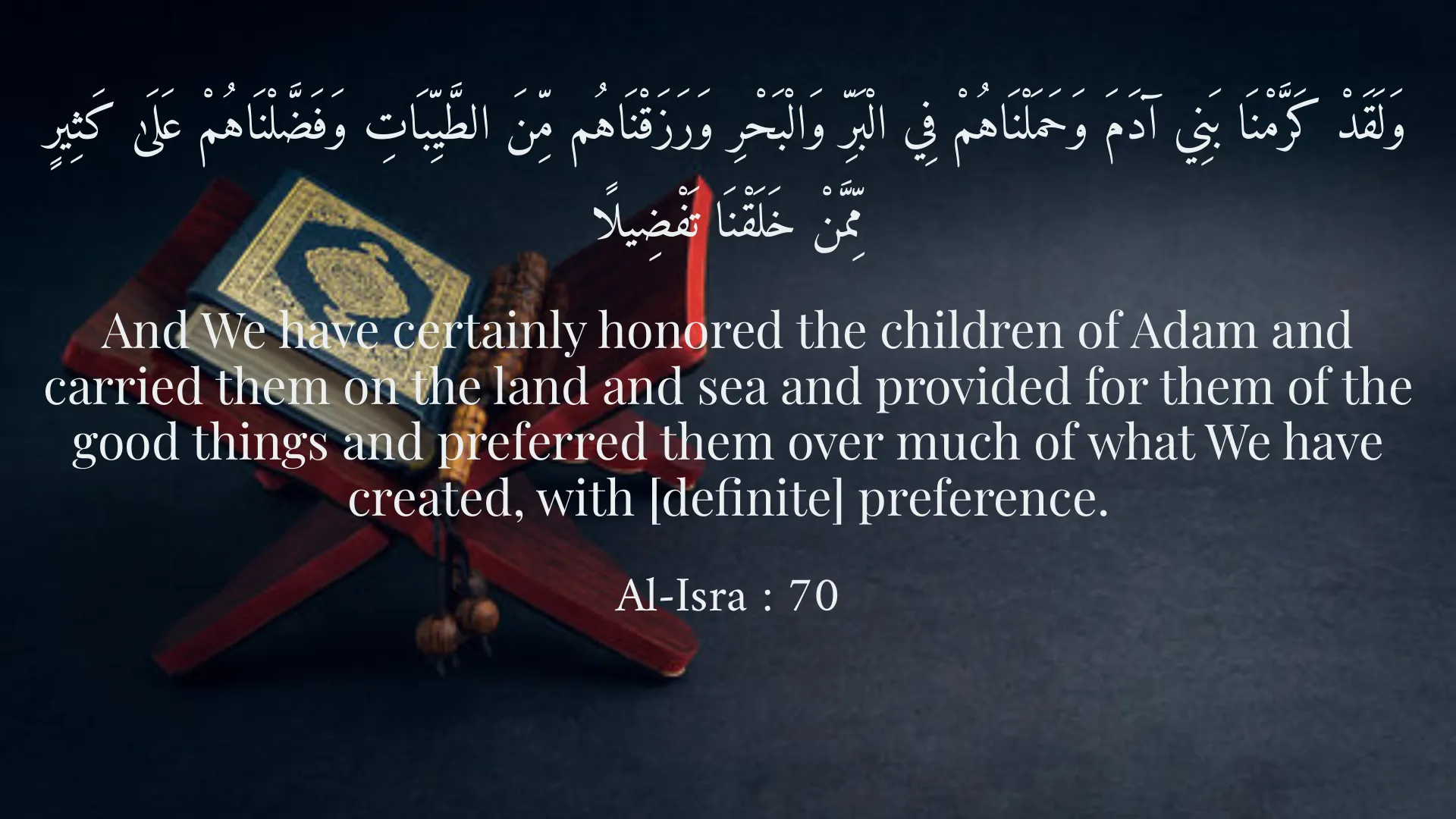
وَلَقَدْ كَرَّمْنَا بَنِي آدَمَ وَحَمَلْنَاهُمْ فِي الْبَرِّ وَالْبَحْرِ وَرَزَقْنَاهُم مِّنَ الطَّيِّبَاتِ وَفَضَّلْنَاهُمْ عَلَىٰ كَثِيرٍ مِّمَّنْ خَلَقْنَا تَفْضِيلًا
And We have certainly honored the children of Adam and carried them on the land and sea and provided for them of the good things and preferred them over much of what We have created, with [definite] preference.
Al-Isra : 70
قُلْ يَا عِبَادِيَ الَّذِينَ أَسْرَفُوا عَلَىٰ أَنفُسِهِمْ لَا تَقْنَطُوا مِن رَّحْمَةِ اللَّهِ ۚ إِنَّ اللَّهَ يَغْفِرُ الذُّنُوبَ جَمِيعًا ۚ إِنَّهُ هُوَ الْغَفُورُ الرَّحِيمُ
Say, 'O My servants who have transgressed against themselves [by sinning], do not despair of the mercy of Allah. Indeed, Allah forgives all sins. Indeed, it is He who is the Forgiving, the Merciful.'
Az-Zumar : 53
قَدْ أَفْلَحَ مَن زَكَّاهَا
He has succeeded who purifies it,
Ash-Shams : 9
وَقَدْ خَابَ مَن دَسَّاهَا
And he has failed who corrupts it.
Ash-Shams : 10
Short Story
It is narrated that a dervish had secluded himself, distancing himself from the world and its people. A disciple came to him and asked, 'O Sheikh, you who are deprived of worldly blessings, how is it that you find such peace and are not sorrowful?' The dervish smiled and replied, 'I do not measure myself by what I have lost, but by what God has bestowed upon me. Every day I awaken, I know that God has granted me the blessing of existence, intellect, and the opportunity for servitude. These are so valuable that even if I were deprived of the entire world, I would still consider myself the wealthiest and happiest, for my worth is with my Lord, not in what I possess of this world.' With these words, the disciple understood the true meaning of self-love and self-worth, returning with a brighter heart.