Quranic Answer
The path of spirituality presents one of its most subtle and significant challenges in how we understand and perform acts of worship (Ibadah). Worship, by its very essence, is an act of drawing closer to God, humbling oneself before His majesty, and acknowledging one's servitude and dependence. The primary goal of worship is the purification of the soul (tazkiyah al-nafs), the refinement of the spirit, and the attainment of inner peace and certainty. However, the question arises: Is it possible for this sacred act, instead of leading a person to humility, to become a source of arrogance and self-aggrandizement? The unequivocal answer from the Holy Quran and Islamic teachings is yes; if the human heart is not purified from the afflictions of the ego (nafs), even worship can provide a fertile ground for the growth of pride and arrogance. This transformation does not originate from worship itself, but rather from the inherent imperfections and spiritual ailments within the human being. The Holy Quran explicitly condemns arrogance (kibr) and pride, considering them among the greatest obstacles to knowing and attaining proximity to God. Arrogance was the very sin of Satan (Iblis) that prevented him from prostrating before Adam. In Surah Al-Baqarah, verse 34, Allah says: "And [mention] when We said to the angels, 'Prostrate before Adam'; so they prostrated, except for Iblis. He refused and was arrogant and became of the disbelievers." This verse illustrates that the root of Iblis's rebellion and disobedience was not a lack of ability, but rather self-importance and a sense of superiority. He believed himself superior to Adam due to his creation from fire, while Adam was created from clay. This is a clear example of how even a being who had spent years in worship and obedience to God could be cast out from the divine presence due to arrogance. Furthermore, the Quran warns humanity against arrogance in numerous other verses. In Surah Luqman, verse 18, it states: "And do not turn your cheek in contempt toward people and do not walk through the earth exultantly. Indeed, Allah does not like every self-deluded and boastful person." This verse directly refers to self-admiration and boasting (which are manifestations of pride) and condemns them. Worship that, instead of fostering humility, causes a person to feel superior to others or to magnify their own deeds, has deviated from its true path. How can worship potentially lead to arrogance? This can occur in several ways: 1. Show-off (Riya'): When an individual performs worship not for the sake of Allah, but to gain admiration and praise from people. In this scenario, the intention behind the worship is not pure, and the ego is driven by the desire for commendation. Surah Al-Bayyinah, verse 5, states: "And they were not commanded except to worship Allah, [being] sincere to Him in religion, inclining to truth, and to establish prayer and to give zakat. And that is the correct religion." Sincerity (Ikhlas) is the core essence of worship; its absence renders worship ineffective and even detrimental, making it a performance for human eyes rather than an act of devotion to God. 2. Self-Admiration (Ujb): Some individuals, after performing extensive acts of worship, fall into 'ujb' – self-admiration. They begin to regard their own deeds as significant and take pride in them. This self-admiration leads the individual to feel entitled to rewards and makes them oblivious to their potential shortcomings. This state is a precursor to full-blown pride and arrogance. It prevents introspection and seeking forgiveness, as one feels no need to repent for 'perfect' deeds. 3. Feeling Superior to Others: Worship that leads to a condescending view of others who might worship less or appear more sinful in our eyes is a sign of hidden arrogance. This type of pride is highly dangerous because the individual presumes that their worship has elevated them above others, thereby taking it upon themselves to judge. True worship should make one introspective and compassionate, not judgmental. It fosters a sense of shared humanity and a recognition that only Allah knows the true state of hearts. 4. Forgetting the Source of Success: Every good deed performed by a human being is a result of divine grace and enabling (Tawfiq). If an individual forgets that the ability to worship and perform good deeds comes from Allah, and instead attributes it entirely to their own capabilities, they have fallen into arrogance. This forgetfulness of divine favor and grace is the foundation of many spiritual deviations. One must always remember that without Allah's help and guidance, even the simplest good deed would be impossible. True gratitude involves acknowledging this divine source. To prevent this spiritual affliction, one must continuously practice humility, adhere firmly to sincerity in intention, and always perceive oneself as small and weak before the grandeur and might of Allah. Remembering that all our deeds, no matter how good, are accepted only through Allah's grace and mercy, can serve as a strong barrier against arrogance. Furthermore, one should always refrain from judging others and instead focus on purifying one's own soul. Genuine worship leads to humility of the heart, an increase in love for Allah, and sincere service to creation, and it never casts a person into the abyss of pride. Instead, it elevates the human spirit and strengthens noble qualities.
Related Verses
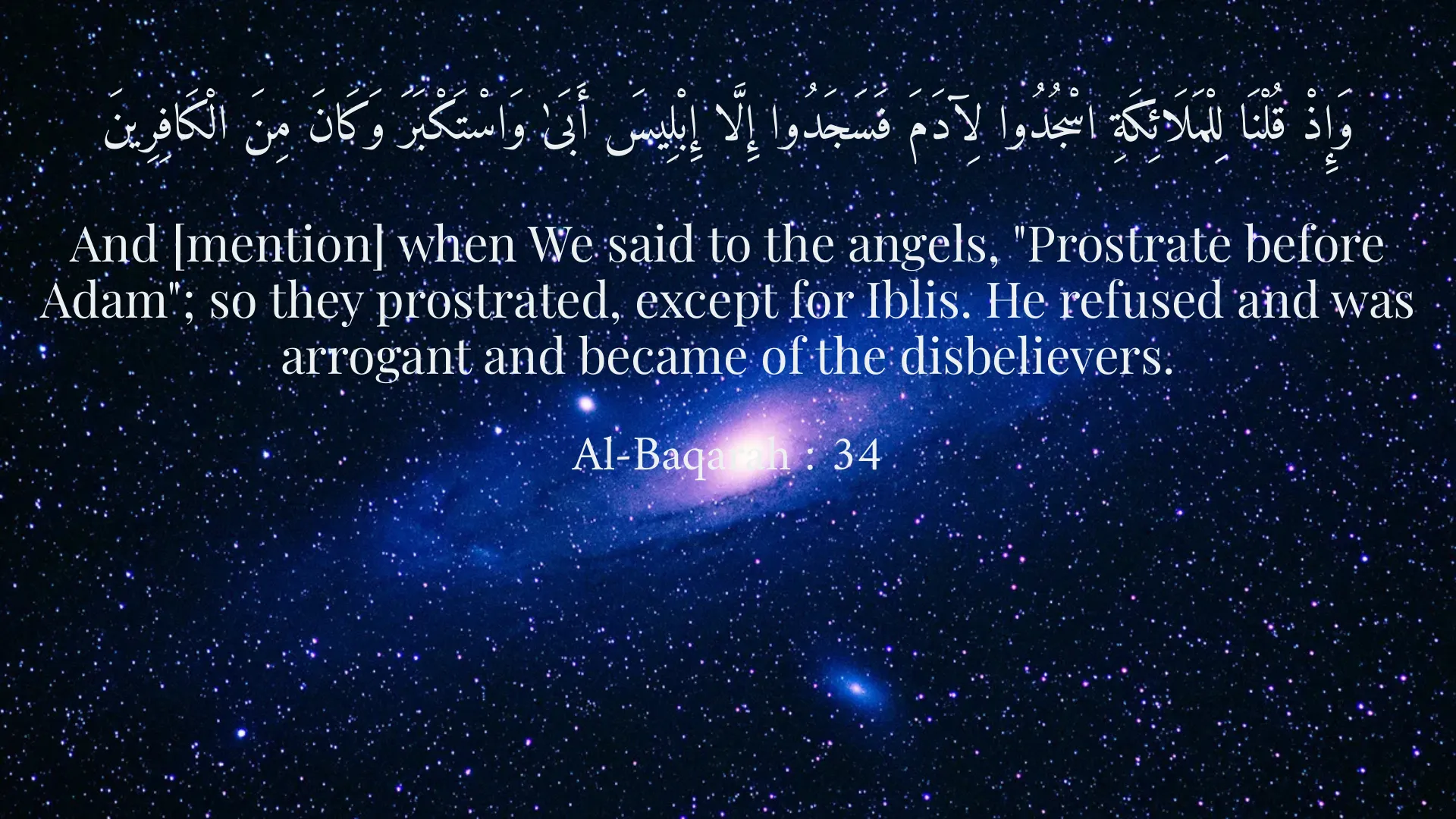
وَإِذْ قُلْنَا لِلْمَلَائِكَةِ اسْجُدُوا لِآدَمَ فَسَجَدُوا إِلَّا إِبْلِيسَ أَبَىٰ وَاسْتَكْبَرَ وَكَانَ مِنَ الْكَافِرِينَ
And [mention] when We said to the angels, "Prostrate before Adam"; so they prostrated, except for Iblis. He refused and was arrogant and became of the disbelievers.
Al-Baqarah : 34
وَلَا تُصَعِّرْ خَدَّكَ لِلنَّاسِ وَلَا تَمْشِ فِي الْأَرْضِ مَرَحًا ۖ إِنَّ اللَّهَ لَا يُحِبُّ كُلَّ مُخْتَالٍ فَخُورٍ
And do not turn your cheek in contempt toward people and do not walk through the earth exultantly. Indeed, Allah does not like every self-deluded and boastful person.
Luqman : 18
وَمَا أُمِرُوا إِلَّا لِيَعْبُدُوا اللَّهَ مُخْلِصِينَ لَهُ الدِّينَ حُنَفَاءَ وَيُقِيمُوا الصَّلَاةَ وَيُؤْتُوا الزَّكَاةَ ۚ وَذَٰلِكَ دِينُ الْقَيِّمَةِ
And they were not commanded except to worship Allah, [being] sincere to Him in religion, inclining to truth, and to establish prayer and to give zakat. And that is the correct religion.
Al-Bayyinah : 5
Short Story
It is narrated in Sa'di's Gulistan that there was a zealous worshiper who engaged in devotion day and night and, because of this, boasted to others. One day, he was passing by and saw a thief sitting by a well, weeping. The worshiper, with arrogance, told him, "O sinner, behold! I have spent my life in obedience, and you in transgression. What a difference there is between your state and mine!" The thief raised his head and said, "O Sheikh! You boast of your obedience, and I weep for my sins. Perhaps from these tears of mine, a door of mercy will open that will never be opened by your boasting. You have deprived yourself of divine mercy through your pride, while I may attain His mercy through confessing my sins." The worshiper felt ashamed by the thief's words and realized that pride diminishes even the purest of deeds and may lead to an unfortunate end, for Allah loves the humble and detests the arrogant.