Quranic Answer
When confronted with life's failures and hardships, many individuals instinctively question whether these adversities are a sign of God's displeasure or wrath. However, a profound understanding of the Holy Quran's teachings and a precise grasp of Allah's attributes reveal a far more nuanced, compassionate, and wise perspective. The Quran consistently portrays Allah as 'Ar-Rahman' (The Most Gracious) and 'Ar-Rahim' (The Most Merciful), 'Al-Hakim' (The All-Wise), and 'Al-Adl' (The Just). These foundational attributes indicate that divine actions and decrees are always rooted in infinite wisdom, encompassing mercy, and absolute justice. Therefore, interpreting every failure or misfortune solely as a direct sign of divine wrath would be an oversimplification that fails to capture the vastness of divine wisdom and mercy, and it would represent a reductionist view of the relationship between humanity and its Creator. One of the most crucial Quranic concepts in this regard is 'Ibtila',' or divine testing. The Quran repeatedly emphasizes that worldly life (dunya) is a constant test. Allah tests humanity with various ups and downs, ease and hardship, success and failure. The purpose of these tests is not mere punishment, but rather growth, purification, elevation, and the manifestation of a person's true faith. In Surah Al-Baqarah, verse 155, Allah explicitly states: "And We will surely test you with something of fear and hunger and a loss of wealth and lives and fruits, but give good tidings to the patient." This verse highlights that experiencing fear, hunger, financial loss, or personal setbacks is an inseparable part of the divine plan for human development and spiritual maturation. These are not indications of abandonment or wrath, but rather opportunities to demonstrate patience, reliance on God, and steadfastness in faith. Such trials are designed to distinguish the sincere from the insincere and to reveal the true depth of an individual's character and commitment to their Creator. Failures can also serve as a means of atonement for sins and expiation of wrongdoings. In Islamic teachings, even the minor difficulties and struggles that a person faces can act as a form of expiation for their sins. This is a profound manifestation of God's immense mercy. Instead of carrying the burden of all their sins until the Afterlife, Allah, in His boundless compassion, allows believers to be purified through earthly hardships. This perspective transforms a perceived 'failure' from a source of despair into an opportunity for spiritual cleansing and drawing closer to a state of purity before God. It is akin to a loving parent who, even when disciplining a child, does so with benevolent intentions for their ultimate well-being and correction. Furthermore, adversities and failures can lead to the elevation of a believer's spiritual ranks (darajat). Prophets and righteous individuals throughout history, despite their lofty status, consistently faced the greatest trials. Their resilience and steadfastness in the face of these calamities were not signs of God's wrath upon them, but rather a testament to their high spiritual standing and a means by which their status was further exalted in the sight of Allah. When a believer endures a failure with patience, gratitude, and reliance on God, their faith is deepened, their character is strengthened, and their reward with Allah is increased. From this perspective, failures transform into stepping stones for profound spiritual advancement. While not every failure signifies wrath, the Quran does establish a clear link between human actions and their consequences. In Surah Ash-Shura, verse 30, it is stated: "And whatever calamity befalls you is for what your hands have earned. And He pardons much." This verse acknowledges that some difficulties are indeed a direct result of our own choices, actions, or negligence. However, even in such cases, God's boundless mercy is evident: "And He pardons much." This means that even when we bring difficulties upon ourselves, Allah, in His infinite mercy, chooses to overlook or forgive many of our transgressions. The calamities that do befall us might serve as a gentle reminder, a wake-up call, or a form of purification, rather than an overwhelming, unforgiving wrath. This verse serves as an invitation to repentance (tawbah) and correction, rather than a final, damning judgment. Human beings often possess a limited perspective, judging events based on immediate outcomes and their personal desires. However, Allah's wisdom is infinite, and His plans encompass dimensions we cannot possibly perceive. What may appear to be a failure in the short term could be a profound hidden blessing in the long run, preventing a greater harm or leading to an unexpected good. The Quran emphasizes reliance on God's wisdom and trusting His divine decree (qadar), even when circumstances are challenging. This encourages a mindset of acceptance and seeking the hidden wisdom in every situation, knowing that "Allah knows and you do not know" (Surah Al-Baqarah 2:216). When faced with failure, Quranic teaching prohibits despair and instead recommends turning to Allah with patience (sabr), prayer (salat), and seeking forgiveness (istighfar). These are the fundamental tools provided for navigating life's challenges. Patience in adversity is highly praised and promised great rewards. Repentance, when sincere, is always accepted by Allah. This active engagement with one's faith transforms the experience of failure from a passive reception of punishment into an active process of spiritual growth and reconnection with the Divine. Ultimately, true divine wrath (ghadab Allah) is typically reserved for those who persist in open defiance, disbelief, and oppression after clear signs and warnings have been given, and who show no inclination whatsoever to repent or reform. It is not something that automatically descends upon a believer who experiences a setback. For a believer, even when experiencing hardship due to their own mistakes, it is more often a form of divine discipline, mercy, or a test, aimed at guiding them back to the straight path, rather than an irreversible judgment of wrath. Therefore, from a Quranic perspective, failures are rarely, if ever, to be unilaterally interpreted as signs of God's wrath upon a believer. Instead, they are profound and multifaceted aspects of the human experience within the divine plan. They are tests designed to strengthen faith, opportunities for spiritual purification and elevation, consequences that prompt reflection and repentance, and manifestations of Allah's infinite wisdom and mercy, guiding His servants towards ultimate success in both this world and the Hereafter. The true test lies not in avoiding failure, but in how one responds to it – with patience, reflection, and unwavering trust in the wisdom and compassion of Allah.
Related Verses
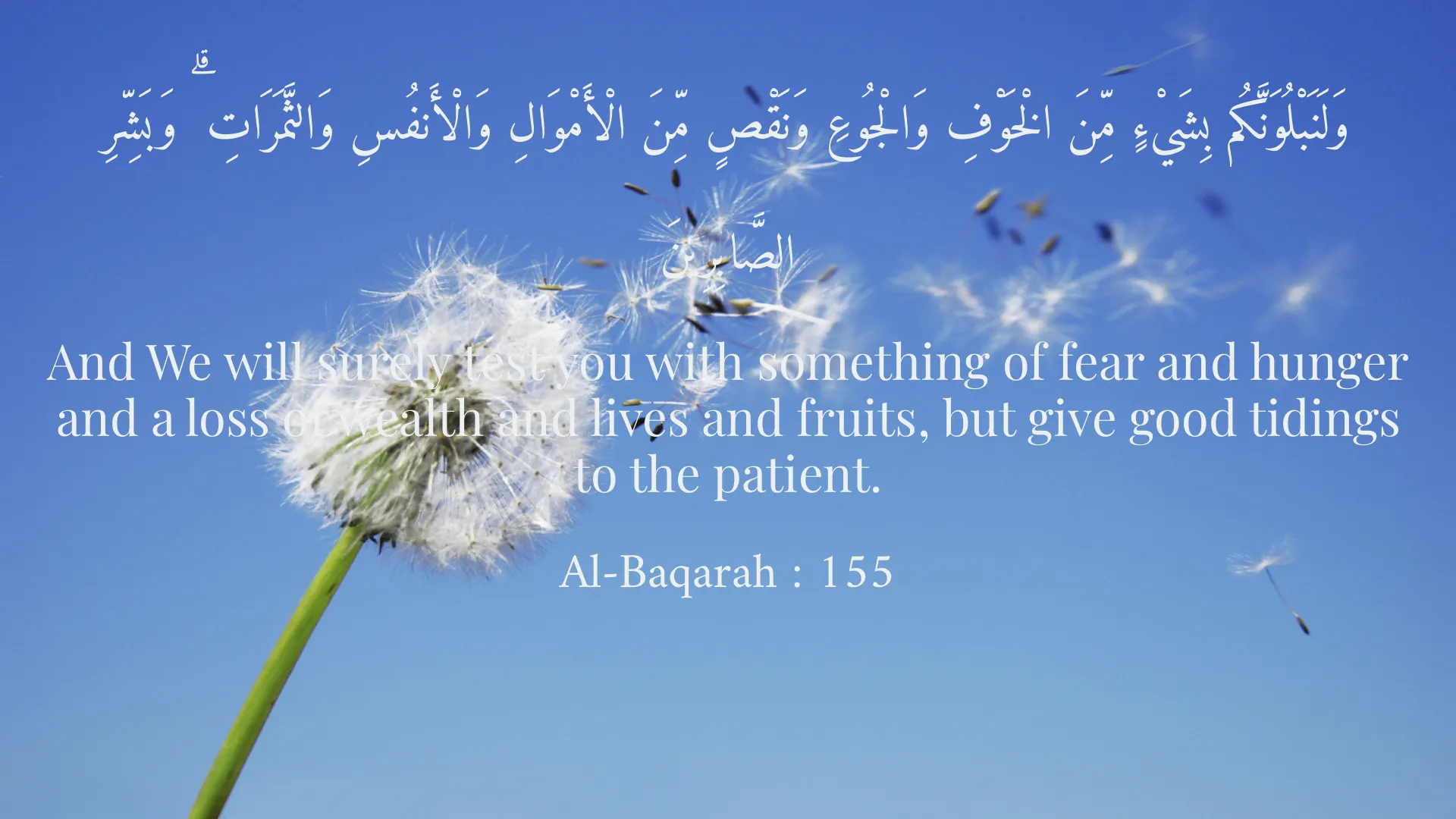
وَلَنَبْلُوَنَّكُم بِشَيْءٍ مِّنَ الْخَوْفِ وَالْجُوعِ وَنَقْصٍ مِّنَ الْأَمْوَالِ وَالْأَنفُسِ وَالثَّمَرَاتِ ۗ وَبَشِّرِ الصَّابِرِينَ
And We will surely test you with something of fear and hunger and a loss of wealth and lives and fruits, but give good tidings to the patient.
Al-Baqarah : 155
وَمَا أَصَابَكُم مِّن مُّصِيبَةٍ فَبِمَا كَسَبَتْ أَيْدِيكُمْ وَيَعْفُو عَن كَثِيرٍ
And whatever calamity befalls you is for what your hands have earned. And He pardons much.
Ash-Shura : 30
مَا أَصَابَ مِن مُّصِيبَةٍ إِلَّا بِإِذْنِ اللَّهِ ۗ وَمَن يُؤْمِن بِاللَّهِ يَهْدِ قَلْبَهُ ۗ وَاللَّهُ بِكُلِّ شَيْءٍ عَلِيمٌ
No disaster strikes except by permission of Allah. And whoever believes in Allah - He will guide his heart. And Allah is Knowing of all things.
At-Taghabun : 11
Short Story
It is narrated that in ancient times, a passionate young merchant named Faridun suffered a great loss of wealth during a trade journey. Grieved and disheartened, he went to a wise sheikh and complained of his condition, saying, "O Sheikh, it seems God has turned away from me, that such a calamity has befallen me!" The sheikh, with a warm smile, said, "O young man, how strange is your hasty judgment! Do not assume that everything unpleasant is a sign of wrath. Listen to a story from bygone days: A righteous man in a dry desert was overwhelmed by thirst. He reached a well whose water was bitter and unpalatable. He lamented, 'Why does God test me with such water?' But a little later, a thief arrived intending to take his life. When the thief saw the man drinking bitter water, he assumed him to be a dying pauper and spared his life. Then the righteous man understood that the bitter water had been the means of saving his life." The sheikh continued, "So, Faridun, how many failures there are whose outward appearance is unpleasant, but within them lie lessons and mercies that only become apparent with the passage of time. Be patient and trust in divine wisdom, for God is absolute goodness and guides His servants only towards good." Faridun was heartened by these words, and with renewed resolve, he returned to his work, and from then on, he saw every difficulty not as a calamity, but as an opportunity for reflection and growth.