Quranic Answer
The discussion around worldly attachments is a pertinent one in both religious and philosophical contexts. In the Holy Quran, the emphasis on not becoming entwined with worldly matters and material desires is repeatedly made, serving as a guiding principle for believers. This message transcends time and culture, resonating with individuals who seek a deeper understanding of life and spirituality. The idea is not just to renounce the material world but to approach it with a balanced perspective, which is crucial for anyone on a spiritual journey. One of the most noteworthy references comes from Surah Al-Imran, verse 14, which states: "Beautified for people is the love of that which they desire - of women and sons, heaped-up sums of gold and silver, fine branded horses, and tilled land." This verse highlights the allure of worldly pleasures, making it clear that human nature tends to gravitate toward desires that can lead one astray. Love for wealth, family, and status can distract one from the remembrance of Allah, thus hampering spiritual growth. The context of this verse serves as a powerful reminder that while human beings possess desires that are natural, allowing these desires to dominate our lives could result in a divergence from our true purpose. The beauty and significance of this message can be further explored in conjunction with Surah At-Taghabun, verse 15, which states: "Your wealth and your children are but a trial, and Allah has with Him a great reward." This verse prompts believers to recognize that material wealth and familial bonds are not inherently negative; rather, they are tests that can either lead us closer to Allah or take us farther away, depending on how we manage our attachment to them. These verses work collaboratively to remind us that the essence of our existence is more profound than mere worldly pleasure. They urge individuals to navigate their lives with the understanding that while one may engage with worldly affairs for sustenance and comfort, it is critical not to become overly attached or distracted by them. Detachment does not equate to abandonment; rather, it is a conscious choice to prioritize spiritual objectives over fleeting desires. The exemplary life of Prophet Muhammad and the teachings of the Ahlul Bayt serve as practical guides for Muslim individuals aiming to find balance. The Prophet led a life of simplicity and humility, even when offered riches and power. His actions epitomized a refusal to become ensnared by worldly desires, demonstrating that one can participate in society and fulfill responsibilities without losing sight of spiritual goals. Moreover, the Ahlul Bayt, revered figures in Islamic belief, also embodied the principles of moderation in worldly affairs while passionately pursuing their spiritual aspirations. Their life stories are filled with instances where they balanced their earthly duties with their commitment to faith, making them ideal role models for those aspiring to maintain a similar equilibrium. In practical terms, maintaining a balance between worldly desires and spiritual pursuits calls for a conscious, consistent effort. It is important to establish priorities that reflect one’s beliefs and values. Setting aside time for prayer, reflection, and acts of kindness can help strengthen one’s connection to Allah and foster spiritual growth. This is vital, as worship provides the necessary foundation for a believer's relationship with their Creator, reinforcing the understanding that all worldly activities should ultimately serve the purpose of enhancing one’s spiritual well-being. Furthermore, the remembrance of Allah can serve as a powerful counterforce against the temptation of worldly distractions. Regularly engaging in dhikr (remembrance of God) can sharpen one’s focus on spiritual goals and serve as a reminder of the transient nature of life. Consequently, believers can cultivate a perspective where worldly possessions are viewed as tools for fulfilling higher purposes rather than ends in themselves. As human beings living in a materialistic society, it can be all too easy to fall prey to consumer culture and lose sight of what truly matters. This necessitates a proactive approach to spirituality, where individuals must regularly assess their commitments and attachments. Are they grounded in faith, or are they driven by desires that steer them away from their ultimate aspirations? By asking such questions, one can create a habit of self-reflection that not only nurtures spiritual growth but also brings clarity to the priorities in life. Moreover, community engagement and acts of goodness can serve as fertile grounds where one can practice detachment from selfish desires. When individuals focus on uplifting others, they shift their attention away from their personal gains, which is immensely rewarding spiritually. Charity, kindness, and service instill a sense of purpose, helping individuals in their quest for nearness to God. In conclusion, while the Holy Quran eloquently warns against becoming overly attached to worldly matters through verses like Surah Al-Imran, verse 14, and Surah At-Taghabun, verse 15, it also provides a pathway toward achieving spiritual growth. The guidance offered is not about renouncing the material world but rather about approaching it with a balanced perspective. By following the practices of the Prophet Muhammad and the Ahlul Bayt, believers can effectively navigate this world while striving for spiritual elevation. Ultimately, the goal is to live a life where worldly affairs are harmoniously integrated within a framework of unwavering faith and commitment to the remembrance of Allah.
Related Verses
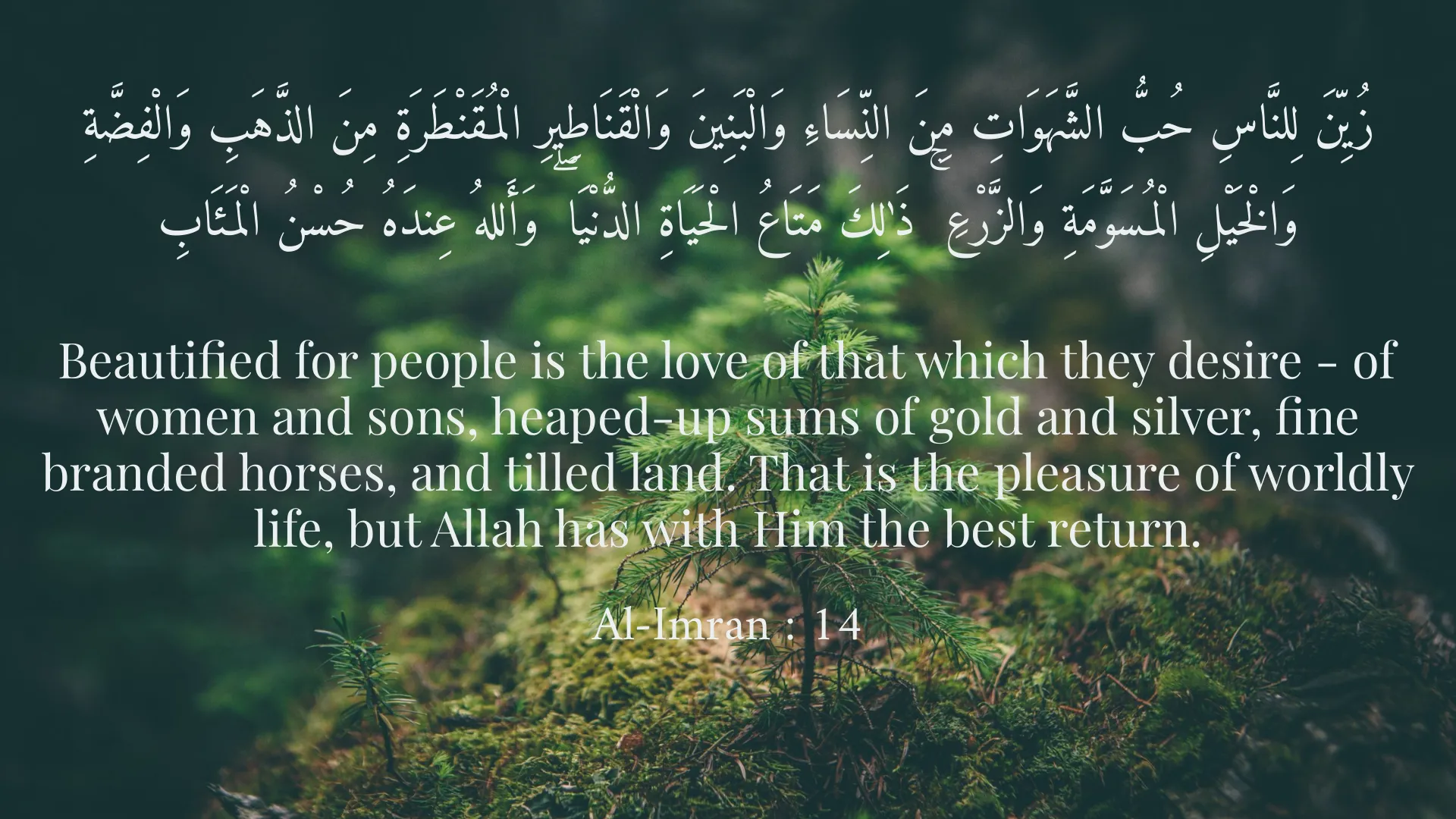
زُيِّنَ لِلنَّاسِ حُبُّ الشَّهَوَاتِ مِنَ النِّسَاءِ وَالْبَنِينَ وَالْقَنَاطِيرِ الْمُقَنْطَرَةِ مِنَ الذَّهَبِ وَالْفِضَّةِ وَالْخَيْلِ الْمُسَوَّمَةِ وَالزَّرْعِ ۚ ذَٰلِكَ مَتَاعُ الْحَيَاةِ الدُّنْيَا ۖ وَأَللهُ عِندَهُ حُسْنُ الْمَئَابِ
Beautified for people is the love of that which they desire - of women and sons, heaped-up sums of gold and silver, fine branded horses, and tilled land. That is the pleasure of worldly life, but Allah has with Him the best return.
Al-Imran : 14
إِنَّمَا أَمْوَالُكُمْ وَأَوْلَادُكُمْ فِتْنَةٌ ۖ وَأَللهُ عِندَهُ أَجْرٌ عَظِيمٌ
Your wealth and your children are but a trial, and Allah has with Him a great reward.
At-Taghabun : 15
Short Story
Once upon a time, there was a young man named Saeed who always dreamed of owning a luxurious and expensive car. He thought that if he had this car, everyone would respect him and he would become more popular. However, during this time, Saeed consulted the Quran for guidance and realized that worldly desires should not distract him from the remembrance of Allah. He decided to invest his income in good and spiritual endeavors and spend time helping others. Spending time with good people, he concluded that true love and friendship lie in helping others and reconnecting with God.