Quranic Answer
In the rich and wise teachings of the Holy Quran, the concept of kindness, compassion, and good character holds a very high status. Islam is a religion of mercy, inviting believers to show kindness to all creatures, even those who do not share their faith. But is this kindness absolute and unconditional? And in specific circumstances, does distancing oneself, or in other words, avoiding certain individuals or environments, contradict the principle of kindness? The Quran's answer to this question is neither an absolute 'no' nor an absolute 'yes'; rather, it offers a wise and comprehensive approach where kindness is intertwined with insight and wisdom. Distancing oneself from certain people in Islam, in specific cases, not only does not contradict kindness but can actually be considered an act of kindness, both towards oneself and, in some instances, towards the other. This distancing is not out of hatred or disrespect, but out of wisdom, preservation of faith, and avoidance of corruption. One of the clearest Quranic reasons for the necessity of distancing oneself from certain gatherings is to preserve faith and protect oneself from negative influences. The Holy Quran explicitly warns believers against sitting with those who deny or ridicule Allah's verses. In Surah An-Nisa, verse 140, we read: "And He has already revealed to you in the Book that when you hear the verses of Allah being denied and ridiculed, do not sit with them until they enter into another conversation. Indeed, in that case, you would be like them. Indeed, Allah will gather the hypocrites and disbelievers in Hell all together." This verse explicitly states that if Allah's verses are ridiculed in a gathering, one should not remain there, otherwise, one would become like them. This command is not out of a lack of kindness, but out of divine mercy and compassion to preserve the servant's faith and spiritual identity. In reality, true kindness includes protecting one's soul, spirit, and beliefs from defilement and harm. Furthermore, in the Quran, the characteristics of Allah's special servants (Ibad ar-Rahman) are mentioned in Surah Al-Furqan, verse 72: "And [they are] those who do not testify to falsehood, and when they pass by ill speech, they pass by with dignity." This means they are those who do not bear false witness, and when they pass by vain talk, they pass by with dignity. "Passing by with dignity" here can mean not participating in idle talk, avoiding frivolous gatherings, and preserving one's self-respect. This type of distancing indicates maturity, wisdom, and a conscious choice to maintain spiritual purity and avoid involvement in worthless matters. This act not only does not contradict kindness but is also a preservation of divine respect and values, which are themselves manifestations of kindness to oneself and to the path of guidance. Sometimes, distancing means not obeying disbelievers and hypocrites and disregarding their annoyances, as commanded to the Prophet Muhammad (PBUH) in Surah Al-Ahzab, verse 48: "And do not obey the disbelievers and the hypocrites, and ignore their annoyance, and rely upon Allah. And sufficient is Allah as Disposer of affairs." This phrase "ignore their annoyance" can mean keeping distance from the source of harm and not engaging with it. This distancing is a distancing from evil and wickedness, not a distancing from kindness. True kindness, in the face of oppression and injustice, does not mean passivity and acceptance, but rather standing firm on truth and distancing oneself from falsehood, even if this stance requires separation from those who promote falsehood. This action ultimately benefits society and promotes justice and goodness, which are among the highest manifestations of divine kindness. From an Islamic perspective, kindness does not mean surrendering to every type of destructive behavior or influence. Sometimes, true kindness lies in limiting interaction with individuals who may harm one's faith, morals, or mental well-being. This is a type of 'intelligent kindness'; a kindness accompanied by insight and protection for oneself and others. For example, if someone consistently spreads negative energy, backbites, lies, or tries to divert you from the path of truth, distancing yourself from them is not unkindness. Rather, it means consciously choosing a healthier environment for one's spiritual and moral growth. This act, in a way, can even be a form of 'tough love' for the other person; as it might make them reflect on why others are distancing themselves and lead them to rectify their behavior, although the primary goal of the person distancing is self-preservation. The importance of choosing good companions in Islam also supports this point. Many narrations and verses emphasize the necessity of selecting righteous friends and avoiding association with the wicked. This emphasis is due to the profound impact a companion has on a person's soul and character. If kindness meant absolute association with everyone, then there would be no recommendation to choose friends. Therefore, distancing oneself from those with negative influences is not only compatible with kindness but is also part of an individual's responsibility to preserve their faith and morals, as well as a social responsibility to maintain the well-being of the community. Finally, it must be noted that this distancing should be done with pure intention and while upholding Islamic ethical principles; without malice, insult, or complete severance of human ties unless explicitly permitted by the Quran and Sunnah. The ultimate goal is always to elevate divine values and preserve human dignity, both for oneself and for others.
Related Verses
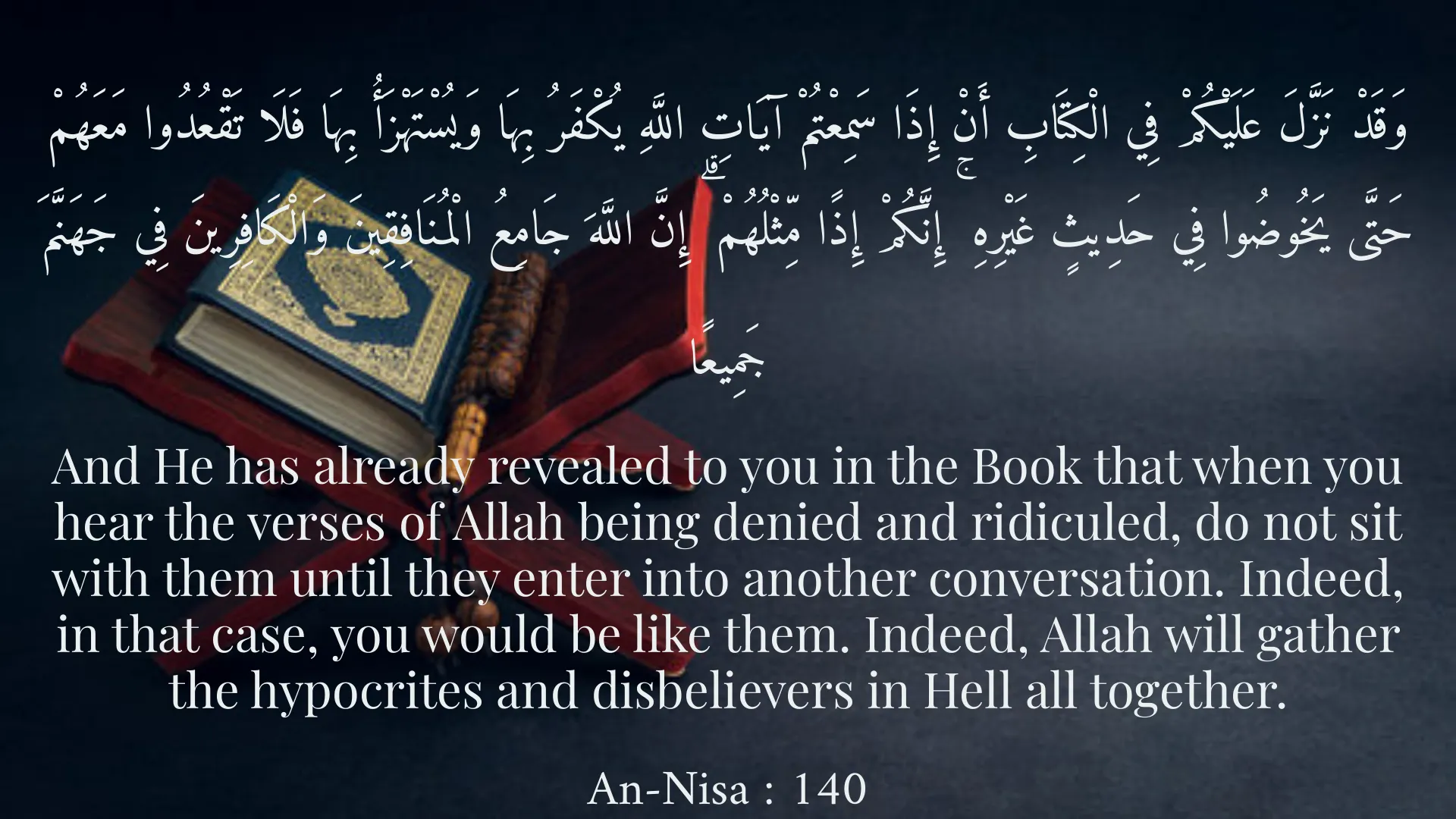
وَقَدْ نَزَّلَ عَلَيْكُمْ فِي الْكِتَابِ أَنْ إِذَا سَمِعْتُمْ آيَاتِ اللَّهِ يُكْفَرُ بِهَا وَيُسْتَهْزَأُ بِهَا فَلَا تَقْعُدُوا مَعَهُمْ حَتَّى يَخُوضُوا فِي حَدِيثٍ غَيْرِهِ ۚ إِنَّكُمْ إِذًا مِّثْلُهُمْ ۗ إِنَّ اللَّهَ جَامِعُ الْمُنَافِقِينَ وَالْكَافِرِينَ فِي جَهَنَّمَ جَمِيعًا
And He has already revealed to you in the Book that when you hear the verses of Allah being denied and ridiculed, do not sit with them until they enter into another conversation. Indeed, in that case, you would be like them. Indeed, Allah will gather the hypocrites and disbelievers in Hell all together.
An-Nisa : 140
وَالَّذِينَ لَا يَشْهَدُونَ الزُّورَ وَإِذَا مَرُّوا بِاللَّغْوِ مَرُّوا كِرَامًا
And [they are] those who do not testify to falsehood, and when they pass by ill speech, they pass by with dignity.
Al-Furqan : 72
وَلَا تُطِعِ الْكَافِرِينَ وَالْمُنَافِقِينَ وَدَعْ أَذَاهُمْ وَتَوَكَّلْ عَلَى اللَّهِ ۚ وَكَفَىٰ بِاللَّهِ وَكِيلًا
And do not obey the disbelievers and the hypocrites, and ignore their annoyance, and rely upon Allah. And sufficient is Allah as Disposer of affairs.
Al-Ahzab : 48
Short Story
In Saadi's Gulistan, it is related that a wise man said to a sage: "A bad friend is like a snake; though soft to the touch, it is venomous." The sage replied: "Yes, but a good companion is like a perfumer; though he may give you nothing, his pleasant scent will reach your nostrils." One day, a piece of clay became fragrant in a bathhouse. They asked it: "Are you musk or ambergris?" It replied: "I was but clay, but for a time I associated with a fragrant rose, and thus I acquired its pleasant scent; otherwise, I am merely earth." This beautiful story teaches us that companionship and proximity to people profoundly affect us. Sometimes, choosing to distance ourselves from those whose words or actions carry an unpleasant odor is not out of unkindness, but out of compassion and care for our own souls and spirits, lest we too acquire their unpleasant scent and stray from the path of purity. This is a wise choice to preserve the pleasant fragrance of humanity and faith within ourselves.