Quranic Answer
Understanding the concept of faith (Iman) in Islam and its relationship with doubt (Shakk) is one of the most crucial topics in the path of spiritual growth. According to the teachings of the Holy Quran, faith signifies a profound, heartfelt conviction that is not merely limited to verbal affirmation but also extends to knowledge, affirmation, and submission to the truth. At first glance, it might seem that true faith necessitates the complete eradication of any doubt or uncertainty, and this understanding is largely correct, especially if the doubt in question is the kind that leads to disbelief (kufr) or hypocrisy (nifaq) and deviates a person from the path of truth. The Quran, in numerous verses, identifies skepticism and persistent doubt as characteristics of disbelievers, hypocrites, or those with diseased hearts, and it condemns such doubt. For instance, Surah Al-Hujurat, verse 15, states: “The believers are only those who have believed in Allah and His Messenger and then have not doubted and have striven with their properties and their lives in the cause of Allah. It is those who are the truthful.” This verse explicitly indicates that complete and sincere faith is incompatible with persistent doubt, and a believer must be free from such skepticism to be counted among the truthful. This type of doubt is destructive and harmful, leading to disbelief and inaction. But does this imply that any form of questioning, reflection, or even a moment of uncertainty (not disbelief) is rejected on the path of faith? The answer to this question requires further contemplation. The Holy Quran commands believers to reflect and ponder upon the signs of Allah, both in the divine scripture and in creation. This invitation to contemplation and reason itself opens the door for inquiry. Sometimes, for a person to reach a higher level of certainty (Yaqin al-Ain or Haqq al-Yaqin), they need to question and explore. The story of Prophet Abraham (peace be upon him) in the Quran is a very instructive example in this regard. In Surah Al-Baqarah, verse 260, Prophet Abraham asks Allah to show him how He brings the dead to life. “And [mention] when Abraham said, 'My Lord, show me how You give life to the dead.' [Allah] said, 'Have you not believed?' He said, 'Yes, but [I ask] only that my heart may be satisfied.'” Here, Abraham does not doubt Allah’s power; rather, he seeks to attain “tranquility of the heart” (itmi'nan al-qalb) and a form of experiential certainty that goes beyond intellectual conviction. This type of questioning is not only commendable but also a path to deepen faith and achieve higher degrees of certainty. This tranquility of the heart is the perfection of faith that eliminates doubt. Therefore, true faith ultimately leads to the cessation of doubt, but the path to this certainty can involve stages of questioning and reflection that lead to the strengthening and firm establishment of faith. From the Quranic perspective, faith is a dynamic process that can increase (yazid) or decrease (yanqus). True believers are those whose faith increases upon hearing the divine verses. This increase in faith means eradicating any shadow of doubt and reaching absolute certainty. The reprehensible doubt is that which stems from ignorance, fanaticism, arrogance, or disregard for Allah's signs and indications. This doubt, instead of guiding to truth, leads to wandering and misguidance. In contrast, sincere questions and reflections aimed at deeper understanding and reaching more secure answers are not only compatible with faith but can also serve as stepping stones for ascending to higher levels of faith. This type of 'constructive doubt' is actually a driving force for seeking truth and attaining 'Yaqin' (complete certainty). For this reason, faith is not only the absence of doubt but also the attainment of 'Yaqin'; this certainty might have been achieved after passing through stages of questioning and reflection. Therefore, true faith certainly means the cessation of destructive and harmful doubt and ultimately leads to heartfelt tranquility and complete certainty. However, this by no means implies the negation of contemplation, reflection, and constructive inquiry; rather, these can be tools for reaching that perfection and tranquility. In truth, complete faith is achieved when a person's heart is purified from every satanic whisper and doubt and is illuminated by the light of divine certainty and knowledge. This state of faith grants the believer a special steadfastness and firmness, making them resilient against temptations and ambiguities and keeping them firm on the path of obedience and servitude. Consequently, it can be said that faith ultimately means the cessation of doubt, but this cessation of doubt is not the starting point of the entire journey of faith; rather, it can be the destination and ultimate goal of the journey of faith. True faith is not merely accepting a truth without question, but rather an acceptance that arises from knowledge and conviction. This knowledge and conviction may itself be the result of passing through stages of questioning and reflection on divine verses. The Holy Quran repeatedly emphasizes the importance of signs and proofs for attaining faith, which itself indicates that faith is not a blind belief but is founded on reason and evidence. When a person reaches this stage of faith, their heart is emptied of doubt and uncertainty and filled with peace and assurance in Allah and His promises. This assurance is manifested not only in their beliefs but also in their conduct and actions, leading them towards righteous deeds and steadfastness in the path of truth. Hence, complete faith is a state of certainty where doubt and skepticism have no place, and the human heart has reached complete tranquility in the face of divine truth. This tranquility and certainty are the direct result of a deep understanding and comprehension of divine greatness and wisdom and by no means imply ignoring intellect and thought. In fact, rationality and contemplation are tools that guide a person to this realm of certainty and tranquility.
Related Verses
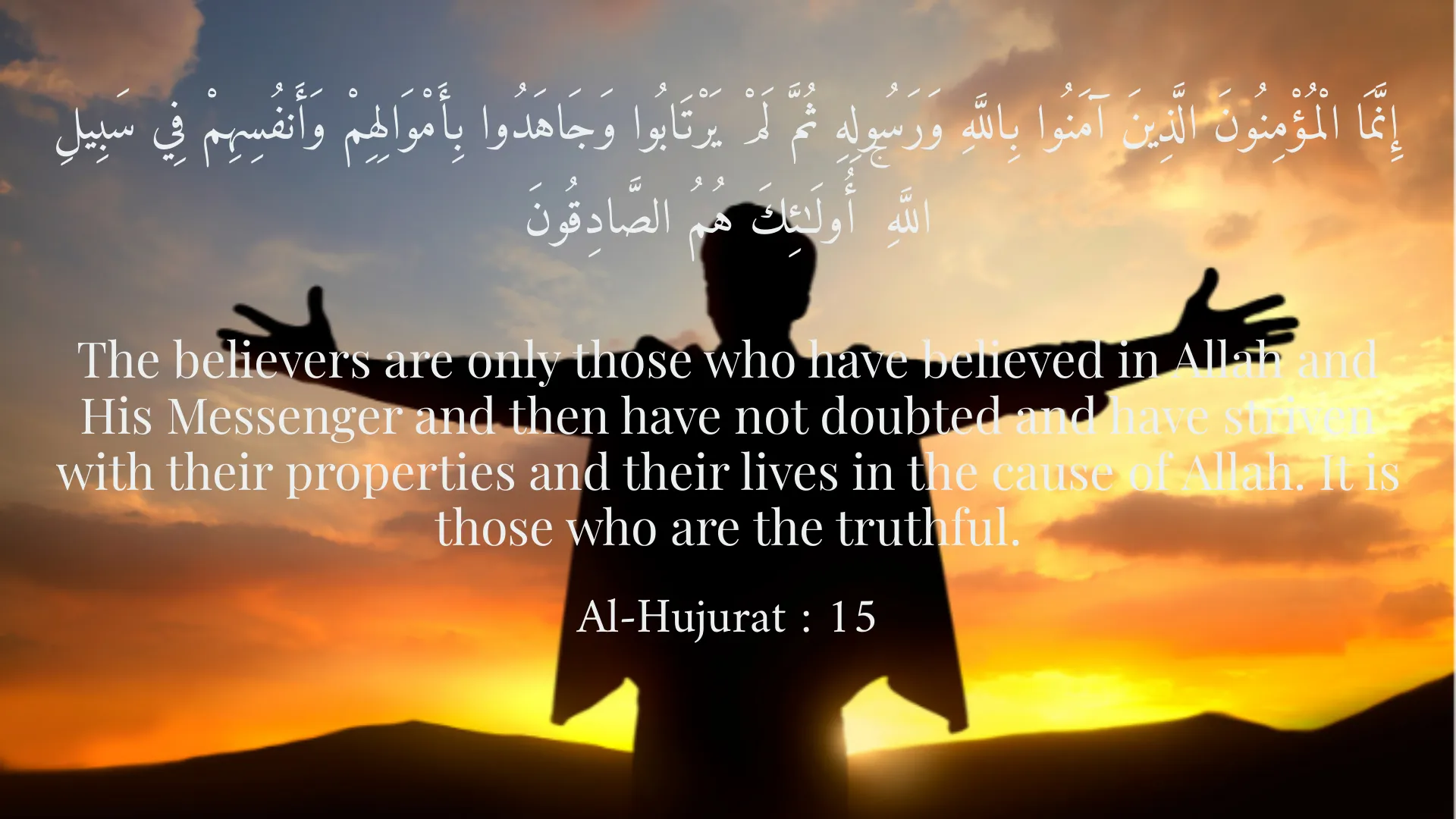
إِنَّمَا الْمُؤْمِنُونَ الَّذِينَ آمَنُوا بِاللَّهِ وَرَسُولِهِ ثُمَّ لَمْ يَرْتَابُوا وَجَاهَدُوا بِأَمْوَالِهِمْ وَأَنفُسِهِمْ فِي سَبِيلِ اللَّهِ ۚ أُولَٰئِكَ هُمُ الصَّادِقُونَ
The believers are only those who have believed in Allah and His Messenger and then have not doubted and have striven with their properties and their lives in the cause of Allah. It is those who are the truthful.
Al-Hujurat : 15
وَإِذْ قَالَ إِبْرَاهِيمُ رَبِّ أَرِنِي كَيْفَ تُحْيِي الْمَوْتَىٰ ۖ قَالَ أَوَلَمْ تُؤْمِن ۖ قَالَ بَلَىٰ وَلَٰكِن لِّيَطْمَئِنَّ قَلْبِي ۖ قَالَ فَخُذْ أَرْبَعَةً مِّنَ الطَّيْرِ فَصُرْهُنَّ إِلَيْكَ ثُمَّ اجْعَلْ عَلَىٰ كُلِّ جَبَلٍ مِّنْهُنَّ جُزْءًا ثُمَّ ادْعُهُنَّ يَأْتِينَكَ سَعْيًا ۚ وَاعْلَمْ أَنَّ اللَّهَ عَزِيزٌ حَكِيمٌ
And [mention] when Abraham said, 'My Lord, show me how You give life to the dead.' [Allah] said, 'Have you not believed?' He said, 'Yes, but [I ask] only that my heart may be satisfied.' [Allah] said, 'Take four birds and commit them to yourself. Then [after slaughtering them] put on every hill a portion of them; then call them – they will come to you in haste. And know that Allah is Exalted in Might and Wise.'
Al-Baqarah : 260
وَمَا يَتَّبِعُ أَكْثَرُهُمْ إِلَّا ظَنًّا ۚ إِنَّ الظَّنَّ لَا يُغْنِي مِنَ الْحَقِّ شَيْئًا ۚ إِنَّ اللَّهَ عَلِيمٌ بِمَا يَفْعَلُونَ
And most of them follow not except assumption. Indeed, assumption avails not against the truth at all. Indeed, Allah is Knowing of what they do.
Yunus : 36
Short Story
In Saadi's Gulistan, it is related that a renowned merchant in Shiraz, despite being blessed with wealth and status, always had a heart troubled by anxieties and doubts about the future and the stability of his livelihood. Therefore, whatever he acquired, he held onto with extreme greed and stinginess, seldom giving to others, for he constantly feared that he might one day become destitute. One day, he approached a wise sage and recounted his distress. The sage, with a pleasant smile, said: “O man, your sustenance comes from the treasury of Truth, and the peace of your heart from certainty in Him. Your story is like that of a man who, in a thirsty desert, carried a full waterskin on his back, but out of fear of running out of water, he never drank his fill nor offered a drop to any thirsty person he met, until he perished from thirst and sorrow. But another, with a small pitcher of water, put his trust in God. He drank himself and gave water to every needy person he saw. And surprisingly, each time he brought the pitcher to his lips, he found it full of water! The first man's doubt led him to loss, while the second man's certainty brought him blessing and peace. True faith is not that you never have a question in your heart, but that even if a question arises, certainty guides you and brings peace to your heart.” The merchant took heed of the sage's words. Gradually, he abandoned his greed and, trusting in the boundless Provider, began to give generously. He found that with every act of charity, his heart became calmer, and his sustenance not only did not diminish but its blessings increased. Doubts departed from his heart, and the light of certainty enveloped his being, bringing him a peace that no wealth could purchase.