Quranic Answer
Yes, absolutely and without a doubt, the Almighty God is fully aware of our hidden thoughts and intentions, even those we have never articulated. This is one of the most fundamental and beautiful attributes of God mentioned in the Holy Quran: the attribute of "Al-Alim," the All-Knowing. Divine knowledge knows no bounds and encompasses everything, whether manifest or hidden, spoken or unspoken, apparent or internal. Not only our actions, but even the slightest whispers of our hearts and the fleeting thoughts in our minds do not escape His penetrating sight. The Holy Quran, in numerous verses, asserts this truth to remind us that God not only observes our outward actions but is also fully encompassing of our inner world and the secrets hidden within our hearts. One of the clearest verses in this regard is Surah Al-Baqarah (2:284), which states: "To Allah belongs whatever is in the heavens and whatever is on the earth. And whether you disclose what is in yourselves or conceal it, Allah will call you to account for it. Then He forgives whom He wills and punishes whom He wills. And Allah is over all things competent." This verse explicitly declares that Allah is aware of both what we disclose and what we conceal (مَا فِىٓ أَنفُسِكُمْ – what is in yourselves), and He will hold us accountable for it. The phrase "what is in yourselves" refers to everything within our being, including our thoughts, intentions, beliefs, and feelings. It is important to note that various interpretations exist regarding the "accountability" for thoughts mentioned in this verse. Many Islamic scholars believe that accountability for thoughts does not apply to mere fleeting thoughts or momentary whisperings from Satan or the lower self, over which a person has little control. Rather, it refers to thoughts that solidify into firm intentions, or corrupt beliefs that take root in the heart, or definite decisions one makes to perform an action (whether good or bad). In other words, a "bad thought" that crosses the mind involuntarily and is immediately dismissed is generally not subject to punishment. This is supported by the Prophet Muhammad's (peace be upon him) saying: "Indeed, Allah has forgiven my nation for what they whisper to themselves, as long as they do not act upon it or speak of it." This Hadith indicates that fleeting thoughts are subject to divine forgiveness and leniency, but firm and persistent intentions, especially if they lead to action or corrupt the heart, are indeed known and considered by Allah. Another verse emphasizing this point is Surah Al-Mulk (67:13): "And conceal your speech or publicize it; indeed, He is Knowing of that within the breasts." "That within the breasts" (بِذَاتِ ٱلصُّدُورِ) signifies the most hidden thoughts, intentions, and inner secrets of a human being. This verse assures us that nothing is hidden from God's knowledge, not even what we painstakingly try to conceal from others. He is not merely a listener to our words; He is also the explorer of our inner being and the Knower of our hidden secrets. Furthermore, in Surah Qaf (50:16), we read: "And We have already created man and know what his soul whispers to him, and We are closer to him than [his] jugular vein." This verse points to the pinnacle of God's closeness and awareness of humanity. Even "whispering" (تُوَسْوِسُ), which is a type of unwanted and fleeting satanic or carnal thought, is not outside God's knowledge. God's closeness "closer than the jugular vein" is an idiom signifying His complete encompassment and infinite awareness, in such a way that no thought, no intention, and no purpose can remain hidden from Him. This absolute awareness of God serves both as a source of comfort and a catalyst for piety and self-awareness (muraqaba). On one hand, believers realize that God is aware of all their concerns, aspirations, sincere intentions, and inner struggles. When someone has a good intention in their heart but lacks the ability to act upon it, or performs an act out of sincerity that no one but God knows, they find solace in knowing that their reward is preserved with God. On the other hand, this divine awareness prompts individuals to constantly monitor their thoughts and intentions. A person who knows that the Almighty God pays attention even to their unspoken thoughts strives to keep their heart pure from grudges, envy, arrogance, and any impurity. This inner self-monitoring (muraqaba) and self-reckoning (muhasaba) become a continuous practice. In conclusion, God's knowledge of unspoken thoughts is one of the fundamental pillars of belief in the Unseen and Tawhid (Oneness of God). This knowledge teaches us that our inner and outer states are equally transparent to God. This truth increases our responsibility towards ourselves and our intentions, guiding us towards inner purification and sincerity in all aspects of life. Knowing that God is aware of our thoughts helps us to be honest with Him even in solitude, to avoid hypocrisy, and to strive on the path of spiritual and moral growth. This profound understanding serves as a source of strength, hope, and responsibility, enriching human life with deeper meaning and purpose.
Related Verses
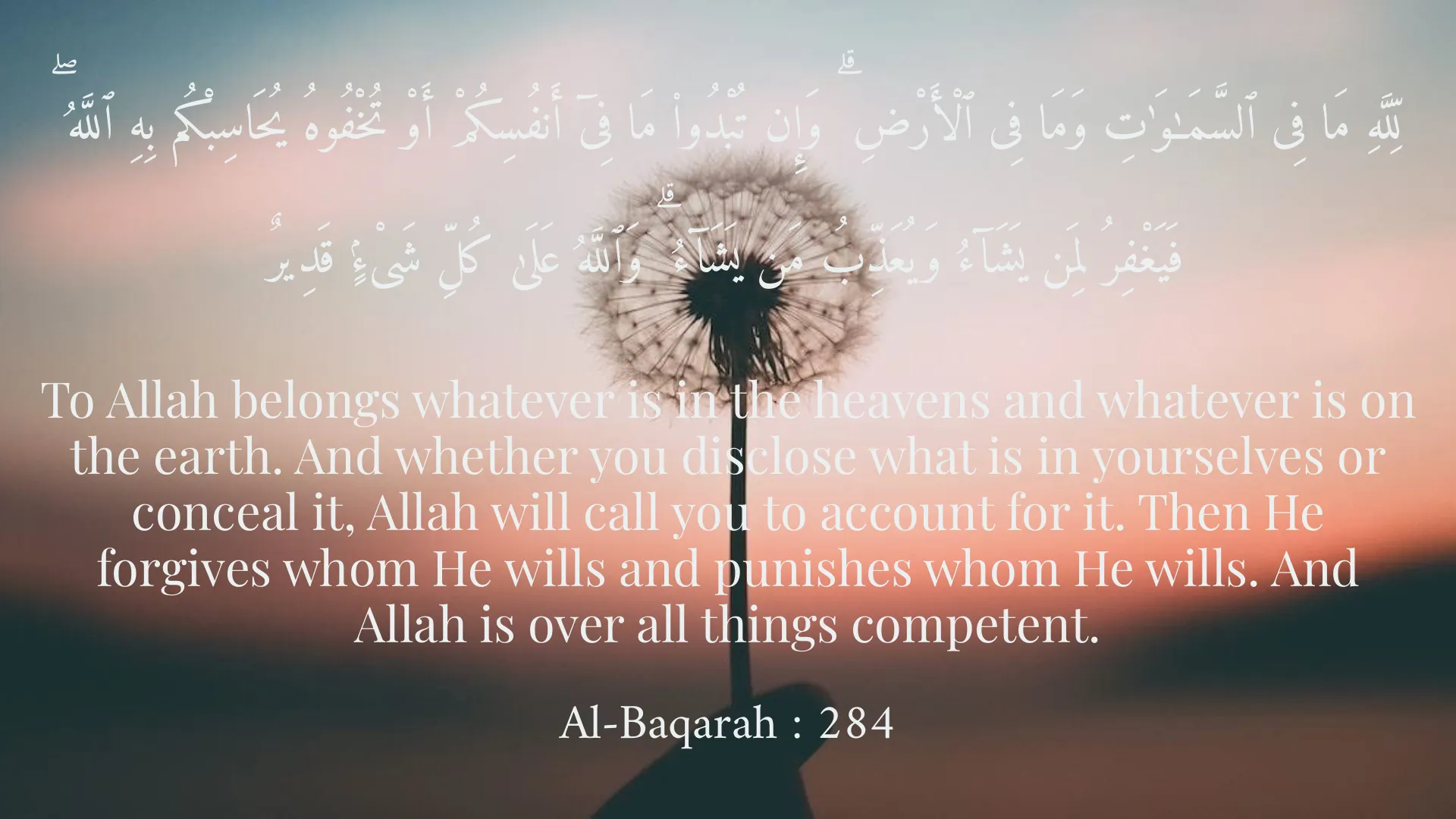
لِّلَّهِ مَا فِى ٱلسَّمَٰوَٰتِ وَمَا فِى ٱلْأَرْضِ ۗ وَإِن تُبْدُوا۟ مَا فِىٓ أَنفُسِكُمْ أَوْ تُخْفُوهُ يُحَاسِبْكُم بِهِ ٱللَّهُ ۖ فَيَغْفِرُ لِمَن يَشَآءُ وَيُعَذِّبُ مَن يَشَآءُ ۗ وَٱللَّهُ عَلَىٰ كُلِّ شَىْءٍۢ قَدِيرٌ
To Allah belongs whatever is in the heavens and whatever is on the earth. And whether you disclose what is in yourselves or conceal it, Allah will call you to account for it. Then He forgives whom He wills and punishes whom He wills. And Allah is over all things competent.
Al-Baqarah : 284
وَأَسِرُّوا۟ قَوْلَكُمْ أَوِ ٱجْهَرُوا۟ بِهِۦٓ ۖ إِنَّهُۥ عَلِيمٌۢ بِذَاتِ ٱلصُّدُورِ
And conceal your speech or publicize it; indeed, He is Knowing of that within the breasts.
Al-Mulk : 13
وَلَقَدْ خَلَقْنَا ٱلْإِنسَٰنَ وَنَعْلَمُ مَا تُوَسْوِسُ بِهِۦ نَفْسُهُۥ ۖ وَنَحْنُ أَقْرَبُ إِلَيْهِ مِنْ حَبْلِ ٱلْوَرِيدِ
And We have already created man and know what his soul whispers to him, and We are closer to him than [his] jugular vein.
Qaaf : 16
Short Story
They say there was a dervish who outwardly appeared devoted to asceticism and piety, yet inwardly, his heart was attached to worldly possessions and status. One day, an old and wise sheikh said to him, 'My son, do not imagine that what you hide in your heart is concealed from the sight of the Truth. God looks not at appearance and dress, but at intention and character.' The dervish was awakened by these words and understood that the Almighty God is aware of unspoken thoughts and hidden intentions. Thereafter, he strove not only to adorn his outer self but also to purify his inner self from impurities and make his intentions sincere, for the path to salvation lies in the purity of the heart, not in hypocrisy and outward display.