Quranic Answer
Absolutely, without a shadow of a doubt. The Holy Quran explicitly and implicitly assures us that Allah, the All-Knowing (Al-Alim), the All-Seeing (Al-Basir), and the All-Aware (Al-Khabir), is fully cognizant of everything, whether it is manifest or concealed. Your patience, even if it is a silent struggle, an inner fortitude, or a deep resolve that you do not vocalize or complain about to anyone, is profoundly visible to Him. In fact, such hidden acts of worship and endurance often carry a special weight and a profound reward in the sight of Allah, precisely because they are undertaken purely for His sake, without seeking human recognition, sympathy, or praise. The very foundation of Islamic faith includes believing in God's perfect attributes. When we affirm Allah as "Al-Alim," it signifies that His knowledge encompasses all things – the past, the present, and the future; the visible and the unseen; the spoken and the unspoken; the actions and, crucially, the intentions behind them. He is intimately aware of what lies in the depths of our hearts, the silent battles raging within our souls, and the unspoken anxieties we bear. He does not require us to verbally articulate our suffering for Him to be aware of it. On the contrary, often, the act of refraining from complaining to other human beings, and instead turning inward or upward to God in silent supplication or deep reflection, is a profound expression of Tawakkul (reliance on God) and unwavering trust in Him alone. This demonstrates a higher level of spiritual maturity and faith, as it shows an understanding that ultimately, only God possesses the power to alleviate distress, and seeking human sympathy might, in some cases, diminish the reward or lead to further disappointment. The Quran speaks extensively about sabr (patience) and its immense virtues. In Surah Az-Zumar (39:10), Allah states: "Indeed, the patient will be given their reward without reckoning." This single verse serves as a powerful testament to the extraordinary value of patience in the sight of God. The phrase "without reckoning" implies an unbounded, limitless reward, far surpassing any conceivable expectation or calculation. This incredibly generous recompense is for all forms of patience, including the silent endurance where one bears adversity with dignity and unwavering faith, consciously refraining from murmuring, lamenting, or complaining to others. Allah knows the true extent of our patience, the profound depth of our inner struggles, and the sincere purity of our reliance on Him. He sees every ounce of pain you endure, every hardship you silently withstand, and the steadfast hope you maintain in His boundless mercy, even when no one else on earth is aware of your internal battle. Moreover, consider Allah's attribute of "Al-Basir," the All-Seeing. This means His sight extends beyond the mere physical and observable. He sees not only our outward actions but also the unseen dimensions of our existence – our thoughts, our deepest emotions, our intentions, and the intricate inner state of our hearts. When you exhibit patience, you are performing a profound act of worship with your heart and soul. You are actively submitting to His divine decree, placing your complete trust in His infinite wisdom, and clinging to the hope for His ultimate relief and justice. This internal disposition, this silent commitment, is fully and perfectly observed by Allah. In Surah At-Taghabun (64:4), Allah emphatically declares: "He knows what is in the heavens and earth and knows what you conceal and what you declare. And Allah is Knowing of [all] that is in the breasts." This verse directly and unequivocally confirms that Allah is perfectly aware of everything we keep hidden within our hearts, including our silent endurance, our unspoken pain, and our steadfastness in times of trial. The act of not complaining to others, while it is certainly permissible and even encouraged to express one's pain and seek relief from Allah through du'a (supplication), reflects a profound level of reliance and pure devotion to Him. It signifies that you are placing your trust directly in the Divine, acknowledging that human beings, no matter how sympathetic or well-intentioned, possess inherently limited power to truly assist or understand the full scope of your distress. This inner strength, this unwavering faith, and this direct connection with the Creator are precisely what Allah values, acknowledges, and rewards. The example of Prophet Yaqub (Jacob), when deeply grieving for his son Yusuf (Joseph), is illustrative. He said, "Indeed, I only complain of my suffering and my grief to Allah, and I know from Allah that which you do not know." (Surah Yusuf, 12:86). This powerful statement elucidates the crucial distinction: complaining to Allah is an act of humility, submission, and seeking help from the ultimate Helper, whereas complaining about Allah's decree or complaining to people out of impatience is generally discouraged in its tone and purpose. Your silent patience, therefore, can be viewed as an even deeper and more internal form of this reliance, where your heart converses with Allah, expressing your resilience and trust, even if your tongue does not articulate the full extent of your hardship to the public. In conclusion, Allah's knowledge is comprehensive, perfect, and all-encompassing. He has no need for external signals, verbal complaints, or outward displays to understand the precise nature of your inner state. He knows the true weight on your heart, the silent battles you fight within yourself, the depth of your hidden pain, and the sincerity of your patience. Every single moment of silent endurance, every tear that is held back, every breath taken in submission to His divine will, is meticulously recorded, profoundly valued, and eternally rewarded by Him. This profound understanding should bring immense solace, comfort, and reassurance to anyone enduring hardship. It confirms that your struggles are never futile, and your patience is never unnoticed. Allah is indeed with those who are patient, constantly supporting them, guiding them through their trials, and meticulously preparing for them a reward beyond human comprehension. The more sincere, the more hidden, and the more purely for Allah's sake your patience is, the greater the likelihood of a purer intention and, consequently, a greater and more abundant reward. So, be absolutely assured, your silent patience is not merely seen; it is deeply appreciated, magnificently recorded, and abundantly rewarded by the Most Merciful, the All-Knowing.
Related Verses
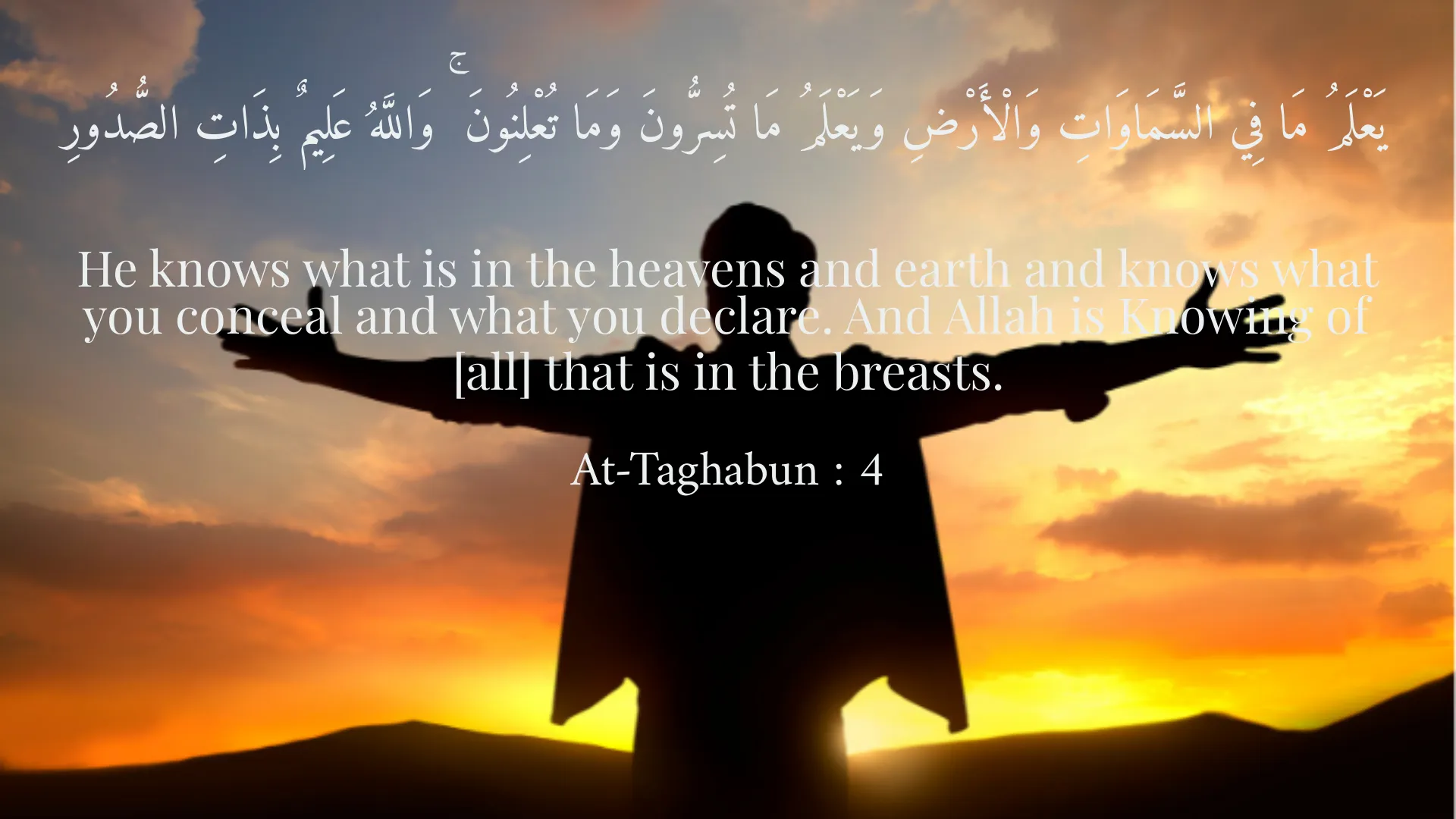
يَعْلَمُ مَا فِي السَّمَاوَاتِ وَالْأَرْضِ وَيَعْلَمُ مَا تُسِرُّونَ وَمَا تُعْلِنُونَ ۚ وَاللَّهُ عَلِيمٌ بِذَاتِ الصُّدُورِ
He knows what is in the heavens and earth and knows what you conceal and what you declare. And Allah is Knowing of [all] that is in the breasts.
At-Taghabun : 4
قُلْ يَا عِبَادِ الَّذِينَ آمَنُوا اتَّقُوا رَبَّكُمْ ۚ لِلَّذِينَ أَحْسَنُوا فِي هَٰذِهِ الدُّنْيَا حَسَنَةٌ ۗ وَأَرْضُ اللَّهِ وَاسِعَةٌ ۗ إِنَّمَا يُوَفَّى الصَّابِرُونَ أَجْرَهُم بِغَيْرِ حِسَابٍ
Say, "O My servants who have believed, fear your Lord. For those who do good in this world is good, and Allah's earth is spacious. Indeed, the patient will be given their reward without reckoning."
Az-Zumar : 10
يَا أَيُّهَا الَّذِينَ آمَنُوا اسْتَعِينُوا بِالصَّبْرِ وَالصَّلَاةِ ۚ إِنَّ اللَّهَ مَعَ الصَّابِرِينَ
O you who have believed, seek help through patience and prayer. Indeed, Allah is with the patient.
Al-Baqarah : 153
Short Story
It is related that in ancient times, there lived a wealthy merchant who suddenly lost all his fortune and fell into utter poverty. He was a man of great dignity and never uttered a complaint, neither to his close friends nor to his family. During the day, he would work in the marketplace, and at night, in the solitude of his chamber, with a heart full of pain yet hopeful of Divine grace, he would engage in supplication. Years passed, and no one came to know of his distressed condition. Outwardly, he smiled and bore life's hardships with patience. One day, a wise dervish, who had been his neighbor for years and had never heard a word of complaint from him, saw him and asked, "My brother, I have known you for years and have never heard a single complaint from you. Your patience astounds me. Is there truly no sigh in your heart?" The merchant smiled and replied, "Is not God wiser and more compassionate than to need our complaints to be aware of our state? He Himself is All-Seeing and All-Hearing, and He knows the reward of the patient. Complaining to people brings nothing but weakness of faith and humiliation, but complaining to Him is the very essence of servitude and seeking mercy. And I have chosen this servitude in my solitude." The dervish nodded, realizing that the merchant, with his sincere patience, had attained a high status in the presence of God. His reward would come not from human hands, but from the unseen treasures of Divine grace. This heartwarming story reminds us that God is aware of our hidden pains and silent patience and has decreed a magnificent reward for it.