Quranic Answer
In today's world, many individuals pursue material success, and societal values are often based on wealth, social status, and worldly achievements. However, the Holy Quran, as a guide for humanity, offers a deeper and more comprehensive perspective on the true value of success. From the Quranic viewpoint, material success alone, detached from spirituality and divine purpose, not only lacks true and lasting value but can also be a source of ruin and misguidance. The Quran repeatedly emphasizes that worldly life is fleeting and transient, and what endures and holds true value are righteous deeds, piety, and a strong connection with God. The primary purpose of human creation, as stated in Surah Adh-Dhariyat, verse 56, is to worship and serve Allah. This verse clearly indicates that our existence is not merely for accumulating wealth or gaining worldly power, but for attaining divine knowledge and closeness to God. Therefore, any form of success, including material success, gains its true value only when it aligns with this grand purpose and, instead of distancing a person from God, becomes a means of drawing closer to Him. Wealth and children, often seen as symbols of material success, are described in Surah Al-Kahf, verse 46, as the “adornment of worldly life.” The verse further states that “enduring good deeds” (righteous and lasting actions) are better and more hopeful in the sight of your Lord. This demonstrates that Allah prefers actions performed with sincere intentions and in accordance with truth over any material achievement that lacks spiritual essence. The Quran likens worldly life to a mere play and amusement, as mentioned in Surah Al-Hadid, verse 20: “Know that the life of this world is only play and amusement, an adornment and boasting among yourselves, and competition in increase of wealth and children.” This analogy aptly illustrates the transient and deceptive nature of the material world. If a person devotes all their efforts to gathering wealth and prestige, neglecting their true purpose, they will ultimately return to the Hereafter empty-handed and regretful. This verse paints a realistic picture of the progression of material life: starting with the excitement of childhood (play), then the period of youth preoccupied with beauty and recreation (amusement and adornment), followed by competition for wealth and progeny (boasting and increase), and finally likened to rain whose plants impress the farmers, but then it withers and turns yellow and crumbles. This wise parable warns us not to become attached to the fleeting allurements of this world. Wealth, from a Quranic perspective, is also a means of divine test. In Surah At-Taghabun, verse 15, it states: “Your wealth and your children are only a trial.” This means that Allah grants us wealth and children to see how we utilize them: Do we show gratitude and spend them in His way, or do we become ungrateful, falling into arrogance and transgression? If wealth, instead of being a means for charity, spending for others, and aiding the needy, transforms into an instrument of pride, injustice, and excessive desire, it not only loses its value but becomes a heavy burden on its possessor on the Day of Judgment. True material success is achieved when an individual uses worldly blessings to prepare for their Hereafter and benefits from them in a way that pleases Allah. The Quran never advocates abandoning the world or asceticism. Rather, Surah Al-Qasas, verse 77, states: “But seek, through that which Allah has given you, the home of the Hereafter; and [yet], do not forget your share of the world. And do good as Allah has done good to you.” This verse establishes a wise balance between this world and the Hereafter. On one hand, it encourages striving for the Hereafter, as that is the ultimate goal; on the other hand, it reminds one to enjoy lawful worldly blessings, but not in a way that diverts them from the main path. This share of the world should serve the greater purpose of achieving eternal bliss. Enjoying worldly possessions is valuable when it means using them to achieve divine goals and helping God's creation, not merely accumulating them for transient personal pleasures. In conclusion, material success without spirituality is like a house that appears beautiful and magnificent from the outside but is hollow and lifeless within. This type of success can never bring true peace, inner contentment, or lasting happiness. Indeed, many individuals who are at the peak of material success feel emptiness, anxiety, and failure deep within themselves. The true value of success lies not in the quantity of wealth and status, but in the quality of a person's relationship with their Creator and its impact on their individual and social life. Quranic success is a balance between legitimate enjoyment of worldly things and prioritizing spirituality, piety, and preparedness for the Hereafter. Only when material success is accompanied by a divine vision and spiritual objectives can it become a valuable and enduring achievement that brings peace in this world and salvation in the Hereafter.
Related Verses
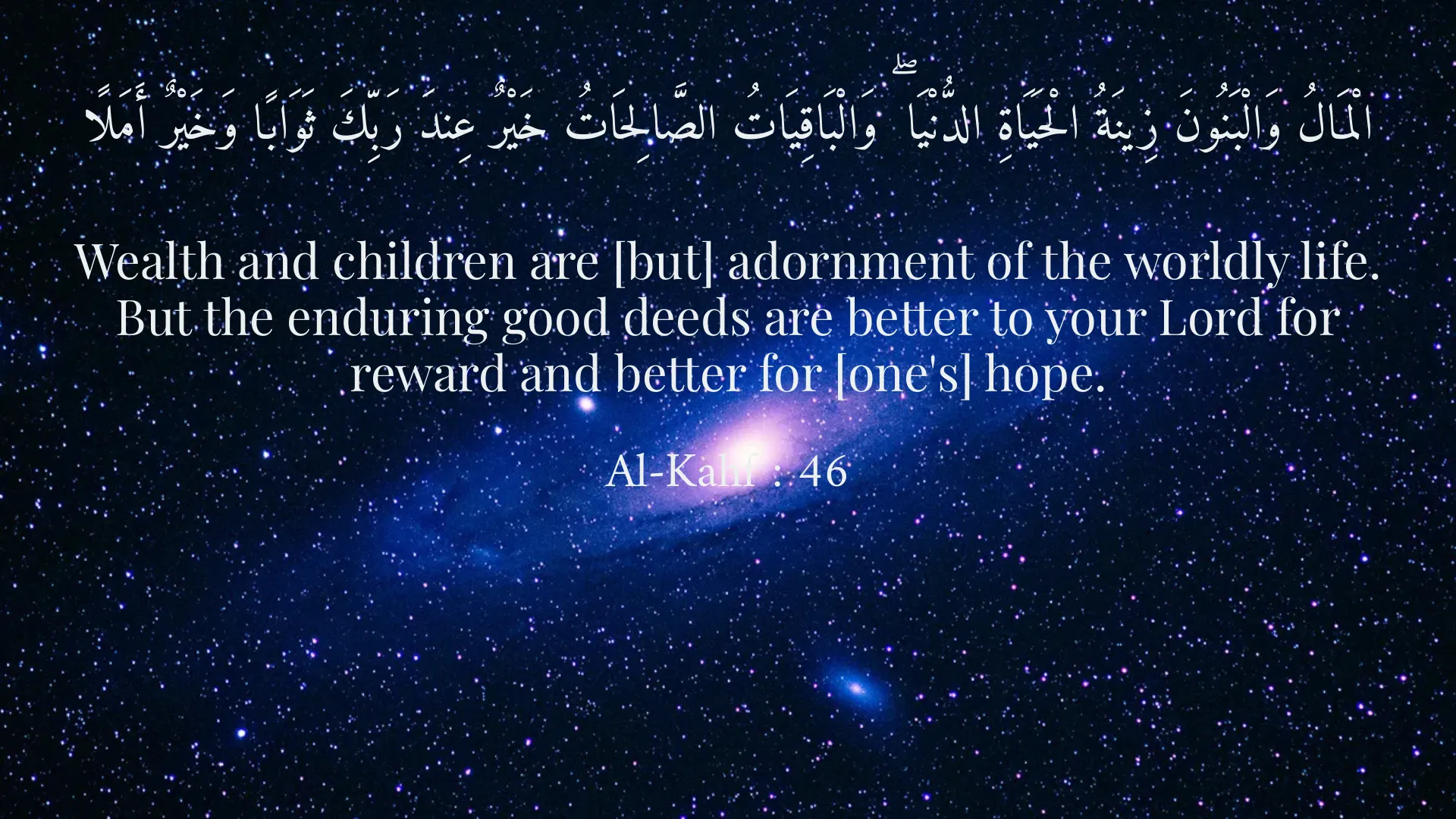
الْمَالُ وَالْبَنُونَ زِينَةُ الْحَيَاةِ الدُّنْيَا ۖ وَالْبَاقِيَاتُ الصَّالِحَاتُ خَيْرٌ عِندَ رَبِّكَ ثَوَابًا وَخَيْرٌ أَمَلًا
Wealth and children are [but] adornment of the worldly life. But the enduring good deeds are better to your Lord for reward and better for [one's] hope.
Al-Kahf : 46
اعْلَمُوا أَنَّمَا الْحَيَاةُ الدُّنْيَا لَعِبٌ وَلَهْوٌ وَزِينَةٌ وَتَفَاخُرٌ بَيْنَكُمْ وَتَكَاثُرٌ فِي الْأَمْوَالِ وَالْأَوْلَادِ ۖ كَمَثَلِ غَيْثٍ أَعْجَبَ الْكُفَّارَ نَبَاتُهُ ثُمَّ يَهِيجُ فَتَرَاهُ مُصْفَرًّا ثُمَّ يَكُونُ حُطَامًا ۚ وَفِي الْآخِرَةِ عَذَابٌ شَدِيدٌ وَمَغْفِرَةٌ مِّنَ اللَّهِ وَرِضْوَانٌ ۚ وَمَا الْحَيَاةُ الدُّنْيَا إِلَّا مَتَاعُ الْغُرُورِ
Know that the life of this world is only play and amusement, an adornment and boasting among yourselves, and competition in increase of wealth and children - like the example of a rain whose [resulting] plant growth pleases the disbelievers; then it dries and you see it [become] yellow; then it becomes [scattered] debris. And in the Hereafter is severe punishment and forgiveness from Allah and approval. And what is the worldly life except the enjoyment of delusion.
Al-Hadid : 20
وَابْتَغِ فِيمَا آتَاكَ اللَّهُ الدَّارَ الْآخِرَةَ ۖ وَلَا تَنسَ نَصِيبَكَ مِنَ الدُّنْيَا ۖ وَأَحْسِن كَمَا أَحْسَنَ اللَّهُ إِلَيْكَ ۖ وَلَا تَبْغِ الْفَسَادَ فِي الْأَرْضِ ۖ إِنَّ اللَّهَ لَا يُحِبُّ الْمُفْسِدِينَ
But seek, through that which Allah has given you, the home of the Hereafter; and [yet], do not forget your share of the world. And do good as Allah has done good to you. And desire not corruption in the land. Indeed, Allah does not like corrupters.
Al-Qasas : 77
وَمَا خَلَقْتُ الْجِنَّ وَالْإِنسَ إِلَّا لِيَعْبُدُونِ
And I did not create the jinn and mankind except to worship Me.
Adh-Dhariyat : 56
Short Story
In Saadi's Gulistan, it is narrated that there was a wealthy and powerful king who, despite all his possessions, always carried a hidden sorrow in his heart and found no peace. The more he sought to accumulate wealth and conquer lands, the more he felt lonely and empty. One day, he encountered a spiritual sage who lived contentedly in a corner of the city and asked him, "I possess the whole world, yet why does my heart find no rest?" The sage smiled and said, "O King! Instead of filling your heart with the light of spirituality and the love of God, you have filled it with worldly desires and the greed for wealth. Riches and power are like fine clothes; though beautiful, they do not quench the soul's thirst. True peace lies in self-knowledge and servitude to the Lord, not in possessing the world. He who ties his heart to the world will never find peace, for the world is fleeting, and only with what you gain in spirituality and good deeds can you attain eternal tranquility." The king was transformed by these words and realized that true happiness lies in a heart full of the remembrance of God, not in a treasury full of gold.