Quranic Answer
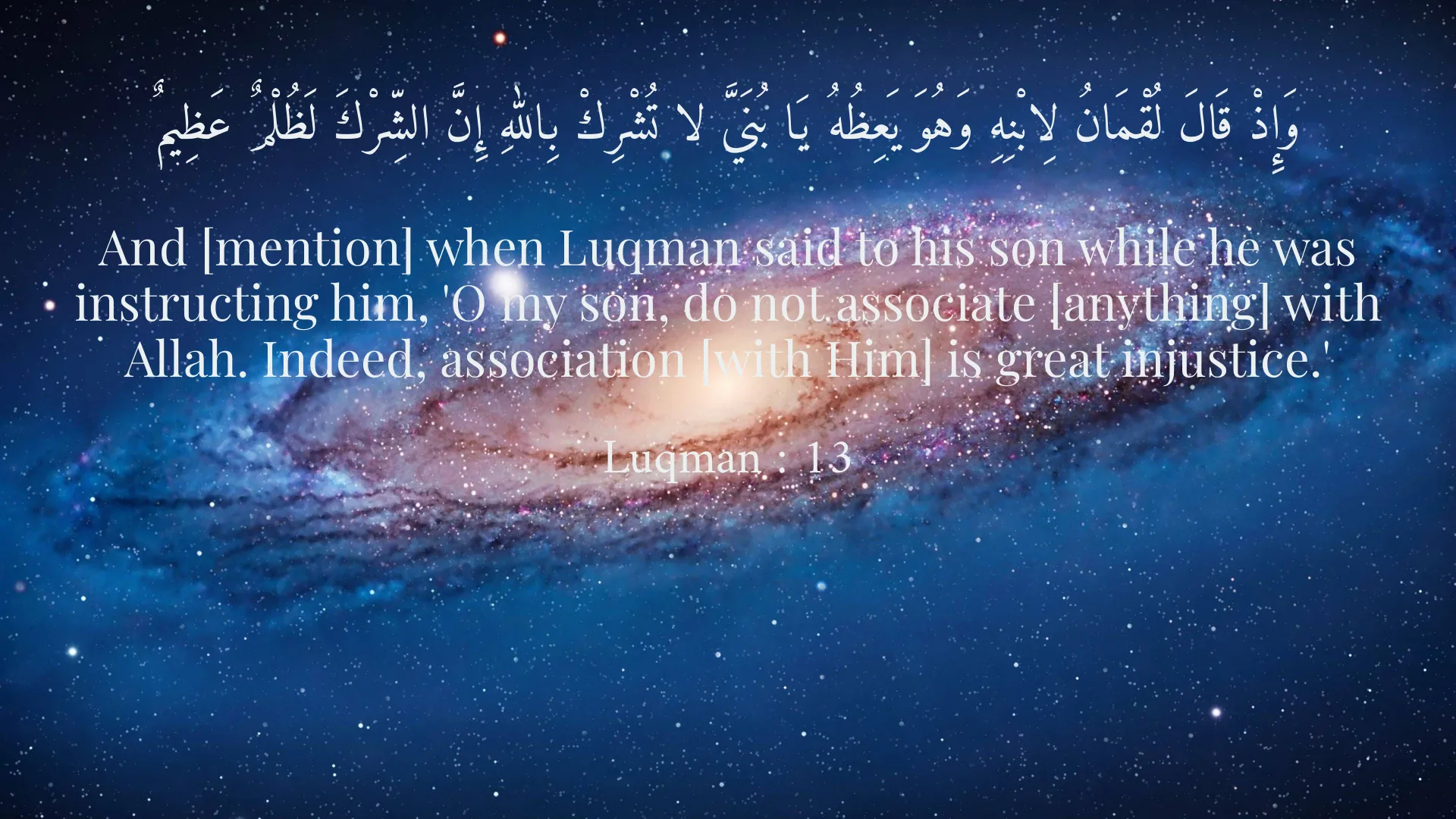
The Holy Quran is a profound text that serves as a guide to many aspects of life, including the vital responsibility of raising children. The importance of nurturing children into morally and spiritually sound individuals is emphasized throughout its verses. Notably, in Surah Luqman, verse 13, Allah underscores the parent-child relationship by stating, "And [mention] when Luqman said to his son while he was instructing him, 'O my son, do not associate [anything] with Allah. Indeed, association [with Him] is great injustice.'" This powerful admonition illustrates the essence of monotheism as a foundational element in the upbringing of children. The teachings provided by Luqman to his son are not mere suggestions; rather, they are crucial guidelines that embody the essence of a believer's faith and commitment to Allah. This verse epitomizes the critical dialogue that should exist between a parent and a child, wherein parents must actively engage in teaching their children the significance of faith, integrity, and the values of life. The phrase 'do not associate' points to the gravity of polytheism and its repercussions in the life of an individual. By emphasizing that associating partners with Allah is the 'great injustice,' the verse guides parents to instill in their children a strong sense of monotheism. This teaching lays the groundwork for a child’s moral compass and future decision-making. Therefore, the upbringing of children in an Islamically sound environment goes beyond mere physical care; it encompasses the nurturing of spiritual and ethical beliefs. Furthermore, this theme of moral upbringing is recurrent throughout the Quran. In Surah An-Nahl, verse 90, Allah commands justice and good deeds. This verse extends the concept of raising children into a broader framework of social responsibility. The instruction to be just is not limited to one's own family but extends to society at large. Parents must embody these principles to serve as role models for their children, ensuring that values such as fairness, accountability, and integrity are ingrained from a young age. Such values create a positive cycle where children are not only nurtured at home but also contribute positively to their communities as they grow older. In a world filled with challenges, pressures, and moral dilemmas, supportive parenting can pave the way for children to become resilient individuals who can navigate complexities with wisdom and gravitas. If parents raise their children with good intentions, patience, and perseverance, they will undoubtedly witness divine rewards both in this world and the hereafter. The nurturing atmosphere an Islamic parent creates serves as fertile soil for the values of respect, kindness, and devotion to bloom within a child. By being mindful of their actions and words, parents can shape their children’s understanding of faith, which will resonate throughout their lives. Moreover, a prophetic tradition substantiates the notion that raising children is an act laden with divine significance. The saying, "Whoever raises a child rightly will be rewarded by God," serves as a beacon of encouragement for parents to adopt an earnest approach toward their parenting responsibilities. This tradition not only reassures parents of the rewards that await them but also highlights the importance of intentionality in raising children. The rewarding aspect is not limited to material or worldly gains; instead, it focuses on spiritual fulfillment and the attainment of blessings in both this life and the hereafter. Achieving this requires consistent effort from parents, as effective upbringing is a mixture of love, discipline, and guidance. It entails setting boundaries, teaching life lessons, and nurturing a child’s ability to choose the right path. Effective communicative practices enable parents to offer their insights while allowing children the space to express their thoughts and feelings. The dialogue fostered between parents and children is imperative, as it nurtures trust and encourages open discussions about faith and choices. In addition to verbal guidance, parental involvement through shared activities and community engagement reinforces the lessons learned at home. Activities such as volunteering, attending religious gatherings, and fostering friendships with like-minded families create enriching experiences for children, enhancing their social and spiritual development. The role of parents is integral, as their involvement can help frame a child's worldview and deepen their understanding of social justice and equality. As children grow, the applicability of the teachings becomes increasingly vital. Teens, in particular, face numerous challenges that test their values and beliefs. Parents must remain engaged, providing guidance while allowing their children to form their own identities. This transitional phase requires a delicate balance of discipline and understanding, ensuring that the lessons from their upbringing continue to shape their choices in complex environments. In reflecting on the broader implications of child-rearing, it becomes clear that raising children is not merely a familial endeavor; it is a societal obligation. Each generation plays a crucial role in shaping the moral fabric of the community. As such, the positive upbringing of children lays the foundation for a just society, as these children grow to be responsible citizens who contribute to the common good. In conclusion, the significance of raising children is profoundly emphasized in the Holy Quran and through the teachings of the Prophet Muhammad. The responsibilities of parents extend beyond the physical upbringing of their children; they encompass the spiritual, emotional, and social aspects necessary for creating well-rounded individuals. It is a daunting but rewarding task, best approached with sincerity, patience, and faith. As articulated through the timeless words of the Quran, those who invest in their children’s proper upbringing will not only secure a better present and future for their families but will also earn the favor and blessings of Allah. Indeed, the path of nurturing children towards the principles of justice, faith, and integrity serves as a means of achieving enduring rewards in this world and the hereafter.
Related Verses
وَإِذْ قَالَ لُقْمَانُ لِابْنِهِ وَهُوَ يَعِظُهُ يَا بُنَيَّ لا تُشْرِكْ بِاللهِ إِنَّ الشِّرْكَ لَظُلْمٌ عَظِيمٌ
And [mention] when Luqman said to his son while he was instructing him, 'O my son, do not associate [anything] with Allah. Indeed, association [with Him] is great injustice.'
Luqman : 13
إِنَّ اللهَ يَأْمُرُكُمْ أَن تُؤَدُّوا الأَمَانَاتِ إلى أَهْلِهَا وَإِذَا حَكَمْتُمْ بَيْنَ النَّاسِ أَن تَحْكُمُوا بِالْعَدْلِ ۚ إِنَّ اللهَ نِعِمَّا يَعِظُكُمْ بِهِ ۚ إِنَّ اللهَ كَانَ سَمِيعًا بَصِيرًا
Indeed, Allah commands you to render trusts to whom they are due and when you judge between people to judge with justice. Excellent is that which Allah instructs you. Indeed, Allah is ever Hearing and Seeing.
An-Nahl : 90
Short Story
One day, a man was sitting in a garden with his son. He asked his son, 'What do you want to be when you grow up?' The son excitedly replied, 'Like you!' The father looked at his son with love and realized he had started the right upbringing. He told his son that he should strive to be the best person, which involves not only knowledge but also faith and staying away from sin.