Quranic Answer
In the lofty teachings of the Holy Quran, the concept of "Ikhlas" (sincerity of intention) stands as one of the fundamental pillars of faith and righteous deeds. Ikhlas means to purify one's intention and action solely for the pleasure of Allah Almighty, such that there is no trace of riya' (showing off), self-admiration, or seeking praise from creation within it. The question then arises: Does "the effort to be seen" contradict this important principle of sincerity? The answer to this question requires a precise distinction between "the outcome of being seen" and "the purpose of seeking to be seen." This subtle yet crucial difference determines the spiritual fate of our actions. The Holy Quran explicitly condemns riya' (showing off) and considers it among the blameworthy attributes and obstacles to the acceptance of deeds. Riya' means performing a good deed with the intention of being seen and gaining admiration from people, rather than for the pleasure of the Lord. This topic is addressed in several verses. For instance, in Surah Al-Baqarah, verse 264, Allah states: "O you who have believed, do not invalidate your charities with reminders [of it] or [other] injury, like one who spends his wealth [only] to be seen by the people and does not believe in Allah and the Last Day." This verse clearly indicates that even good and virtuous deeds, such as charity, if performed with the intention of showing off and riya', become devoid of any spiritual value and are rendered ineffective in the sight of Allah. This is because the primary goal of worship, which is seeking proximity to God, is forgotten, and instead, the attention of creation becomes the objective. Such an act not only yields no reward but may even be considered a sin, as it contains a subtle form of shirk (associating partners with God). Furthermore, in Surah Al-Ma'un, verses 4 to 6, Allah states with a tone of reprimand: "So woe to those who pray, [but] who are heedless of their prayer - those who make show [of their deeds]." These verses demonstrate that even acts of worship like prayer, if performed with the intention of riya' and display to people, are not only unacceptable but deserve "Woe" (destruction or torment). These examples emphasize that the criterion for the acceptance of a deed in the divine presence is the sincerity of intention, not the outward appearance of the deed or the extent of its impact on people. Ikhlas is the spirit of the action; without it, the body of the action will be lifeless and ineffective. Therefore, the fundamental contradiction between sincerity and "the effort to be seen" arises when the primary goal of performing an action is solely to gain attention, praise, admiration, or material benefit from people. In this scenario, the pure intention for Allah is lost, and the action deviates from its devotional nature. This state is actually referred to as subtle shirk (shirk al-khafi), because the person targets the pleasure of creation alongside the pleasure of Allah, or even prioritizes it over divine pleasure. The Prophet Muhammad (peace be upon him) referred to riya' as "minor shirk" (shirk asghar), indicating its dangerous nature, as it gradually deviates a person from the path of pure monotheism. One who performs deeds for people is essentially enslaving themselves to people, not to God. Such an individual becomes captive to the praise and criticism of others, losing the freedom and spiritual tranquility that comes from reliance on Allah. However, does every instance of being seen inherently contradict sincerity? Absolutely not. Many righteous deeds are inherently public or, due to their widespread impact, inevitably come to public attention. For example, a religious scholar who disseminates knowledge, a benevolent entrepreneur who implements public benefit projects, or a mujahid (one striving in Allah's cause) who fights in the way of Allah – their actions may naturally be seen and praised. In such cases, if the primary and initial intention of the person is purely for the pleasure of Allah and serving His creation, then being seen, and even being praised by people, not only does not harm sincerity but can be considered a blessing from Allah that encourages others towards goodness and righteousness. In other words, it's not about how much you are seen, but why you want to be seen. If being seen is a means to promote good (e.g., encouraging charity or serving as a role model for youth), and the initial intention is pure, then there is no issue. The key distinction here lies in the "intention of the heart." The Prophet Muhammad (peace be upon him) said: "Indeed, actions are only by intentions." This Prophetic narration clearly shows that the value and weight of an action are not in its outward form but in the inner motive and purpose of its doer. If the intention is purely for Allah, even if the action is seen, sincerity is preserved. But if the intention is solely to be seen by people, even if the action is performed in private (with the thought that it would be good if it were seen), then it is still devoid of sincerity. Ikhlas is the soul's liberation from the chains of dependence on external validation. In some cases, the visibility of a good deed can even be desirable and commendable, provided that the initial intention is for Allah. For instance, when the purpose of making an action public is to encourage others to do good, to promote a virtuous tradition, or to defend the truth. Imam Ali (peace be upon him) said: "Whenever you conceal a good deed, also reveal another good deed, so that a good tradition and path may be promoted." This indicates that in specific circumstances and with the right intention, making an action public can also be beneficial, as it can guide others towards goodness and illuminate the path of righteousness. The difference between making an action public to encourage others and riya' lies in the focal point of the intention: in the former, the focus is God and promoting good; in the latter, the focus is the self and self-admiration. Ultimately, it can be concluded that the effort to be seen, if the primary goal and inner intention of the person is to gain praise, fame, or worldly benefits rather than the pleasure of Allah, definitely contradicts sincerity. This type of effort stems from pride and self-centeredness and renders the deed worthless. However, if being seen is a natural outcome of a sincere action performed with the intention of serving Allah and His creation, and the person uses this visibility for proper purposes (such as encouraging others to do good or serving as a positive role model), then this does not contradict sincerity. Indeed, the true believer is one who, in all circumstances, whether in private or in public, keeps their intention pure for Allah and constantly purifies their heart from the impurities of riya' and self-conceit. Ikhlas is a continuous struggle against the commanding self (nafs al-ammarah) and satanic whispers that drive a person towards seeking the attention of creation, whereas they should only seek the attention of the Creator and prefer His pleasure over everything else. Ikhlas is a jewel that frees the action from the mirage of appearances and connects it to the spring of truth.
Related Verses
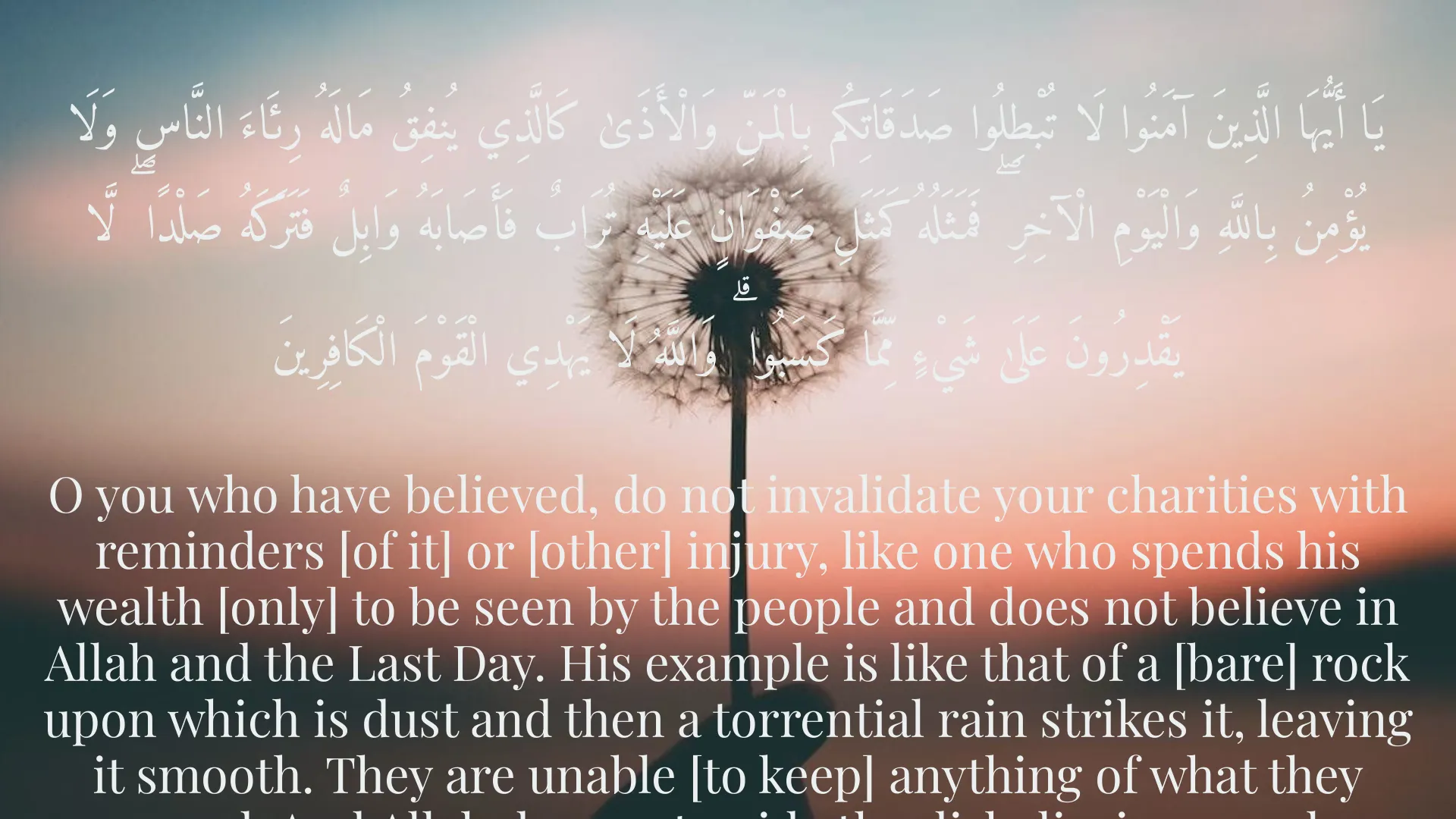
يَا أَيُّهَا الَّذِينَ آمَنُوا لَا تُبْطِلُوا صَدَقَاتِكُم بِالْمَنِّ وَالْأَذَىٰ كَالَّذِي يُنفِقُ مَالَهُ رِئَاءَ النَّاسِ وَلَا يُؤْمِنُ بِاللَّهِ وَالْيَوْمِ الْآخِرِ ۖ فَمَثَلُهُ كَمَثَلِ صَفْوَانٍ عَلَيْهِ تُرَابٌ فَأَصَابَهُ وَابِلٌ فَتَرَكَهُ صَلْدًا ۖ لَّا يَقْدِرُونَ عَلَىٰ شَيْءٍ مِّمَّا كَسَبُوا ۗ وَاللَّهُ لَا يَهْدِي الْقَوْمَ الْكَافِرِينَ
O you who have believed, do not invalidate your charities with reminders [of it] or [other] injury, like one who spends his wealth [only] to be seen by the people and does not believe in Allah and the Last Day. His example is like that of a [bare] rock upon which is dust and then a torrential rain strikes it, leaving it smooth. They are unable [to keep] anything of what they earned. And Allah does not guide the disbelieving people.
Al-Baqarah : 264
وَمَا أُمِرُوا إِلَّا لِيَعْبُدُوا اللَّهَ مُخْلِصِينَ لَهُ الدِّينَ حُنَفَاءَ وَيُقِيمُوا الصَّلَاةَ وَيُؤْتُوا الزَّكَاةَ ۚ وَذَٰلِكَ دِينُ الْقَيِّمَةِ
And they were not commanded except to worship Allah, [being] sincerely obedient to Him, inclining to truth, and to establish prayer and to give zakat. And that is the correct religion.
Al-Bayyinah : 5
فَوَيْلٌ لِّلْمُصَلِّينَ الَّذِينَ هُمْ عَن صَلَاتِهِمْ سَاهُونَ الَّذِينَ هُمْ يُرَاءُونَ
So woe to those who pray, [but] who are heedless of their prayer - those who make show [of their deeds].
Al-Ma'un : 4
Short Story
It is recounted in the tales of Saadi's Gulistan that a wealthy and ambitious man decided to build a magnificent and splendid mosque. During its construction, he constantly urged the engineers and architects to make it so grand that it would dazzle all eyes and immortalize his name. Every stone he laid was accompanied by the intention that people would speak of the grandeur of his edifice. After its completion, throngs of townspeople came to admire the mosque and praise him. The man was exceedingly pleased, thinking to himself, "This is immortality!" Some time passed. In the same town, there lived a poor and dervish-like man. Whenever he managed to earn a small sum of money, he would, without anyone knowing, contribute to a small mosque in a poor neighborhood. Sometimes he would buy a single brick, sometimes a bit of plaster, and sometimes he would clear the debris from the mosque with his own hands. He sought neither fame nor recognition. His sole intention was to earn the pleasure of God and to provide a place of worship for His servants. No one knew of his deeds, save God. One night, the wealthy man dreamt that an angel told him: "The mosque you built with such splendor, you received its worldly reward from the people, but in the heavens, there is no reward for you, for your intention was fame, not Our pleasure. But that small mosque in a remote neighborhood, with every pure brick that the humble dervish laid, adorned Our Throne, because his intention was pure and he had only Us in mind." The wealthy man awoke with fear and regret, realizing that the effort to be seen, without sincerity, is vain and fruitless.