Quranic Answer
In addressing the complex issue of 'evil' and its origins, the Holy Quran offers a profound and multifaceted perspective that emphasizes both human free will and the influence of ignorance, though often as a consequence of the misuse of that will. The question of whether evil stems from ignorance or from human will and choice is answered with particular nuance in Quranic teachings. Generally, the Quran attributes the primary root of moral evil and social corruption to humanity's misuse of their bestowed gift of free will and choice. However, it does not deny the role of ignorance and unawareness, though this ignorance is frequently not a forced state but rather a result of deliberate choices and human negligence. Indeed, the Quran explicitly grants humans free will and the power of choice. God created humanity with the capacity to discern good from evil, guidance from misguidance, and showed them the path. In Surah Al-Kahf, verse 29, it states: "And say, 'The truth is from your Lord, so whoever wills - let him believe; and whoever wills - let him disbelieve.'" This verse clearly places the responsibility of choice and freedom of action on humanity. Therefore, when a person, by their own will, chooses a false path, they commit evil. Actions such as oppression, corruption, lying, treachery, and various sins all originate from deliberate human choices. This free will enables human growth and elevation, but it can also lead to downfall and destruction. Moral evil in the world is a direct result of decisions and actions that humans undertake with their full freedom. Furthermore, the Quran emphasizes that every individual is accountable for their actions. Verses 7 and 8 of Surah Az-Zalzalah illustrate this truth: "So whoever does an atom's weight of good will see it, And whoever does an atom's weight of evil will see it." These verses clearly show that the consequences of good and evil directly revert to human deeds. If corruption and mischief appear on Earth, the Quran attributes it to the actions of humans themselves: "Corruption has appeared on land and sea by [reason of] what the hands of people have earned" (Surah Ar-Rum, verse 41). This verse is a strong testament that the primary source of evil is human actions and choices. Regarding the role of 'ignorance' (jahl), the Quran does not present it as an independent factor for creating evil. Instead, ignorance is often seen as a result of heedlessness, lack of contemplation, and a conscious choice to disregard the truth. Humanity possesses an inherent inclination towards truth (fitra) and intellect (aql) that can discern right from wrong. When a person acts wrongly due to ignorance, this ignorance might stem from their failure to seek knowledge, their lack of reflection on divine signs, or their disregard for the guidance of prophets. In other words, many forms of 'ignorance' are of the type known as 'culpable ignorance' (jahl taqsiri); that is, an ignorance for which the person himself is responsible and could have overcome by their own will. For example, those who disobey divine commands due to ignorance often do so because of their unwillingness to acquire knowledge and understanding. The Quran repeatedly invites people to reflect, use their intellect, ponder, and seek knowledge, and it condemns those who do not use their minds and remain in ignorance. Satan (Shaytan) plays the role of a tempter, but the Quran clarifies that he has no power over humans to force them into evil. Satan's role is merely to invite and beautify evil, and it is humanity that, by their own will, accepts or rejects this invitation. In Surah Ibrahim, verse 22, Satan will say to the inhabitants of Hell on the Day of Judgment: "And I had no authority over you except that I invited you, and you responded to me." This verse also explicitly emphasizes human accountability and free will in accepting or rejecting evil. In conclusion, the Holy Quran primarily attributes moral evil and its resulting corruption to human free will and conscious choices. Although ignorance can also lead to evil deeds, this ignorance itself is often a consequence of the improper use of intellect and free will, or stems from deliberate negligence and disregard for the truth. Therefore, the fundamental root of evil in the Quranic perspective is humanity's misuse of the gift of choice, which was given to them to choose their path to felicity or wretchedness. This human accountability for actions forms the basis of divine justice in reward and punishment and gives meaning to the world's moral order. Evil is a deviation from the pure human nature (fitra) and the call of reason and revelation, a deviation that begins with human will.
Related Verses
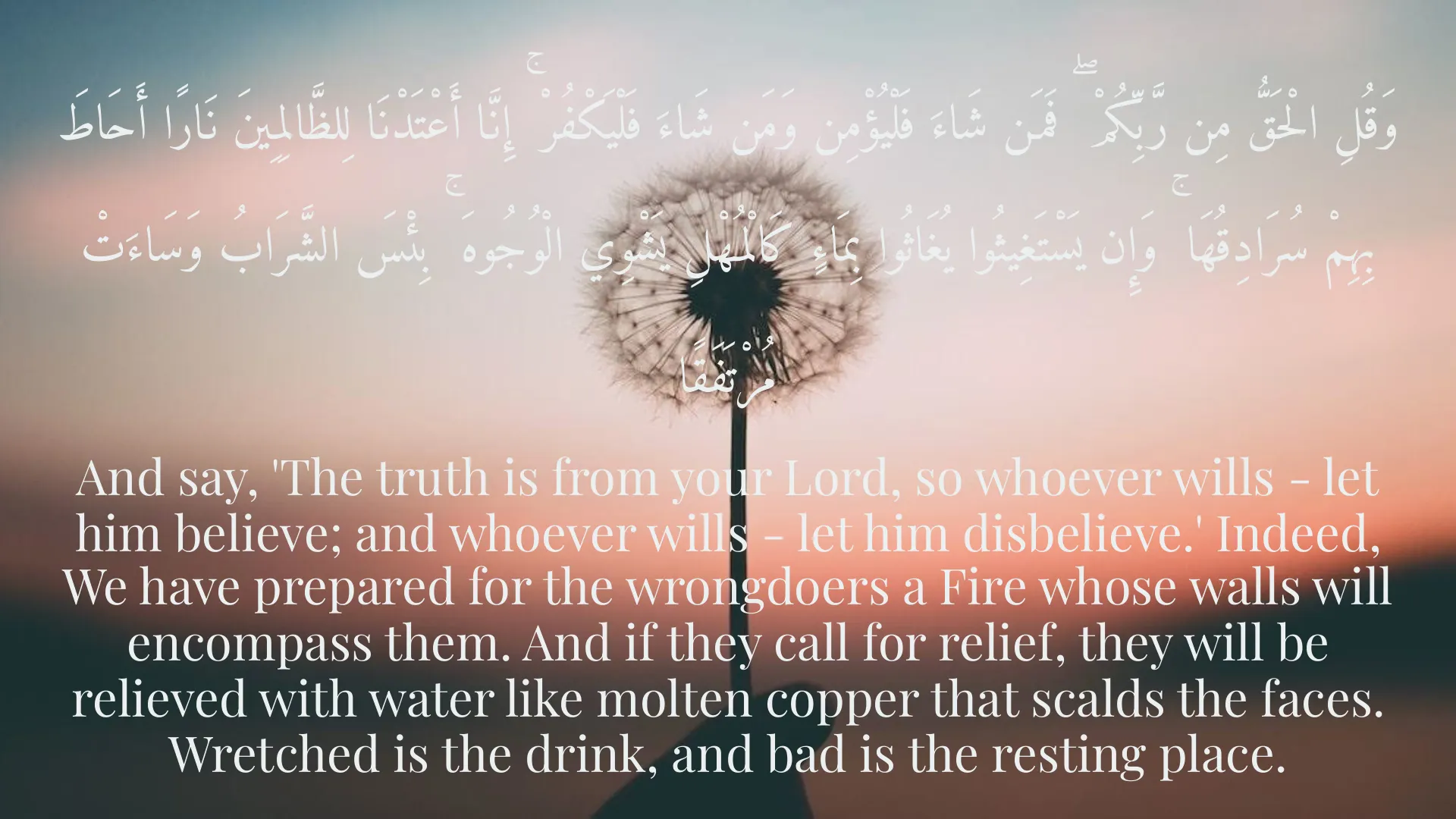
وَقُلِ الْحَقُّ مِن رَّبِّكُمْ ۖ فَمَن شَاءَ فَلْيُؤْمِن وَمَن شَاءَ فَلْيَكْفُرْ ۚ إِنَّا أَعْتَدْنَا لِلظَّالِمِينَ نَارًا أَحَاطَ بِهِمْ سُرَادِقُهَا ۚ وَإِن يَسْتَغِيثُوا يُغَاثُوا بِمَاءٍ كَالْمُهْلِ يَشْوِي الْوُجُوهَ ۚ بِئْسَ الشَّرَابُ وَسَاءَتْ مُرْتَفَقًا
And say, 'The truth is from your Lord, so whoever wills - let him believe; and whoever wills - let him disbelieve.' Indeed, We have prepared for the wrongdoers a Fire whose walls will encompass them. And if they call for relief, they will be relieved with water like molten copper that scalds the faces. Wretched is the drink, and bad is the resting place.
Al-Kahf : 29
فَمَن يَعْمَلْ مِثْقَالَ ذَرَّةٍ خَيْرًا يَرَهُ
So whoever does an atom's weight of good will see it,
Az-Zalzalah : 7
وَمَن يَعْمَلْ مِثْقَالَ ذَرَّةٍ شَرًّا يَرَهُ
And whoever does an atom's weight of evil will see it.
Az-Zalzalah : 8
ظَهَرَ الْفَسَادُ فِي الْبَرِّ وَالْبَحْرِ بِمَا كَسَبَتْ أَيْدِي النَّاسِ لِيُذِيقَهُم بَعْضَ الَّذِي عَمِلُوا لَعَلَّهُمْ يَرْجِعُونَ
Corruption has appeared on land and sea by [reason of] what the hands of people have earned so that He may let them taste part of [the consequence of] what they have done that perhaps they will return [to righteousness].
Ar-Rum : 41
وَقَالَ الشَّيْطَانُ لَمَّا قُضِيَ الْأَمْرُ إِنَّ اللَّهَ وَعَدَكُمْ وَعْدَ الْحَقِّ وَوَعَدتُّكُمْ فَأَخْلَفْتُكُمْ ۖ وَمَا كَانَ لِيَ عَلَيْكُم مِّن سُلْطَانٍ إِلَّا أَن دَعَوْتُكُمْ فَاسْتَجَبْتُمْ لِي ۖ فَلَا تَلُومُونِي وَلُومُوا أَنفُسَكُم ۖ مَّا أَنَا بِمُصْرِخِكُمْ وَمَا أَنتُم بِمُصْرِخِيَّ ۖ إِنِّي كَفَرْتُ بِمَا أَشْرَكْتُمُونِ مِن قَبْلُ ۗ إِنَّ الظَّالِمِينَ لَهُمْ عَذَابٌ أَلِيمٌ
And Satan will say when the matter has been concluded, "Indeed, Allah had promised you the promise of truth. And I promised you, but I betrayed you. But I had no authority over you except that I invited you, and you responded to me. So do not blame me; but blame yourselves. I cannot be your rescuer, nor can you be my rescuer. Indeed, I deny your association of me [with Allah] before. Indeed, for the wrongdoers is a painful punishment."
Ibrahim : 22
Short Story
Once upon a time, in a pleasant village, lived two brothers. One was named 'Wise,' who always sought knowledge and carried out his affairs with deliberation and thought. The other was named 'Heedless,' who was mostly occupied with his desires and paid no attention to the consequences of his actions. One day, a devastating flood swept through the village, destroying many homes. Wise, having observed signs of heavy rainfall months prior and applying his knowledge of construction principles, had built his house on high, solid ground. However, Heedless, despite warnings, due to laziness and lack of foresight, had built his house in the path of the flood with weak materials. When the flood came, Wise's house stood firm, but Heedless's house was instantly ruined. Heedless looked at his brother with regret and asked, 'Why did this happen?' Wise kindly replied, 'My dear brother, the flood was a natural disaster, but the destruction of your house was not due to absolute ignorance, but to negligence and disregard for warnings, and ignoring the will of sound reason. You could have, with foresight and correct choices, protected yourself from this great loss. This is what the Quran says: evil is from the deeds of humanity themselves.'