Quranic Answer
While the Holy Quran does not use the modern term 'minority,' its profound and comprehensive teachings lay down foundational principles for interaction, justice, and respect towards all human beings, irrespective of their religion, race, or social status. These principles clearly underscore the necessity of respecting and upholding the rights of those who differ in belief or social standing, which, in contemporary terms, aligns with the concept of 'minorities.' The Quran emphasizes the inherent dignity of all humankind, considering this dignity a divine gift not confined to any specific group or nation. In Surah Al-Isra, verse 70, it states: "And We have certainly honored the children of Adam." This verse establishes a universal principle that serves as the basis for respectful interaction with every human being, regardless of their background or beliefs. One of the most prominent Quranic teachings in this regard is the principle of "La Ikraha fid-Din," meaning "There shall be no compulsion in [acceptance of] the religion," explicitly stated in Surah Al-Baqarah, verse 256. This verse lays the groundwork for the most fundamental principle of freedom of belief. It signifies that no one should be coerced, pressured, or threatened into embracing Islam or changing their religion. This principle guarantees the right to religious freedom for all religious minorities within a society. When there is no compulsion in adopting a belief, it automatically implies recognition and respect for differing beliefs and the right to choose for others. This respect is not merely limited to silence or non-interference but extends to supporting their right to practice their religious rituals, provided they do not disrupt public order. In addition to freedom of belief, the Quran heavily emphasizes the importance of 'absolute justice.' Justice in Islam is a supreme and uncompromising value that must be observed equally towards everyone, whether friend or foe, Muslim or non-Muslim. In Surah Al-Ma'idah, verse 8, it states: "O you who have believed, be persistently standing firm for Allah, witnesses in justice, and do not let the hatred of a people prevent you from being just. Be just; that is nearer to righteousness. And fear Allah. Indeed, Allah is Acquainted with what you do." This verse clearly indicates that even animosity or hatred towards a group should not impede the execution of justice towards them. This principle forms the bedrock for protecting the rights of minorities against any form of oppression, discrimination, or mistreatment. An Islamic society must uphold the utmost justice in its dealings with minorities, fully respecting their rights in various spheres such as economic, social, and judicial matters. Furthermore, the Quran advises Muslims to treat non-Muslims who do not wage war against them and have not expelled them from their homes with 'goodness and justice.' In Surah Al-Mumtahanah, verse 8, we read: "Allah does not forbid you from those who do not fight you because of religion and do not expel you from your homes - from being righteous toward them and acting justly toward them. Indeed, Allah loves those who act justly." This verse not only permits kindness and beneficence towards non-Muslims but actively encourages it. 'Birr' (righteousness/goodness) here signifies more than merely refraining from causing harm; it encompasses acts of kindness, affection, and respect. This principle is the basis for peaceful and constructive relations with religious minorities, instructing Muslims to maintain human relations built on mutual respect and cooperation, even despite doctrinal differences. Moreover, the Quran points to the diversity and variety of human beings as signs of divine power and wisdom. Surah Al-Hujurat, verse 13, states: "O mankind, indeed We have created you from male and female and made you peoples and tribes that you may know one another. Indeed, the most noble of you in the sight of Allah is the most righteous of you." This verse explicitly refutes race, ethnicity, or creed as criteria for superiority, declaring piety and righteousness as the sole measure of nobility. Piety is an inner quality related to an individual's relationship with God, not external appearance or group affiliations. This perspective negates all forms of racism, discrimination, and superiority based on ethnicity or religion, encouraging recognition and respect for human diversity. In conclusion, the Quranic teachings provide a robust ethical and legal framework for respecting minorities and interacting peacefully with them. These teachings emphasize the inherent dignity of humans, freedom of belief, the implementation of absolute justice, and kindness and beneficence even towards those who differ in belief. These principles form the foundations of a just, tolerant, and coexisting society where the rights of all individuals, regardless of their affiliations, are preserved and respected. This approach is not only a religious obligation but also a guarantee of social peace and stability. In today's world, where cultural and religious diversity is more apparent than ever, these Quranic teachings can serve as valuable guidance for building societies based on mutual understanding and respect.
Related Verses
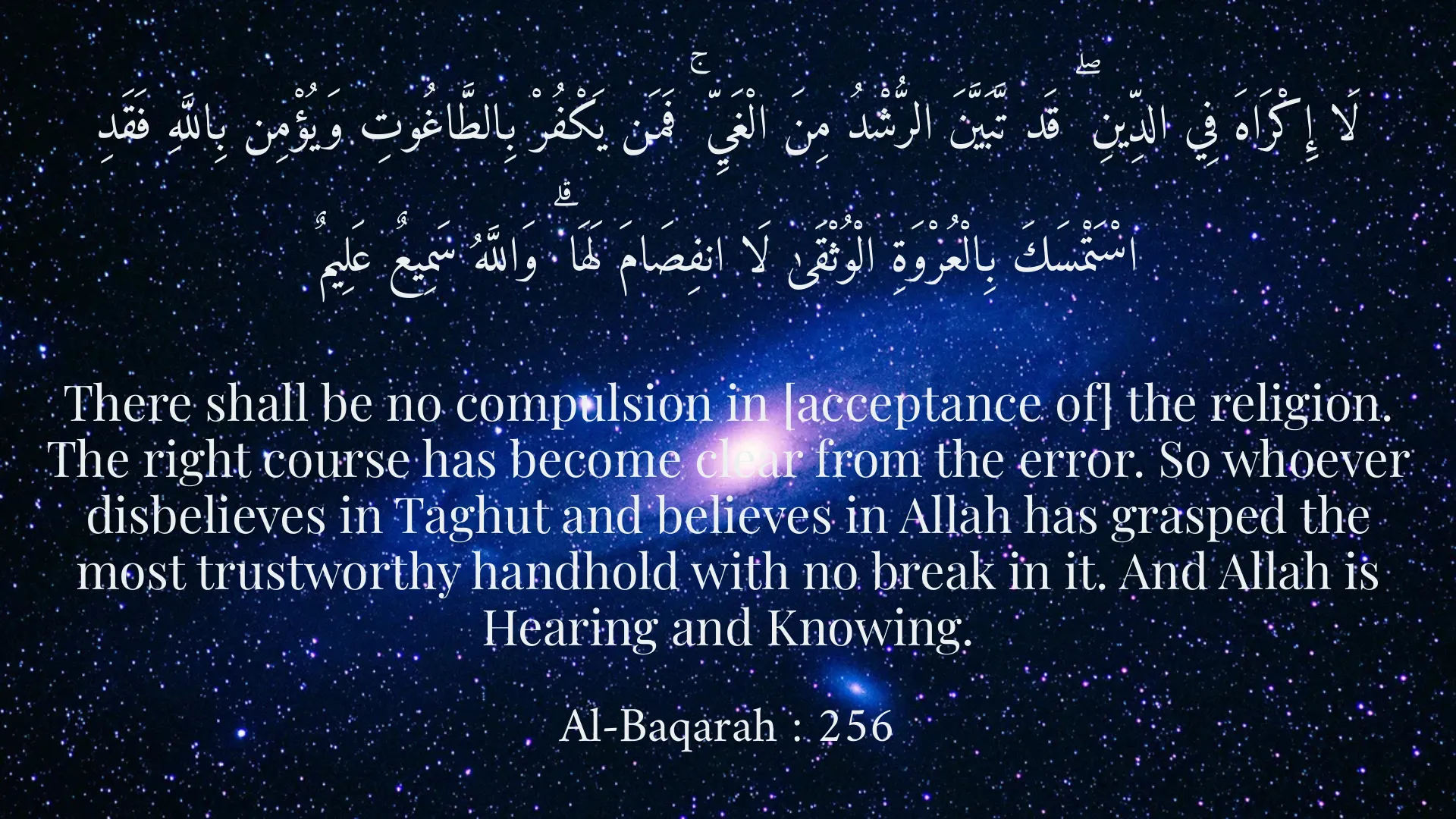
لَا إِكْرَاهَ فِي الدِّينِ ۖ قَد تَّبَيَّنَ الرُّشْدُ مِنَ الْغَيِّ ۚ فَمَن يَكْفُرْ بِالطَّاغُوتِ وَيُؤْمِن بِاللَّهِ فَقَدِ اسْتَمْسَكَ بِالْعُرْوَةِ الْوُثْقَىٰ لَا انفِصَامَ لَهَا ۗ وَاللَّهُ سَمِيعٌ عَلِيمٌ
There shall be no compulsion in [acceptance of] the religion. The right course has become clear from the error. So whoever disbelieves in Taghut and believes in Allah has grasped the most trustworthy handhold with no break in it. And Allah is Hearing and Knowing.
Al-Baqarah : 256
لَّا يَنْهَاكُمُ اللَّهُ عَنِ الَّذِينَ لَمْ يُقَاتِلُوكُمْ فِي الدِّينِ وَلَمْ يُخْرِجُوكُم مِّن دِيَارِكُمْ أَن تَبَرُّوهُمْ وَتُقْسِطُوا إِلَيْهِمْ ۚ إِنَّ اللَّهَ يُحِبُّ الْمُقْسِطِينَ
Allah does not forbid you from those who do not fight you because of religion and do not expel you from your homes - from being righteous toward them and acting justly toward them. Indeed, Allah loves those who act justly.
Al-Mumtahanah : 8
يَا أَيُّهَا النَّاسُ إِنَّا خَلَقْنَاكُم مِّن ذَكَرٍ وَأُنثَىٰ وَجَعَلْنَاكُمْ شُعُوبًا وَقَبَائِلَ لِتَعَارَفُوا ۚ إِنَّ أَكْرَمَكُمْ عِندَ اللَّهِ أَتْقَاكُمْ ۚ إِنَّ اللَّهَ عَلِيمٌ خَبِيرٌ
O mankind, indeed We have created you from male and female and made you peoples and tribes that you may know one another. Indeed, the most noble of you in the sight of Allah is the most righteous of you. Indeed, Allah is Knowing and Acquainted.
Al-Hujurat : 13
Short Story
It is narrated that during the just reign of Nushirvan, an old man from the Dhimmis (non-Muslims under the protection of the government) lived in a corner of the city. One day, he brought a complaint to the judge, stating that a Muslim neighbor had violated his rights. The judge, without any hesitation regarding the religion of either party, summoned both and listened to their words with utmost attention. Then, based on evidence and justice, he ruled in favor of the non-Muslim old man. The people were astonished by this justice and asked the judge, "How do you treat someone who is not of our faith and religion with such justice and fairness?" The judge replied: "Are we not all created from one Adam and Eve? And has not God Himself commanded us to deal justly with all people, even if they are your enemies? In the sight of God, there is no difference or superiority except by righteousness. So how can I differentiate among God's creation in administering justice?" This tale illustrates that respecting human rights and dignity, beyond any differences, is a cornerstone of faith and justice.