Quranic Answer
The Holy Quran, while not explicitly using modern terms like 'sustainability' or 'natural resource preservation,' provides a comprehensive and profound set of principles that form the foundation for a responsible and sustainable approach to the environment and natural resources. These principles not only encompass the protection of existing resources but also emphasize their wise and equitable utilization for present and future generations. In essence, the Quranic perspective on the universe is rooted in respect, gratitude, and accountability. One of the most central concepts in this regard is the notion of 'Khalifa' or human vicegerency on Earth. In Surah Al-Baqarah, verse 30, Allah states: "And when your Lord said to the angels, 'Indeed, I will make upon the earth a successive authority (Khalifa)...'" This position of vicegerency is not an absolute dominion but rather a profound responsibility and a divine trust (Amanah). As Allah's vicegerent, humanity is obligated to care for what has been entrusted to them in the best possible manner, not to destroy or corrupt it. This duty includes maintaining ecological balance, optimizing the use of water, soil, plants, and animals, and preventing pollution and environmental degradation. Another fundamental principle is the 'prohibition of corruption and mischief on Earth' (Fasad fil Ard). The Quran repeatedly forbids causing corruption on Earth. 'Fasad' encompasses a broad meaning, including any form of destruction or harm to the natural and social order. In Surah Al-A'raf, verse 56, we read: "And do not cause corruption upon the earth after its reformation..." This verse clearly states that humans should not harm the excellent order of creation that Allah has established. Deforestation, water pollution, excessive hunting, and unsustainable mining are all examples of 'Fasad fil Ard' that are condemned in the Quran. The concept of 'fasad' not only includes physically destructive acts but also extends to mismanagement and unjust exploitation of resources, which can lead to ruin and annihilation. 'The concept of Mizan (Balance and Equilibrium)' is also a cornerstone of the Quranic perspective on sustainability. In Surah Ar-Rahman, verses 7-9, Allah says: "And the heaven He raised and set the balance That you may not transgress [in] the balance And establish weight in justice and do not make the balance deficient." These verses explicitly point to the importance of maintaining the delicate balance and precise order of existence. All components of nature, from air and water to soil and living beings, exist in a subtle and complex equilibrium. Any unchecked and irregular human intervention can disrupt this balance and lead to devastating consequences. Sustainability, in this context, means preserving this balance and not transgressing natural limits. 'The avoidance of Israf and Tabdheer' (extravagance and squandering) is another crucial Quranic teaching directly related to resource preservation. In Surah Al-A'raf, verse 31, it is stated: "...And eat and drink, but be not excessive. Indeed, He likes not those who commit excess." This principle applies to all resources, whether water and food or other natural assets. 'Israf' means using anything excessively and unnecessarily, which leads to waste and depletion of resources. The Quran encourages believers to practice moderation and temperance in consumption. This perspective not only addresses the waste of food and water but also extends to the wise utilization of energy sources, raw materials, and other divine blessings. A sustainable life is one where consumption is optimized, and all forms of waste are prevented. Furthermore, the Holy Quran presents nature as 'Ayatullah' (Signs of Allah) and manifestations of His power and wisdom. Reflecting on the creation of the heavens, earth, waters, plants, and animals guides humanity toward recognizing Allah and being grateful for His blessings. This viewpoint instills a sense of respect and sanctity for nature within humans, deterring them from its destruction. When humans perceive nature as a manifestation of Allah's Names and Attributes, they would never allow themselves to harm it. This approach forms the foundation of Islamic environmental ethics, which goes beyond material benefits to address the spiritual dimension and humanity's connection with the Creator through nature. This profound understanding leads to individual and collective responsibility for the environment, considering sustainability not just a material necessity but an act of worship and a moral obligation. In conclusion, although the Quran does not use the modern terminology of 'sustainability,' it provides strong and comprehensive foundations for a sustainable environmental approach by articulating concepts such as vicegerency, prohibition of corruption, the importance of balance, and avoidance of extravagance. These teachings not only encourage environmental preservation but also consider it an inseparable part of faith and righteous deeds. The ultimate goal of these teachings is to cultivate human beings who, in their interaction with the universe, consistently uphold balance, justice, and gratitude so that both they and future generations can benefit from divine blessings, and life on Earth may continue.
Related Verses
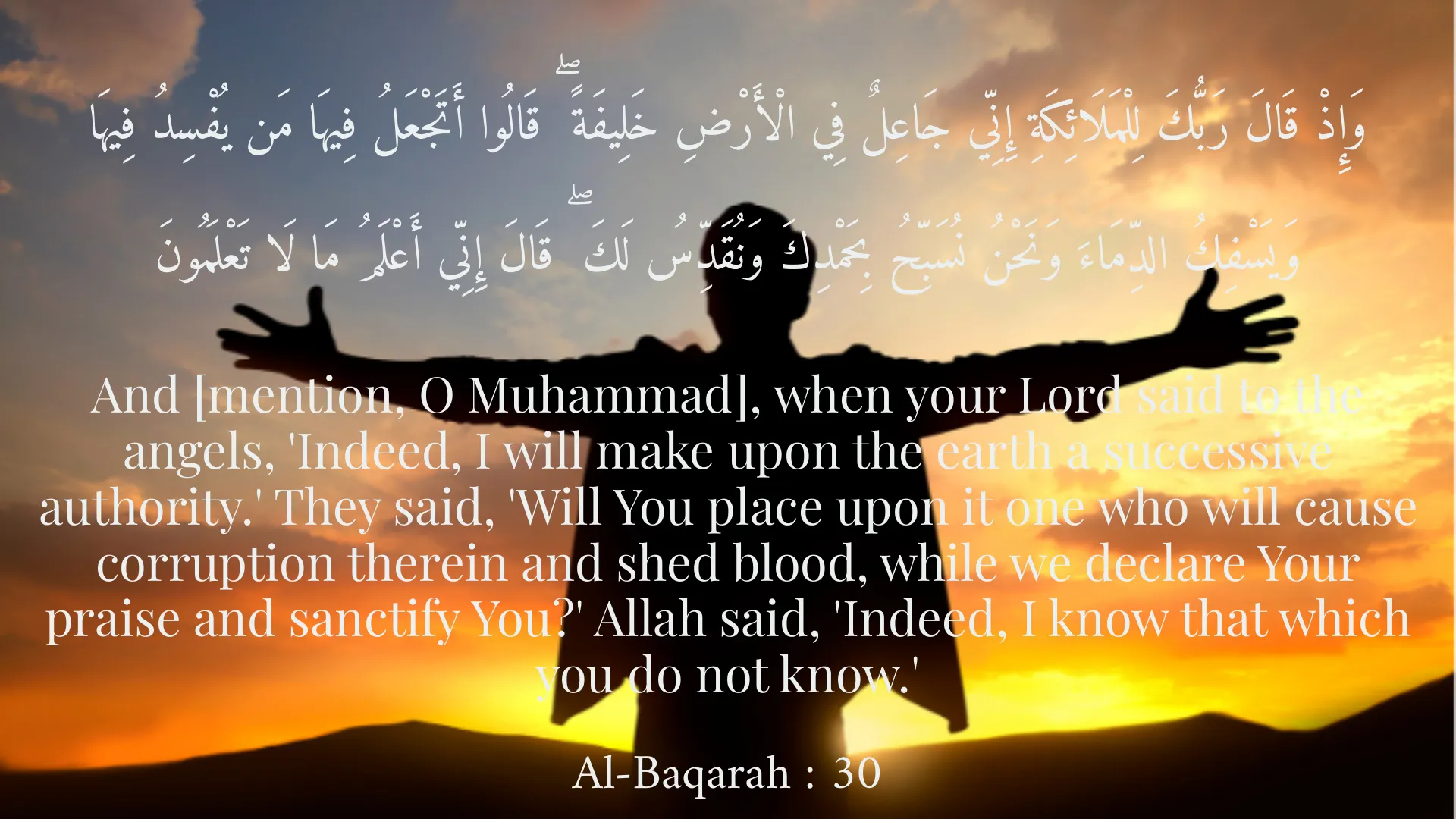
وَإِذْ قَالَ رَبُّكَ لِلْمَلَائِكَةِ إِنِّي جَاعِلٌ فِي الْأَرْضِ خَلِيفَةً ۖ قَالُوا أَتَجْعَلُ فِيهَا مَن يُفْسِدُ فِيهَا وَيَسْفِكُ الدِّمَاءَ وَنَحْنُ نُسَبِّحُ بِحَمْدِكَ وَنُقَدِّسُ لَكَ ۖ قَالَ إِنِّي أَعْلَمُ مَا لَا تَعْلَمُونَ
And [mention, O Muhammad], when your Lord said to the angels, 'Indeed, I will make upon the earth a successive authority.' They said, 'Will You place upon it one who will cause corruption therein and shed blood, while we declare Your praise and sanctify You?' Allah said, 'Indeed, I know that which you do not know.'
Al-Baqarah : 30
وَلَا تُفْسِدُوا فِي الْأَرْضِ بَعْدَ إِصْلَاحِهَا وَادْعُوهُ خَوْفًا وَطَمَعًا ۚ إِنَّ رَحْمَتَ اللَّهِ قَرِيبٌ مِّنَ الْمُحْسِنِينَ
And cause not corruption upon the earth after its reformation. And invoke Him in fear and aspiration. Indeed, the mercy of Allah is near to the doers of good.
Al-A'raf : 56
وَالسَّمَاءَ رَفَعَهَا وَوَضَعَ الْمِيزَانَ
And the heaven He raised and set the balance
Ar-Rahman : 7
أَلَّا تَطْغَوْا فِي الْمِيزَانِ
That you may not transgress [in] the balance.
Ar-Rahman : 8
وَأَقِيمُوا الْوَزْنَ بِالْقِسْطِ وَلَا تُخْسِرُوا الْمِيزَانَ
And establish weight in justice and do not make the balance deficient.
Ar-Rahman : 9
Short Story
It is narrated that in ancient times, there were two neighboring gardeners, one named Shadab (meaning 'fresh' or 'flourishing') and the other Harees (meaning 'greedy'). Shadab planted fruit trees in his garden and with his own hands, watered each tree just as much as it needed, neither a drop less nor more. Each year, he took only enough fruit for himself and a little for the needy, preserving the rest for future years. He used to say, 'This garden is a trust from God, and I must keep it healthy and fruitful for my children and their children.' But Harees was always thinking of greater profit. He indiscriminately cut down trees to quickly obtain wood, wasted large amounts of water thinking that more was better, and continuously planted without giving the soil rest or fertilizer. Initially, Harees's garden seemingly yielded more produce, but it wasn't long before his garden's soil became exhausted and dry, his trees became barren, and he had nothing left to harvest. Yet, Shadab's garden remained green and fruitful for many years, its bounty always benefiting him and generations after him. Saadi wisely said, 'A ruler's duty to his realm is to exert effort, take little, and leave much for others.' This story reminds us of the responsibility of sustainability and natural resource preservation, illustrating how wise and responsible use not only ensures present benefits but also brings forth a fruitful future, whereas greed leads only to ruin and regret.