Quranic Answer
You have asked a profoundly important question that resonates with the innate nature of every human being: 'What is the purpose of my life?' Fortunately, the Holy Quran not only provides a way to find life's purpose but explicitly defines it, outlining a comprehensive framework for a purposeful existence. Indeed, the most significant gift the divine revelation bestows upon us is this profound insight into the meaning and ultimate destination of human existence. Let us embark on this journey of discovery through divine verses to unveil the secret of purposeful living in the light of the Quran. The Quran unequivocally states that the primary purpose for the creation of humans and jinn is 'worship.' Allah Almighty declares in Surah Adh-Dhariyat, verse 56: "And I did not create the jinn and mankind except to worship Me." This verse serves as the central point for understanding the purpose of life from an Islamic perspective. But what exactly does 'worship' (Ibadah) entail? Does it merely mean performing ritual acts like prayer, fasting, and Hajj? Absolutely not. In the Quranic worldview, 'Ibadah' encompasses a much broader and more comprehensive meaning. It signifies servitude, obedience, submission, and humility before the divine will and commands. This servitude extends to all facets of human life: from individual and social relationships to professional and economic activities, even sleep and wakefulness, if performed with sincere intention and in pursuit of divine pleasure, can be considered acts of worship. Every good deed, every pursuit of knowledge, every lawful profession undertaken to serve humanity, every act of patience in the face of adversity, every expression of gratitude for blessings, and every endeavor towards personal and societal growth—all these can fall within the vast domain of worship, provided they are accompanied by awareness and the intention of serving God. The second and complementary purpose is the concept of 'divine vicegerency' (Khalifah) on Earth. In Surah Al-Baqarah, verse 30, we read: "And [mention, O Muhammad], when your Lord said to the angels, 'Indeed, I will make upon the earth a successive authority.'" This verse indicates that humans were not created merely to passively worship God; rather, they bear a significant responsibility as Allah's vicegerents or stewards on Earth. This responsibility includes cultivating the land, establishing justice, properly utilizing divine blessings, preserving the environment, guiding society towards goodness, and preventing corruption and decay. With the power of intellect, free will, and determination bestowed upon them by God, humans can be worthy representatives in manifesting divine will in the world. This vicegerency does not imply indiscriminate exploitation of resources but rather entails trustworthiness, stewardship, and responsible management. Therefore, the purpose of life in the Quran is two-fold: on one hand, a deep connection and pure servitude to the Creator of the universe, and on the other, an active and constructive role in developing and reforming the Earth as His representative. These two purposes are intricately linked; for servitude to God grants humans the insight and power to effectively fulfill their vicegerency, and vicegerency on Earth becomes the practical arena for actualizing servitude and obedience to divine commands. To achieve these purposes, the Quran provides clear paths for humanity: 1. Knowing God (Ma'rifat Allah): The first step is to know the Lord—to understand His attributes, names, power, and wisdom. This knowledge is gained through reflection on the 'Ayat al-Afaqiyyah' (signs of God in the universe) and 'Ayat al-Anfusiyyah' (signs of God within oneself). The more one comprehends divine majesty and wisdom, the deeper and more purposeful their worship becomes. 2. Faith and Piety (Iman and Taqwa): Belief in Allah and the Day of Judgment is the backbone of a purposeful life. Taqwa (piety) means refraining from sins and fulfilling divine obligations. This faith and piety serve as a guiding map for all human decisions and actions in life, keeping one on the right path. 3. Recitation and Reflection on the Quran: The Quran is a book of guidance and light. By reciting and reflecting upon its verses, one can discover divine instructions for life and delve into the depth of their purpose. Every verse is a gateway to truth and a guide to achieving perfection. 4. Righteous Deeds (Amal Salih) and Goodness (Ihsan): The Quran repeatedly emphasizes 'Amal Salih.' This encompasses every good deed performed with sincere intention and in accordance with divine pleasure. These actions benefit both the individual and society. Kindness to parents, helping the needy, establishing justice and equity, and respecting the rights of others are examples of righteous deeds that bring one closer to their ultimate purpose. 5. Patience (Sabr) and Reliance on God (Tawakkul): Human life is full of challenges and tests. Patience in the face of difficulties and reliance on God are crucial tools for maintaining steadfastness on the path of purpose. These qualities help individuals not to forget their purpose amidst life's ups and downs and to avoid straying from the path. 6. Focus on the Hereafter: The Quran clearly states that this worldly life is merely a bridge to the afterlife. The ultimate goal is to attain divine pleasure and eternal bliss in Paradise. When an individual understands that all their actions in this world will be weighed in the divine balance of justice, their life gains deeper meaning, and all their efforts are directed towards achieving that greater purpose. In conclusion, the Holy Quran not only answers the question, 'What is my purpose?' but also illuminates the path to achieving that purpose. A purposeful life from the Quranic perspective means living every breath, every action, and every moment with the remembrance of God and in the path of His servitude and vicegerency. This kind of life saves humanity from aimlessness and meaninglessness, bringing about lasting peace, contentment, and happiness that transcend fleeting worldly pleasures. To fulfill this purpose, one needs to continuously strive for self-improvement, strengthen their connection with Allah, and always work towards serving themselves, their family, society, and the environment. This is a dynamic and continuous journey that extends until the last moments of life, and with every small step, one draws closer to their ultimate destination. Therefore, if you are seeking your life's purpose, the Holy Quran is an unparalleled guide that will lead you to it.
Related Verses
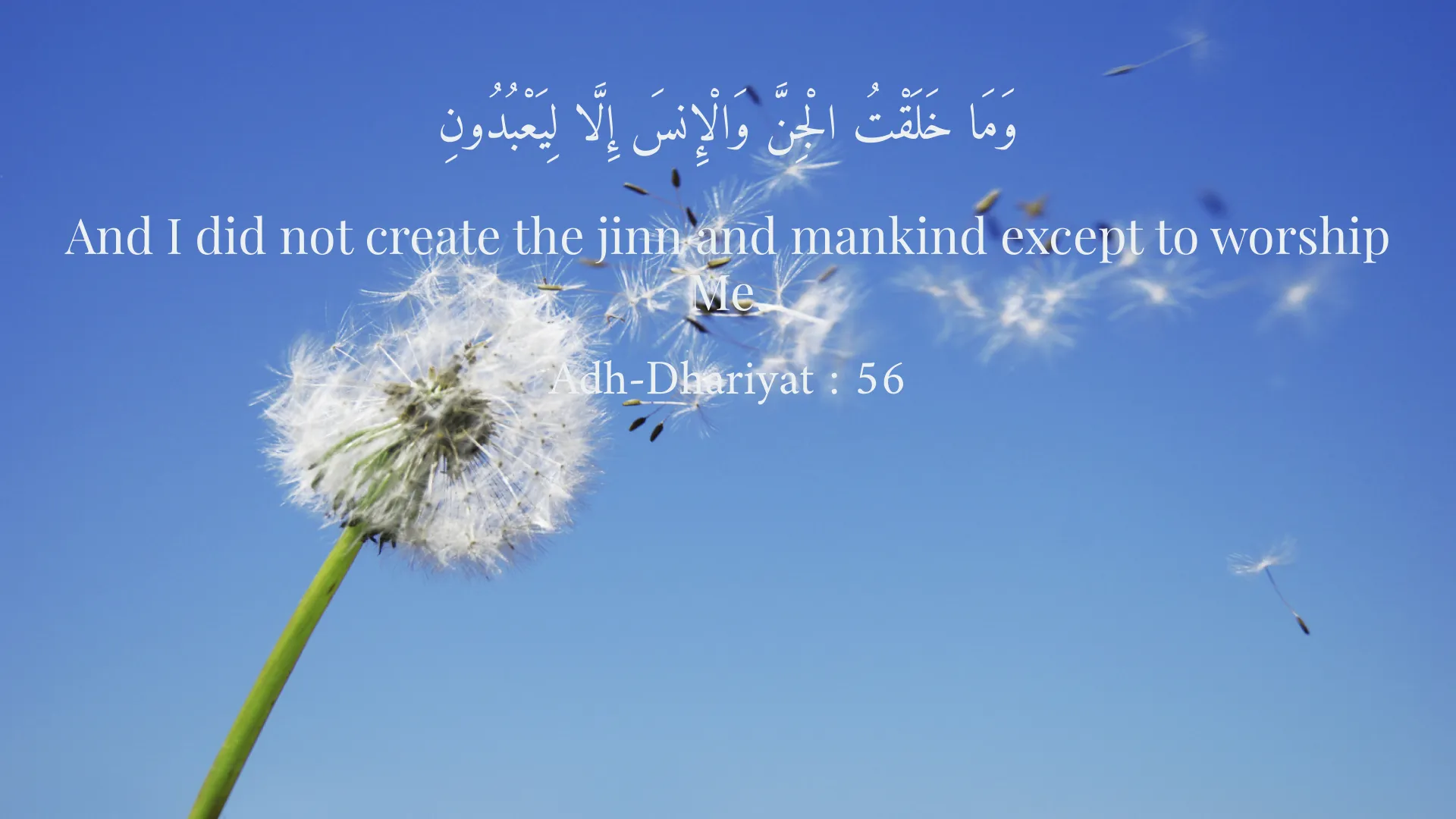
وَمَا خَلَقْتُ الْجِنَّ وَالْإِنسَ إِلَّا لِيَعْبُدُونِ
And I did not create the jinn and mankind except to worship Me.
Adh-Dhariyat : 56
وَإِذْ قَالَ رَبُّكَ لِلْمَلَائِكَةِ إِنِّي جَاعِلٌ فِي الْأَرْضِ خَلِيفَةً ۖ قَالُوا أَتَجْعَلُ فِيهَا مَن يُفْسِدُ فِيهَا وَيَسْفِكُ الدِّمَاءَ وَنَحْنُ نُسَبِّحُ بِحَمْدِكَ وَنُقَدِّسُ لَكَ ۖ قَالَ إِنِّي أَعْلَمُ مَا لَا تَعْلَمُونَ
And [mention, O Muhammad], when your Lord said to the angels, "Indeed, I will make upon the earth a successive authority." They said, "Will You place upon it one who will cause corruption therein and shed blood, while we declare Your praise and sanctify You?" Allah said, "Indeed, I know that which you do not know."
Al-Baqarah : 30
قُلْ إِنَّ صَلَاتِي وَنُسُكِي وَمَحْيَايَ وَمَمَاتِي لِلَّهِ رَبِّ الْعَالَمِينَ
Say, 'Indeed, my prayer, my rites of sacrifice, my living and my dying are for Allah, Lord of the worlds.'
Al-An'am : 162
Short Story
It is narrated that a certain king was walking in a lush garden, full of flowers and verdant trees, enjoying the beauties of the world. In the same garden, he saw a simple-hearted dervish sitting under the shade of a tree, engaged in remembrance and prayer. The king, with arrogance, approached him and said, "O dervish, what do you possess in this world? What meaning does your life hold?" The dervish, with a calm smile, replied: "O king, everyone who sees me asks, 'What do you possess?' But I ask myself, 'What will you take with you?' What I possess is peace of heart, which comes from the remembrance of God, and my purpose is His pleasure; every action I perform is a step towards Him. But you, with all this grandeur, what will you carry with you to the next abode?" The king paused for a moment and fell into deep thought. The dervish's words settled upon his heart like a cool breeze, reminding him that the true purpose of life transcends the accumulation of worldly wealth and power; rather, it lies in servitude and moving towards perfection and divine knowledge. He understood that the dervish, despite lacking worldly possessions, had a greater purpose and had attained true tranquility.