Quranic Answer
While the precise term “positive solitude” or “constructive seclusion” is not explicitly used in the Holy Quran, the concept and the profound value of engaging in periods of isolation and retreat for contemplation, worship, self-purification, and a deeper connection with the Almighty are clearly evident in Quranic teachings and the narratives of the prophets mentioned within its verses. The Quran implicitly, through illustrative examples from the lives of divine messengers and righteous individuals, elucidates the significance of such intentional seclusion. One of the most striking examples is the story of Prophet Moses (peace be upon him), who secluded himself for forty nights on Mount Sinai to receive divine revelation and the Torah. This prolonged period of detachment from people and complete focus on God underscores the supreme value of solitude in preparing the soul and receiving divine grace. As stated in Surah Al-A'raf, verse 142: “And We made an appointment with Moses for thirty nights and completed them with ten [more], so the appointed time of his Lord was completed as forty nights. And Moses said to his brother Aaron, 'Take my place among my people, do right, and do not follow the way of the corrupters.'” This verse clearly indicates that this seclusion was not merely an avoidance of people, but a spiritual and physical preparation for receiving divine discourse. In this solitude, Moses (PBUH) was able to attain the pinnacle of proximity to God and converse with his Lord. This event demonstrates that solitude can pave the way for magnificent divine manifestations and unparalleled spiritual elevation; it allowed him to shed worldly distractions and fully immerse himself in the divine presence, making his heart and mind receptive to the sacred words and profound revelations. Another powerful illustration comes from the narrative of Virgin Mary (peace be upon her). During her pregnancy, she withdrew from her family and sought refuge in a secluded place, away from public view, to engage in peaceful worship and supplication. Surah Maryam, verses 16-17, narrates: “And mention in the Book [the story of] Mary, when she withdrew from her family to a place toward the east. And she took in seclusion a screen apart from them; then We sent to her Our Spirit, and he appeared to her as a [perfectly] normal man.” This withdrawal provided the perfect environment for her to receive divine glad tidings and the miraculous event of Prophet Jesus's (PBUH) birth. This example also illustrates that purposeful seclusion can be a fertile ground for spiritual growth and the reception of unseen divine guidance. Mary's solitude was not born out of blameworthy reclusiveness but out of chastity and a profound desire to focus on her connection with God, preparing her for the monumental divine decree and the extraordinary spiritual experience. The Quran also alludes to “I'tikaf” (seclusion in a mosque for worship), a form of spiritual retreat. In this practice, believers temporarily withdraw from daily activities and dedicate themselves entirely to prayer, supplication, Quranic recitation, and contemplation. Surah Al-Baqarah, verse 125, mentions: “And [mention, O Muhammad], when We made the House a place of return for the people and [a place of] security. And take, [O believers], from the standing place of Abraham a place of prayer. And We charged Abraham and Ishmael, [saying], 'Purify My House for those who perform Tawaf and those who are staying [for worship] and those who bow and prostrate.'” This tradition emphasizes the importance of detaching from worldly attachments and focusing on the spiritual realm for purifying the soul and strengthening faith. I'tikaf symbolizes a communal solitude within a sacred space, aimed at returning to one's innate disposition (fitra) and deepening the connection with the Creator, providing a unique environment for introspection, spiritual discipline, and intense devotion. Beyond these specific examples, the Quran repeatedly encourages humanity to reflect (tafakkur), ponder deeply on divine signs (tadabbur) – both in the cosmos and within themselves – and engage in abundant remembrance (dhikr) of God. While these intellectual and spiritual activities can certainly occur in gatherings, they often achieve greater depth and impact in solitude and tranquility. When an individual contemplates the creation of the heavens and the earth in solitude, or delves into the intricacies of their own existence, they can gain a more profound understanding of God's majesty and enhance their knowledge and wisdom. This type of “positive solitude” offers an invaluable opportunity to hear the inner voice and divine inspirations that are often overlooked amidst the clamor of daily life. It allows for a state of deep focus where the mind can transcend mundane concerns and reach higher levels of spiritual awareness and clarity. The importance of such periods of seclusion for nurturing the soul and elevating the spirit is undeniable. In today's world, filled with noise, overwhelming information, and constant stimuli, the need for space to “re-evaluate” and “re-energize” spiritually is more pressing than ever. The Quran, by providing these models and encouraging contemplation and remembrance, guides us on how to dedicate moments for connecting with our true selves and the source of existence amidst a busy life. It is in these quiet moments that one can truly listen to the whispers of the soul and the call of the divine, fostering a sense of peace and purpose. It is crucial to understand that these periods of solitude do not imply abandoning the world or perpetual withdrawal from society. On the contrary, they signify creating a vital balance between social life and individual spiritual needs. Islam condemns monasticism and absolute reclusiveness, emphasizing active participation in society and fulfilling social responsibilities. However, it simultaneously deems moments of solitude essential for nourishing the soul and strengthening faith. The purpose of these retreats is to enhance insight, increase patience, better understand oneself, and ultimately, achieve the peace and tranquility (sakinah) that can only be attained through a profound connection with God. This solitude is an opportunity to purify the soul from material impurities and achieve mental and spiritual clarity. In this state, one can confront their true self, evaluate their actions and thoughts, and discern the true path forward for spiritual growth and self-improvement. In essence, while the Quran does not employ the exact phrase “positive solitude,” it unequivocally affirms the importance and value of purposeful seclusion for spiritual growth, fostering a deep connection with God, and self-purification, through inspiring examples of prophets and encouraging practices like I'tikaf, contemplation, and remembrance. This type of solitude is not an isolation from society but a powerful tool to empower the individual to return to it stronger and more effective. It extends beyond mere physical detachment; it signifies a complete presence of the heart before the Divine and an immersion in the ocean of divine knowledge. It is an opportunity for humanity to connect with its divine nature and inner voice without external disturbances. This solitude is a source of tranquility and strength that prepares an individual to face life's challenges and aids them on their journey toward salvation and divine pleasure. Indeed, this form of solitude is a spiritual strategy for rejuvenation and strengthening faith against worldly temptations and pressures, leading to true prosperity in this life and the Hereafter.
Related Verses
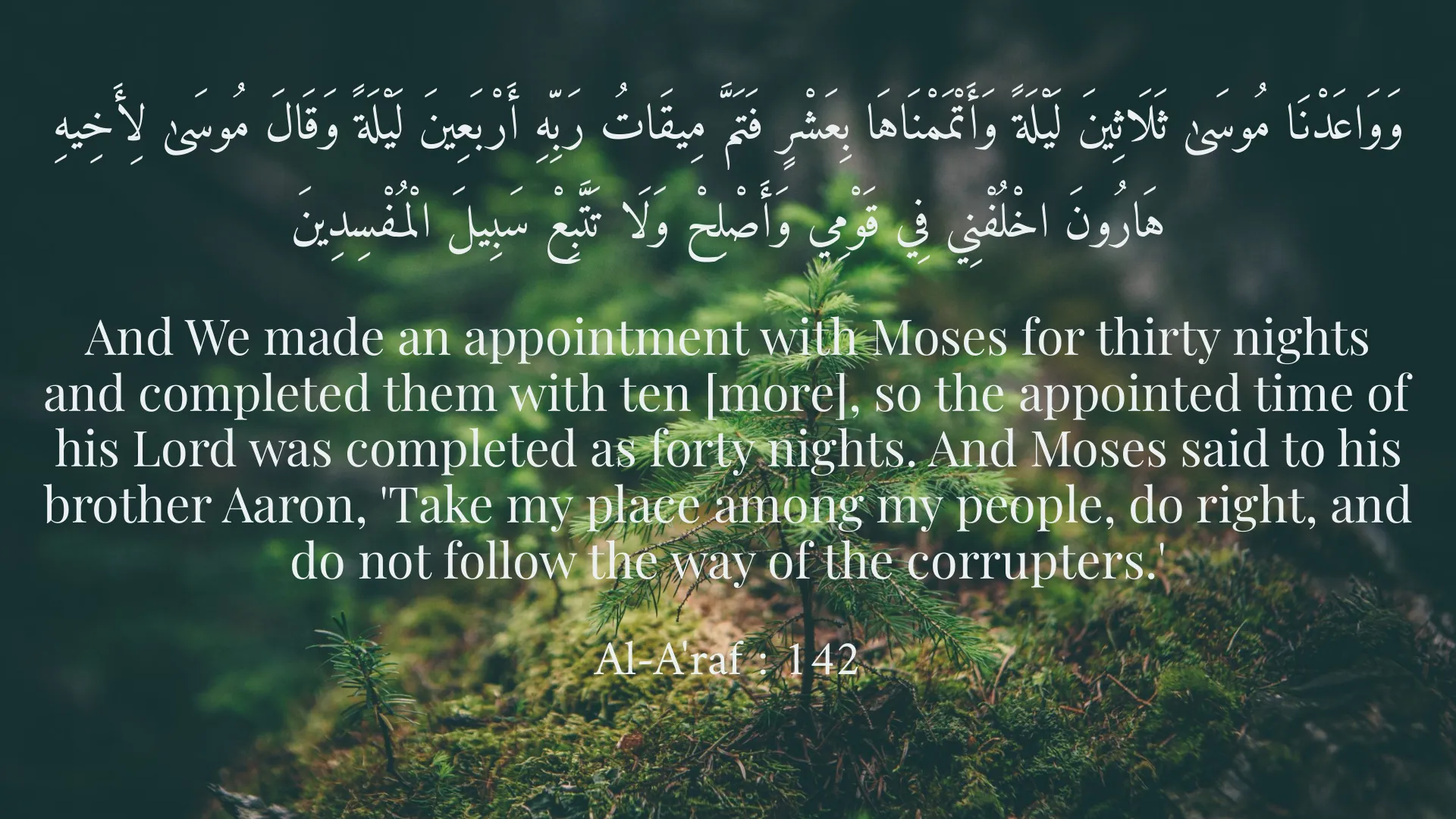
وَوَاعَدْنَا مُوسَىٰ ثَلَاثِينَ لَيْلَةً وَأَتْمَمْنَاهَا بِعَشْرٍ فَتَمَّ مِيقَاتُ رَبِّهِ أَرْبَعِينَ لَيْلَةً وَقَالَ مُوسَىٰ لِأَخِيهِ هَارُونَ اخْلُفْنِي فِي قَوْمِي وَأَصْلِحْ وَلَا تَتَّبِعْ سَبِيلَ الْمُفْسِدِينَ
And We made an appointment with Moses for thirty nights and completed them with ten [more], so the appointed time of his Lord was completed as forty nights. And Moses said to his brother Aaron, 'Take my place among my people, do right, and do not follow the way of the corrupters.'
Al-A'raf : 142
وَاذْكُرْ فِي الْكِتَابِ مَرْيَمَ إِذِ انْتَبَذَتْ مِنْ أَهْلِهَا مَكَانًا شَرْقِيًّا
And mention in the Book [the story of] Mary, when she withdrew from her family to a place toward the east.
Maryam : 16
فَاتَّخَذَتْ مِنْ دُونِهِمْ حِجَابًا فَأَرْسَلْنَا إِلَيْهَا رُوحَنَا فَتَمَثَّلَ لَهَا بَشَرًا سَوِيًّا
And she took in seclusion a screen apart from them; then We sent to her Our Spirit, and he appeared to her as a [perfectly] normal man.
Maryam : 17
وَإِذْ جَعَلْنَا الْبَيْتَ مَثَابَةً لِّلنَّاسِ وَأَمْنًا وَاتَّخِذُوا مِن مَّقَامِ إِبْرَاهِيمَ مُصَلًّى ۖ وَعَهِدْنَا إِلَىٰ إِبْرَاهِيمَ وَإِسْمَاعِيلَ أَن طَهِّرَا بَيْتِيَ لِلطَّائِفِينَ وَالْعَاكِفِينَ وَالرُّكَّعِ السُّجُودِ
And [mention, O Muhammad], when We made the House a place of return for the people and [a place of] security. And take, [O believers], from the standing place of Abraham a place of prayer. And We charged Abraham and Ishmael, [saying], 'Purify My House for those who perform Tawaf and those who are staying [for worship] and those who bow and prostrate.'
Al-Baqarah : 125
Short Story
In ancient times, there lived a merchant who had grown weary of the clamor of the marketplace and the struggles of the world. He possessed immense wealth, yet peace eluded his heart. One day, he heard of an ascetic who lived in seclusion in a distant mountain, occupied solely with the remembrance of God and contemplation of divine signs. The merchant thought to himself, 'Perhaps there lies the cure for my ailment.' So he embarked on a journey, and after much hardship, reached the humble hut of the ascetic. The ascetic welcomed him warmly. The merchant complained of his restless heart and troubled mind. The ascetic smiled and said, 'O good man, the heart is like a mirror upon which the dust of the world settles. If you wish it to be clear, you must occasionally remove it from the clamor of the market and polish it in solitude. Every morning and evening, in this solitude, I gaze into the mirror of my heart, wiping away the dust, and find peace in the divine light.' The merchant stayed in that secluded place for a few days, kept company with the ascetic, and engaged in remembrance and contemplation himself. In this solitude, his heart found peace and became clear. He returned to the marketplace, but he was no longer the same merchant. He had found an inner tranquility that no wealth could buy. He realized that 'positive solitude' is an opportunity to find oneself and connect with the Creator, not an escape from the world.