Quranic Answer
While the Quran does not explicitly mention the term 'Fear of Missing Out' or 'FOMO,' it profoundly addresses the underlying psychological and spiritual roots of this modern anxiety. FOMO primarily stems from comparing oneself to others, excessive attachment to worldly possessions and ephemeral opportunities, and a lack of trust in divine decree. The Quran, through its comprehensive worldview concerning this life (dunya) and the afterlife (akhirah), the human being's place, and God's absolute power, offers profound remedies for achieving inner peace and liberation from these fears. One of the most significant Quranic responses to this pervasive anxiety is its emphasis on the transient and fleeting nature of worldly life. In numerous verses, this world is described as mere play, amusement, and a temporary provision. For instance, in Surah Al-Hadid, verse 20, Allah states: "Know that the life of this world is only play and amusement, pomp and mutual boasting in rivalry for wealth and children. It is like a rain whose growth pleases the tillers; then it withers and you see it turning yellow; then it becomes scattered pieces. And in the Hereafter is a severe punishment and forgiveness from Allah and [His] approval. And what is the life of this world except the enjoyment of delusion." This verse clearly illustrates that attachment to worldly glitter and comparing one's possessions and successes with others is nothing but delusion and distraction. This perspective helps individuals understand the true value of worldly opportunities and frees them from the fear of losing them, as they realize that such opportunities, however grand they may seem, are ultimately transient and worthless when compared to what awaits them in the Hereafter. Furthermore, the Quran strongly emphasizes the importance of focusing on the Hereafter and the enduring divine rewards. In Surah Al-A'la, verses 16 and 17, Allah says: "But you prefer the worldly life, while the Hereafter is better and more enduring." This verse provides a practical guide for combating FOMO; when one's mind and heart are directed towards what is lasting and eternal—namely, divine rewards and His pleasure—then the perceived 'missed opportunities' in this world lose their significance. The primary concern of a believer is to utilize the opportunities of this life to gain Allah's pleasure and accumulate provisions for the Hereafter, rather than fearing the loss of fleeting worldly moments. This paradigm shift eliminates the anxiety arising from FOMO, as the criterion for success transitions from external, comparative achievements to internal, divine satisfaction. It cultivates a sense of purpose beyond material gain, directing one's energy towards deeds that truly matter and have lasting value, far surpassing any temporary worldly 'gain' that could be missed. Another fundamental Quranic antidote to FOMO is the concept of 'Tawakkul' (trust in Allah). Tawakkul signifies complete reliance on Allah's planning and provision. A believer understands that their sustenance and destiny are in Allah's hands, and what is decreed for them will reach them, and what is not decreed will pass them by. This profound belief eradicates the roots of fear and anxiety about missing opportunities. In Surah At-Talaq, verse 3, it is stated: "And whoever relies upon Allah, then He is sufficient for him. Indeed, Allah will accomplish His purpose. Allah has already set for everything a [decreed] extent." This verse offers deep reassurance that if one fulfills their duties sincerely and trusts in Allah, no good opportunity destined for them will ever be missed. This reliance on Allah enables individuals to find contentment in what Allah has bestowed upon them, instead of regretting what they do not have, thereby living in peace and serenity. This trust instills a sense of security, knowing that one's fate is in the best hands, reducing the need to frantically chase every perceived opportunity out of fear of deprivation. The concept of 'Qana'ah' (contentment) is another crucial aspect of Quranic teachings that directly counteracts FOMO. Qana'ah implies being satisfied with what one possesses and refraining from greed and covetousness towards what others have. The Quran warns believers against gazing enviously at others' wealth and being excessively greedy for worldly accumulation. In Surah At-Takathur, verses 1 and 2, it directly addresses the rivalry and boasting in increasing wealth and children: "Competition in worldly increase diverts you, until you visit the graves." This competitive and excessive desire, which is a clear manifestation of the FOMO mindset, distracts individuals from the true purpose of life and from focusing on more significant matters, keeping them preoccupied until death. The Quran advises people to look at what they have and be grateful, instead of comparing themselves to others and feeling inadequate. This approach liberates individuals from anxieties stemming from missing material opportunities and guides them towards inner peace and acceptance of divine decree. Qana'ah allows a person to focus on what they have and on true opportunities for spiritual growth and serving humanity, rather than constantly chasing what they might lose. In essence, the Quran teaches that true opportunities are spiritual opportunities, opportunities to serve others, and opportunities to draw closer to Allah, which have lasting value, unlike transient material opportunities that quickly fade and hold no value for the Hereafter. Ultimately, the Quran teaches believers to focus on righteous deeds and what is in the path of Allah's pleasure, as these are the true and lasting investments. The fear of missing out often leads to hasty decisions, greed, and restlessness, all of which contradict the Quran's calming and wise teachings. Therefore, by adopting the Quranic worldview that perceives this world as a passage and the Hereafter as the ultimate destination, emphasizing reliance on Allah (Tawakkul), contentment (Qana'ah), and acceptance of divine decree, one can overcome the anxieties of FOMO and experience a more purposeful and peaceful life.
Related Verses
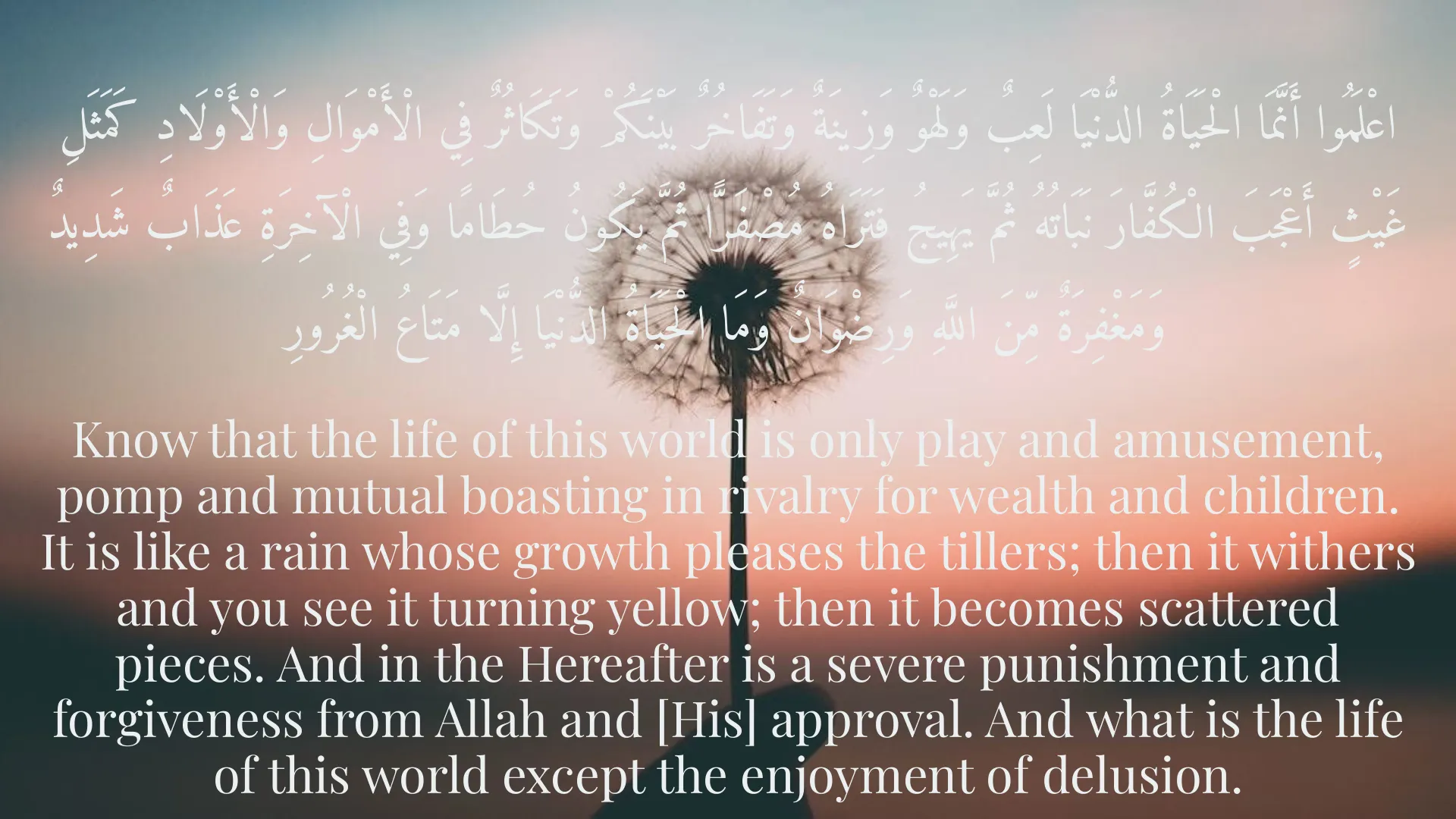
اعْلَمُوا أَنَّمَا الْحَيَاةُ الدُّنْيَا لَعِبٌ وَلَهْوٌ وَزِينَةٌ وَتَفَاخُرٌ بَيْنَكُمْ وَتَكَاثُرٌ فِي الْأَمْوَالِ وَالْأَوْلَادِ كَمَثَلِ غَيْثٍ أَعْجَبَ الْكُفَّارَ نَبَاتُهُ ثُمَّ يَهِيجُ فَتَرَاهُ مُصْفَرًّا ثُمَّ يَكُونُ حُطَامًا وَفِي الْآخِرَةِ عَذَابٌ شَدِيدٌ وَمَغْفِرَةٌ مِّنَ اللَّهِ وَرِضْوَانٌ وَمَا الْحَيَاةُ الدُّنْيَا إِلَّا مَتَاعُ الْغُرُورِ
Know that the life of this world is only play and amusement, pomp and mutual boasting in rivalry for wealth and children. It is like a rain whose growth pleases the tillers; then it withers and you see it turning yellow; then it becomes scattered pieces. And in the Hereafter is a severe punishment and forgiveness from Allah and [His] approval. And what is the life of this world except the enjoyment of delusion.
Al-Hadid : 20
بَلْ تُؤْثِرُونَ الْحَيَاةَ الدُّنْيَا
But you prefer the worldly life,
Al-A'la : 16
وَالْآخِرَةُ خَيْرٌ وَأَبْقَىٰ
while the Hereafter is better and more enduring.
Al-A'la : 17
وَمَن يَتَوَكَّلْ عَلَى اللَّهِ فَهُوَ حَسْبُهُ ۚ إِنَّ اللَّهَ بَالِغُ أَمْرِهِ ۚ قَدْ جَعَلَ اللَّهُ لِكُلِّ شَيْءٍ قَدْرًا
And whoever relies upon Allah, then He is sufficient for him. Indeed, Allah will accomplish His purpose. Allah has already set for everything a [decreed] extent.
At-Talaq : 3
أَلْهَاكُمُ التَّكَاثُرُ
Competition in worldly increase diverts you,
At-Takathur : 1
حَتَّىٰ زُرْتُمُ الْمَقَابِرَ
until you visit the graves.
At-Takathur : 2
Short Story
I heard that one day, a wealthy king would lay his head down at night with a troubled and sorrowful heart, fearing the loss of his kingdom and wealth. Yet, near his palace lived a simple dervish who, with a piece of dry bread and pure water, would fall asleep with exemplary tranquility. The king learned of the dervish's state and summoned him, saying: 'O dervish, with all this wealth and power, I have no peace for a moment, fearing its demise. How is it that with such poverty, you are so tranquil?' The dervish smiled and replied: 'O King, the fear of losing what you possess has made you restless, but I have nothing to fear losing. My peace lies in being independent of this world and knowing that what is destined for me will never depart. If you are content with what you have and trust in the Almighty's plan, neither the fear of missing out on worldly opportunities will trouble you, nor will regret for what others possess.' The king learned a wise lesson from these words and his heart found some peace.