Quranic Answer
Yes, the Holy Quran explicitly and emphatically speaks about the preservation and upholding of human dignity in all circumstances and for all individuals, regardless of race, gender, creed, or social status. This is one of the fundamental pillars of the Quranic worldview and is addressed in numerous verses across various dimensions. The foundation of human dignity in the Quran stems from the unique creation of humanity. Allah Almighty created humans with His own hands, breathed His spirit into them, commanded the angels to prostrate before them, and appointed them as His vicegerents on Earth. These concepts bestow a special status upon humanity in the cosmic order, distinguishing them from other creations. In Surah Al-Isra, verse 70, Allah says: "And We have certainly honored the children of Adam and carried them on the land and sea and provided them with good things and preferred them over much of what We have created, with [definite] preference." This verse clearly indicates the inherent dignity granted by Allah to all descendants of Adam. This divinely bestowed dignity forms the basis of all human rights and responsibilities, and no one has the right to abrogate or violate it. To preserve this inherent dignity, the Quran provides numerous practical instructions and teachings that encompass individual, social, economic, and even military dimensions. In the social sphere, the Quran emphasizes the principle of equality among human beings. In Surah Al-Hujurat, verse 13, it states: "O mankind, indeed We have created you from male and female and made you peoples and tribes that you may know one another. Indeed, the most noble of you in the sight of Allah is the most righteous of you. Indeed, Allah is Knowing and Acquainted." This verse negates any form of superiority based on race, color, wealth, or social position, establishing piety as the sole criterion for distinction. This principle is the cornerstone of a just and dignified society where every individual, regardless of superficial differences, is treated with respect and appreciation. Furthermore, the Quran vehemently condemns any form of humiliation, mockery, backbiting, and suspicion. In Surah Al-Hujurat, verses 11 and 12, it is stated: "O you who have believed, let not a people ridicule [another] people; perhaps they may be better than them; nor let women ridicule [other] women; perhaps they may be better than them. And do not insult one another and do not call each other by [offensive] nicknames. Wretched is the name of disobedience after [one's] faith. And whoever does not repent - then it is those who are the wrongdoers. O you who have believed, avoid much [negative] assumption. Indeed, some assumption is sin. And do not spy or backbite one another. Would one of you like to eat the flesh of his brother when dead? You would abhor it. And fear Allah; indeed, Allah is Accepting of repentance and Merciful." These verses strongly prohibit social behaviors that undermine human dignity. Even in challenging circumstances such as war, captivity, and poverty, the Quran emphasizes the preservation of human dignity. Regarding prisoners of war, Islam mandates upholding their rights, feeding them, and treating them with kindness. In Surah Ad-Dahr, verse 8, Allah says: "And they give food in spite of love for it to the needy, the orphan, and the captive." This statement not only refers to providing basic needs but also emphasizes feeding them with love and attention to their dignity. Moreover, the Quran stresses the necessity of absolute justice in all circumstances, even towards enemies. In Surah Al-Ma'idah, verse 8, we read: "O you who have believed, be persistently [upholders of] justice, witnesses for Allah, even if it be against yourselves or parents and relatives. And let not the hatred of a people prevent you from being just. Be just; that is nearer to righteousness. And fear Allah; indeed, Allah is Acquainted with what you do." This verse indicates that even hatred towards a people should not prevent the execution of justice and the preservation of their human dignity. Finally, the Quran also refers to freedom of belief and no compulsion in religion, which itself is one of the highest levels of respect for human dignity. Verse 256 of Surah Al-Baqarah, "There shall be no compulsion in [acceptance of] the religion," clearly states this principle. These are just some examples of the Quran's emphasis on human dignity in all aspects of life and under all circumstances. This dignity is both an inherent right and a moral duty that believers must always uphold and protect.
Related Verses
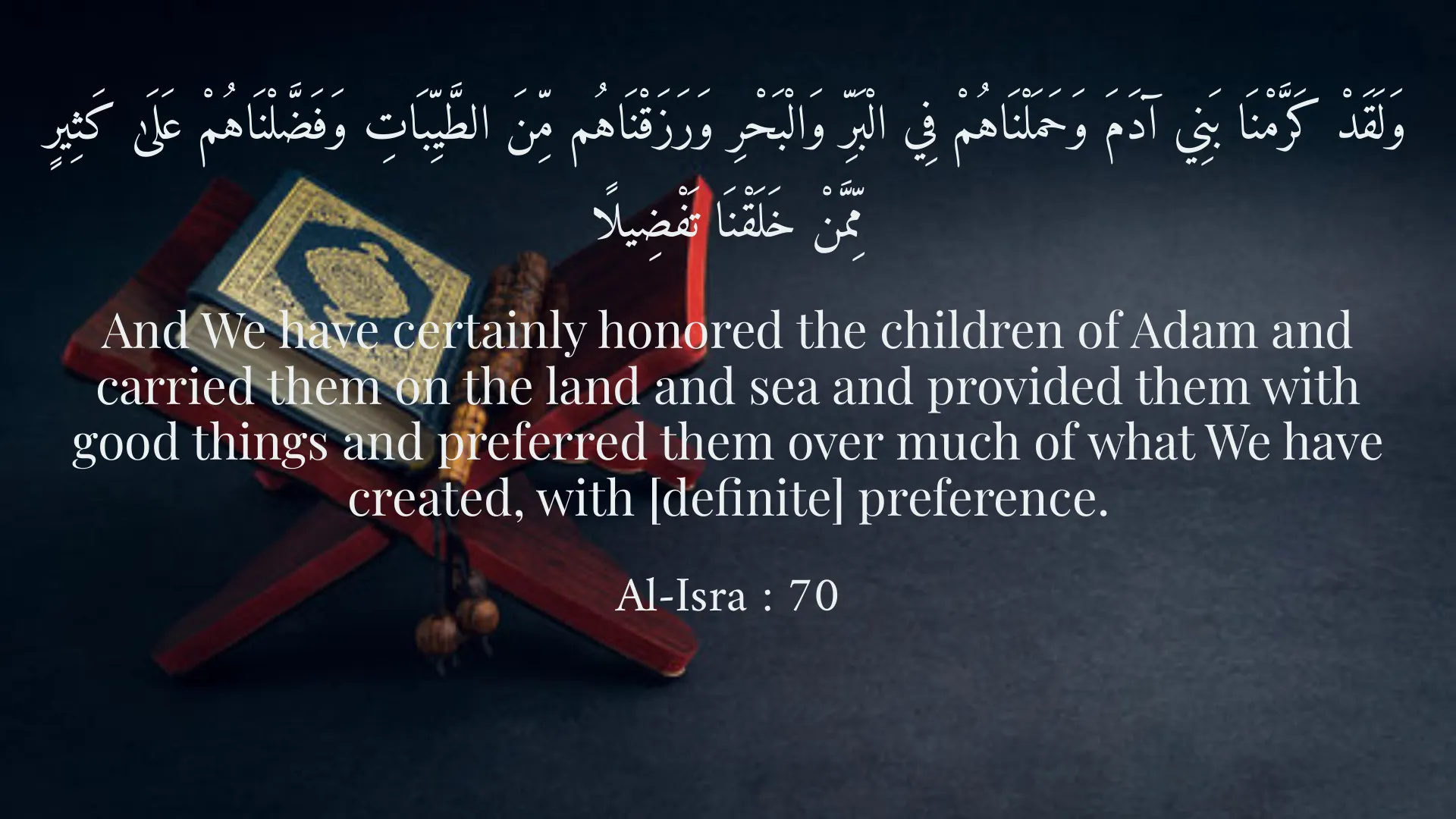
وَلَقَدْ كَرَّمْنَا بَنِي آدَمَ وَحَمَلْنَاهُمْ فِي الْبَرِّ وَالْبَحْرِ وَرَزَقْنَاهُم مِّنَ الطَّيِّبَاتِ وَفَضَّلْنَاهُمْ عَلَىٰ كَثِيرٍ مِّمَّنْ خَلَقْنَا تَفْضِيلًا
And We have certainly honored the children of Adam and carried them on the land and sea and provided them with good things and preferred them over much of what We have created, with [definite] preference.
Al-Isra : 70
يَا أَيُّهَا النَّاسُ إِنَّا خَلَقْنَاكُم مِّن ذَكَرٍ وَأُنثَىٰ وَجَعَلْنَاكُمْ شُعُوبًا وَقَبَائِلَ لِتَعَارَفُوا ۚ إِنَّ أَكْرَمَكُمْ عِندَ اللَّهِ أَتْقَاكُمْ ۚ إِنَّ اللَّهَ عَلِيمٌ خَبِيرٌ
O mankind, indeed We have created you from male and female and made you peoples and tribes that you may know one another. Indeed, the most noble of you in the sight of Allah is the most righteous of you. Indeed, Allah is Knowing and Acquainted.
Al-Hujurat : 13
يَا أَيُّهَا الَّذِينَ آمَنُوا لَا يَسْخَرْ قَوْمٌ مِّن قَوْمٍ عَسَىٰ أَن يَكُونُوا خَيْرًا مِّنْهُمْ وَلَا نِسَاءٌ مِّن نِّسَاءٍ عَسَىٰ أَن يَكُنَّ خَيْرًا مِّنْهُنَّ ۖ وَلَا تَلْمِزُوا أَنفُسَكُمْ وَلَا تَنَابَزُوا بِالْأَلْقَابِ ۖ بِئْسَ الِاسْمُ الْفُسُوقُ بَعْدَ الْإِيمَانِ ۚ وَمَن لَّمْ يَتُبْ فَأُولَٰئِكَ هُمُ الظَّالِمُونَ
O you who have believed, let not a people ridicule [another] people; perhaps they may be better than them; nor let women ridicule [other] women; perhaps they may be better than them. And do not insult one another and do not call each other by [offensive] nicknames. Wretched is the name of disobedience after [one's] faith. And whoever does not repent - then it is those who are the wrongdoers.
Al-Hujurat : 11
Short Story
It is said that one day a great king was seated on his royal carpet, surrounded by nobles, ministers, and dignitaries. In came an old man, disheveled and weary, whose tattered clothes spoke of his poverty. He wished to ask the king for a favor. One of the courtiers looked at him with arrogance and disdain, and in a loud voice, said: "Old man, how dare you appear before the king in such a state? This is a place of high standing, and who are you?" The old man, with tranquility and a smile, replied: "I am also a human, from the lineage of Adam, and these tattered clothes do not reflect a tattered inner self. If kingship demands only fine attire, then human dignity is not in one's garment, but in one's essence." The king, astonished by the wise words of the old man, became agitated and told the courtier: "Be silent! Have you not heard that God has honored the children of Adam? Dignity is in one's essence, not in clothing or status. This old man, with his humble appearance, possesses a great spirit of which you are unaware." Then, he respectfully welcomed the old man, granted his request, and taught his courtiers that appearance is never the measure of people, and one must always uphold the dignity of everyone in all circumstances.