Quranic Answer
The Holy Quran, as a comprehensive guide for human life, not only addresses the individual and spiritual dimensions of human existence but also meticulously defines the foundations of a virtuous and responsible society. The concept of "collective responsibility" is deeply interwoven into the fabric of Quranic teachings, explicitly and subtly emphasizing mutual assistance, cooperation, enjoining good and forbidding evil, and social unity. This holistic perspective guides Muslims not only towards individual perfection but also towards building a just, compassionate, and progressive society. Indeed, the mission of Islam is not merely the individual establishment of religion but also its establishment within the social context, ensuring prosperity and justice for all members of society. This demonstrates that the Quran views Islam as a social religion, defining the well-being of society as a shared responsibility of all its members. One of the most crucial verses regarding collective responsibility is Surah Al-Ma'idah, verse 2, which states: "And cooperate in righteousness and piety, but do not cooperate in sin and aggression." This verse presents a fundamental and overarching principle for the social interactions of believers. "Birr" (righteousness) is a broad concept encompassing all forms of goodness, benevolence, justice, seeking knowledge, serving people, and meeting the needs of the underprivileged. "Taqwa" (piety) refers to abstaining from sins and adhering to divine limits. Therefore, the Holy Quran calls upon Muslims to join hands in all aspects of life, from scientific and cultural development to helping the poor and oppressed, and from establishing justice in commercial relations to protecting the environment. This cooperation can manifest in various forms, such as charitable organizations, interest-free loan funds, educational activities, and constructive social and political participation. This divine command is not merely a suggestion but a social obligation aimed at creating a strong support network and elevating the spiritual and material quality of life in society. Lack of cooperation in this regard can lead to social weakness and collapse, whereas cooperation is the driving force for progress and flourishing, making society resilient against external and internal challenges. This collaboration should not be limited to major issues but should also extend to the smallest details of daily life, where neighbors feel responsible for neighbors, relatives for relatives, and friends for friends. Furthermore, the duty of "enjoining good and forbidding evil" is one of the most prominent symbols of collective responsibility in the Quran. In Surah Al-Imran, verse 104, we read: "And let there be [arising] from you a nation inviting to [all that is] good, enjoining what is right and forbidding what is wrong, and those will be the successful." This verse clearly emphasizes collective responsibility in reforming society. "Enjoining good and forbidding evil" is not merely about verbal admonition but includes any practical action to promote goodness and prevent evil at the societal level. This can occur through education, creating employment opportunities, legal reforms, combating corruption, supporting the oppressed, and even awakening public consciousness. This duty is not solely incumbent upon the government or specific institutions but rests upon all believers, and everyone, to the extent of their capability and capacity, must participate in this field. This responsibility guarantees the moral and social health of society and prevents its deviation and decay. Surah At-Tawbah, verse 71, further reinforces this concept: "The believing men and believing women are allies of one another. They enjoin what is right and forbid what is wrong and establish prayer and give zakah and obey Allah and His Messenger. Those – Allah will have mercy upon them. Indeed, Allah is Exalted in Might and Wise." This verse illustrates the reciprocal relationships among believers, considering enjoining good and forbidding evil an integral part of mutual guardianship and support. The Quran also places great emphasis on "unity and avoiding division," which is a cornerstone of collective responsibility. In Surah Al-Imran, verse 103, it states: "And hold firmly to the rope of Allah all together and do not become divided." This verse underscores the necessity of social unity and cohesion. Collective responsibility mandates that believers resist disagreements and divisions and always remain united around the Quran and divine teachings. Division and fragmentation are weaknesses for any society, making it vulnerable to challenges and threats. Through this command, the Quran guides society towards solidarity and empathy, which results in increased collective power and capability to achieve greater goals and overcome difficulties. This collective responsibility also encompasses upholding "social justice." Many verses call upon Muslims to observe justice, even towards enemies and opponents. This duty is a collective responsibility placed upon rulers and all individuals. For instance, in Surah An-Nisa, verse 135, it states: "O you who have believed, be persistently firm in justice, witnesses for Allah, even if it be against yourselves or parents and relatives..." This demonstrates that maintaining justice in society is a universal duty from which no one is exempt. In conclusion, the Holy Quran, by presenting profound and comprehensive teachings, introduces collective responsibility as a fundamental pillar for a faithful and thriving society. From cooperation in righteousness and abstaining from sin to the duty of enjoining good and forbidding evil, and from the necessity of unity and avoiding division to the importance of establishing justice and social solidarity, all point to Islam's holistic view of the individual and society. These responsibilities are not limited to individual acts of worship but encompass all dimensions of social, economic, cultural, and political life. Under these teachings, the Islamic community is obligated to assist one another, strive to rectify affairs, and work for the prosperity of all humanity. Therefore, it can be stated with certainty that the Quran extensively and in detail addresses the issue of strengthening collective responsibility, considering it one of the vital pillars of a healthy and stable society. These responsibilities, serving as ethical and social foundations, guarantee the progress and elevation of society in every time and place.
Related Verses
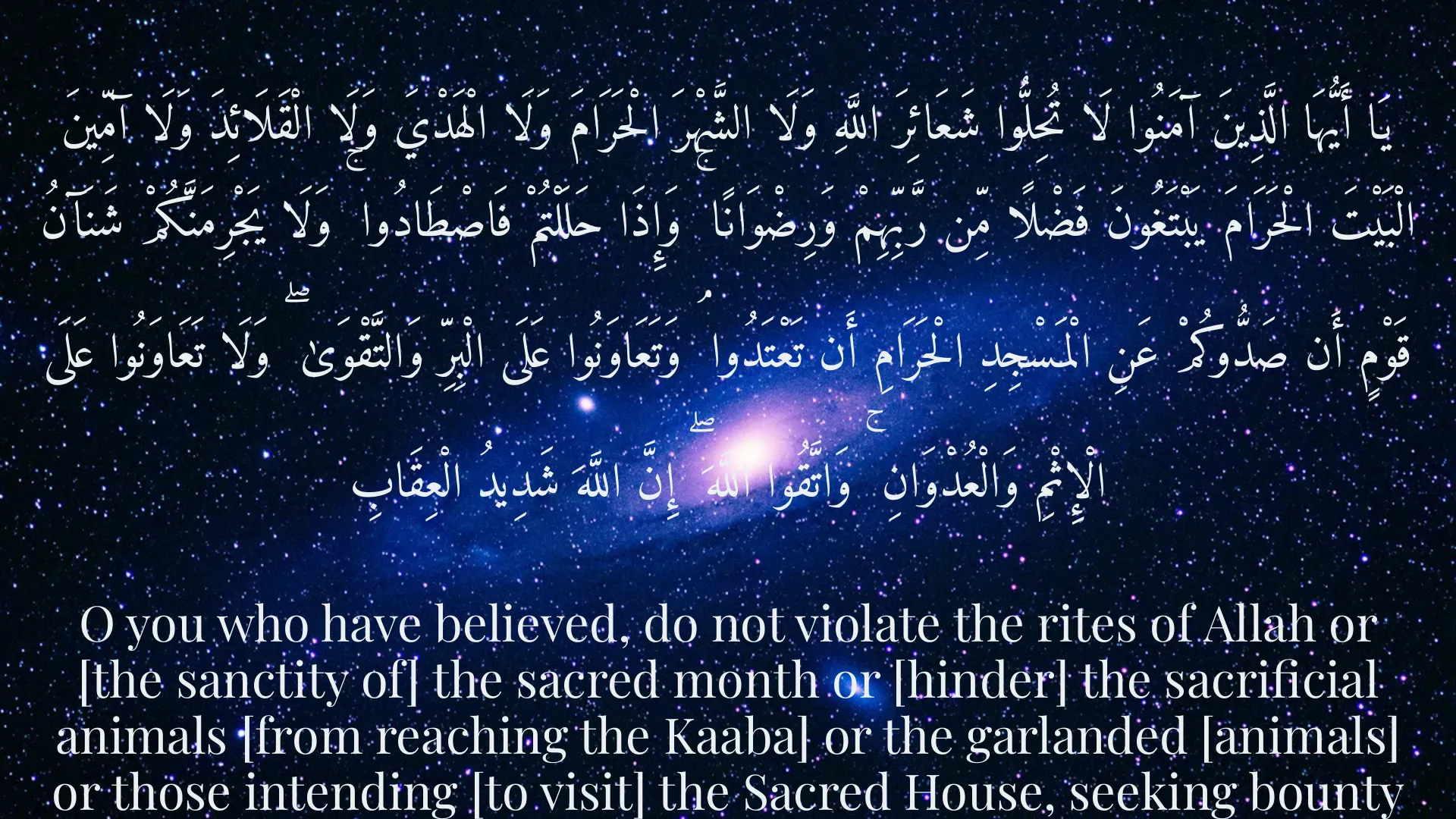
يَا أَيُّهَا الَّذِينَ آمَنُوا لَا تُحِلُّوا شَعَائِرَ اللَّهِ وَلَا الشَّهْرَ الْحَرَامَ وَلَا الْهَدْيَ وَلَا الْقَلَائِدَ وَلَا آمِّينَ الْبَيْتَ الْحَرَامَ يَبْتَغُونَ فَضْلًا مِّن رَّبِّهِمْ وَرِضْوَانًا ۚ وَإِذَا حَلَلْتُمْ فَاصْطَادُوا ۚ وَلَا يَجْرِمَنَّكُمْ شَنَآنُ قَوْمٍ أَن صَدُّوكُمْ عَنِ الْمَسْجِدِ الْحَرَامِ أَن تَعْتَدُوا ۘ وَتَعَاوَنُوا عَلَى الْبِرِّ وَالتَّقْوَىٰ ۖ وَلَا تَعَاوَنُوا عَلَى الْإِثْمِ وَالْعُدْوَانِ ۚ وَاتَّقُوا اللَّهَ ۖ إِنَّ اللَّهَ شَدِيدُ الْعِقَابِ
O you who have believed, do not violate the rites of Allah or [the sanctity of] the sacred month or [hinder] the sacrificial animals [from reaching the Kaaba] or the garlanded [animals] or those intending [to visit] the Sacred House, seeking bounty from their Lord and [His] approval. But when you have emerged from iḥrām, then [you may] hunt. And do not let the hatred of a people for having obstructed you from the Sacred Mosque lead you to transgress. And cooperate in righteousness and piety, but do not cooperate in sin and aggression. And fear Allah; indeed, Allah is severe in penalty.
Al-Ma'idah : 2
وَلْتَكُن مِّنكُمْ أُمَّةٌ يَدْعُونَ إِلَى الْخَيْرِ وَيَأْمُرُونَ بِالْمَعْرُوفِ وَيَنْهَوْنَ عَنِ الْمُنكَرِ ۚ وَأُولَٰئِكَ هُمُ الْمُفْلِحُونَ
And let there be [arising] from you a nation inviting to [all that is] good, enjoining what is right and forbidding what is wrong, and those will be the successful.
Al-Imran : 104
وَالْمُؤْمِنُونَ وَالْمُؤْمِنَاتُ بَعْضُهُمْ أَوْلِيَاءُ بَعْضٍ ۚ يَأْمُرُونَ بِالْمَعْرُوفِ وَيَنْهَوْنَ عَنِ الْمُنكَرِ وَيُقِيمُونَ الصَّلَاةَ وَيُؤْتُونَ الزَّكَاةَ وَيُطِيعُونَ اللَّهَ وَرَسُولَهُ ۚ أُولَٰئِكَ سَيَرْحَمُهُمُ اللَّهُ ۗ إِنَّ اللَّهَ عَزِيزٌ حَكِيمٌ
The believing men and believing women are allies of one another. They enjoin what is right and forbid what is wrong and establish prayer and give zakah and obey Allah and His Messenger. Those – Allah will have mercy upon them. Indeed, Allah is Exalted in Might and Wise.
At-Tawbah : 71
Short Story
It is narrated that among people, like a single body, every limb is connected to another. If a thorn pricks someone's foot, everyone feels its pain, and until that thorn is removed, peace will not settle in the hearts of others either. A sage was asked why he strove wholeheartedly when he saw a suffering dervish. He replied, 'Because I know that my comfort comes from his comfort, and his deficiency is my deficiency.' This anecdote from Saadi's Bustan reminds us that the happiness and peace of society originate not from divisions, but from solidarity and empathy; for every particle that strives in the path of good lightens the burden of others, and the collective radiance stems from the individual glow of each person. In this body, every helping hand is a balm to another's wound, and every benevolent word is a light in the darkness of society's path.