Quranic Answer
In the contemporary era, where the speed of information dissemination is astonishingly high and the line between truth and falsehood often becomes blurred, the concept of 'fake news' has emerged as one of the major challenges facing societies. While the exact term 'fake news' may not appear in the Holy Quran, as this divine book was revealed in a time when the modern concept of media and information propagation did not exist, a deep reflection on Quranic teachings clearly reveals that it provides very clear and robust principles for dealing with information, news, and rumors. These principles fundamentally address the issue of fake news and offer comprehensive strategies for identifying and countering it. These principles are, in essence, the cornerstone of a healthy society founded on truth and justice, and adhering to them is more vital than ever in today's world. One of the most central and explicit verses that offers guidance in this regard is Surah Al-Hujurat, verse 6. Allah Almighty states: “O you who have believed, if there comes to you a disobedient person with information, investigate, lest you harm a people out of ignorance and become regretful over what you have done.” This verse lays down a golden rule in communication ethics and information reception. The term 'disobedient person' (fasiq) here refers to someone who deviates from the path of truth and justice and lacks piety. Allah instructs believers not to easily trust news and information coming from such a source. Instead, they are commanded to meticulously 'tabayyan' (verify) and 'tathabbut' (ascertain); meaning, they should seek the truth and not accept any news or act upon it until its authenticity is confirmed. The message of this verse is more crucial than ever in the age of the internet and social media, where news spreads rapidly from all directions and from unknown or untrustworthy sources. Failure to adhere to this principle leads to 'ignorance' and 'regret'; ignorance in the sense of acting based on lack of knowledge and awareness, and regret over the detrimental consequences that this uninformed action brings about, whether it harms an individual, a family, or a community. This is particularly important in matters of reputation, finances, and social relations, where irreversible damage can be done to individuals' honor or cause division and suspicion within society. Furthermore, the Holy Quran meticulously and sternly addresses the issue of 'rumors' and 'slander,' which themselves constitute another form of 'fake news' and can undermine the foundations of society. The incident of 'Ifk' (the great lie), referring to the false accusation made against the Prophet Muhammad’s wife, Aisha, detailed in verses 11 to 19 of Surah An-Noor, is a prime example of the Quran’s stance on this phenomenon. In these verses, Allah severely condemns those who spread falsehoods and accusations without valid proof or witnesses, and warns of the dire consequences. The Quran, in this narrative, emphasizes why the believing men and women did not entertain a good presumption when they heard such rumors and why they so easily accepted and helped spread them. Allah says: “Why, when you heard it, did not the believing men and believing women think good of one another and say, 'This is an obvious falsehood'?” (An-Noor, 12). This verse shows that a believer’s duty is not only to refrain from spreading false news but also to regard it with skepticism when heard and to maintain a good presumption towards their fellow believers to prevent the spread of falsehood. In these verses, four righteous witnesses are required to prove such claims, indicating the seriousness and importance of preserving people’s honor and preventing the spread of indecency and moral decay in society. This approach blocks any form of spreading false news aimed at destroying characters or creating discord within the community, emphasizing collective responsibility for information. The Quran also generally emphasizes the necessity of 'knowledge' and 'awareness' in speech and conduct. Surah Al-Isra, verse 36, states: “And do not pursue that of which you have no knowledge. Indeed, the hearing, the sight, and the heart – about all those [one] will be questioned.” This verse expresses a broader principle that a person should not believe in or pursue anything without sufficient knowledge and awareness. This principle also applies to news and information. Before believing and spreading any news, one must ascertain its authenticity and should not transmit it to others without 'knowledge' and 'certainty.' In fact, this verse underscores individual responsibility for the content one receives and re-shares; for on the Day of Judgment, every ear, eye, and heart will be questioned about how they were used. This responsibility includes verifying the accuracy of information, distinguishing between truth and falsehood, and refraining from spreading harmful or baseless content. The outcomes and consequences of fake news and rumors, from the Quranic perspective, are extremely grave. These actions are not only considered sins but can also lead to 'fitna' (strife and disorder) and 'fasad' (corruption and destructiveness) in society. The Quran strongly opposes anything that leads to corruption and disrupts public order and peace. Spreading lies sows seeds of discord and mistrust, damages human relationships, and can lead to oppression and injustice against the innocent. For this reason, the Quran invites believers to 'qawlan sadeeda' (sound and correct speech) in Surah Al-Ahzab, verse 70, and 'qawlan ma’rufa' (good and appropriate speech) in Surah Al-Baqarah, verse 263, both of which involve abstaining from lies and rumors and speaking the truth. These recommendations are essential for building a society based on honesty, trust, and mutual respect. In conclusion, although the Quran does not use the term 'fake news,' with its unparalleled depth and wisdom, it has provided robust principles and rules for dealing with phenomena similar to it. From emphasizing the necessity of 'investigation and verification' in the face of suspicious news, to severely condemning 'slander' and 'rumor-mongering,' and obliging 'knowledge' and 'awareness' in all actions and words, the Quran offers a comprehensive strategy for maintaining the informational and moral integrity of society. These teachings call upon Muslims to adopt a critical and responsible approach to the information they receive, preventing them from falling prey to lies and deception, and from becoming tools for spreading falsehood. Therefore, from a Quranic perspective, combating fake news is not only a social necessity but also a religious and ethical duty rooted in piety, faith, and individual and collective responsibility before God and society. This approach helps us find a path towards truth and peace in a world overwhelmed by information.
Related Verses
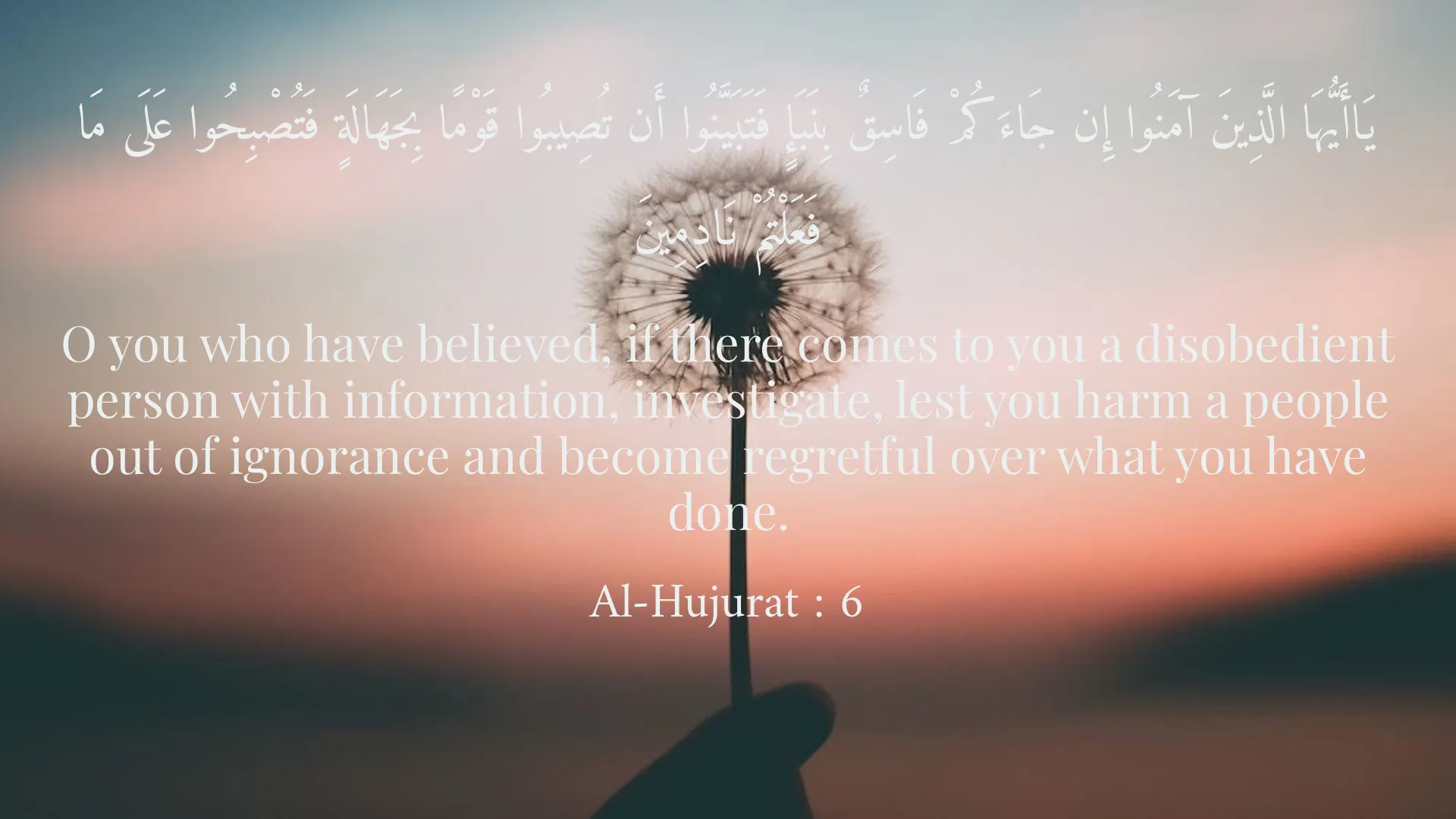
يَاأَيُّهَا الَّذِينَ آمَنُوا إِن جَاءَکُمْ فَاسِقٌ بِنَبَإٍ فَتَبَيَّنُوا أَن تُصِيبُوا قَوْمًا بِجَهَالَةٍ فَتُصْبِحُوا عَلَى مَا فَعَلْتُمْ نَادِمِينَ
O you who have believed, if there comes to you a disobedient person with information, investigate, lest you harm a people out of ignorance and become regretful over what you have done.
Al-Hujurat : 6
لَوْلَا إِذْ سَمِعْتُمُوهُ ظَنَّ الْمُؤْمِنُونَ وَالْمُؤْمِنَاتُ بِأَنفُسِهِمْ خَیْرًا وَقَالُوا هَذَا إِفْکٌ مُّبِینٌ
Why, when you heard it, did not the believing men and believing women think good of one another and say, 'This is an obvious falsehood'?
An-Noor : 12
وَلَا تَقْفُ مَا لَیْسَ لَکَ بِهِ عِلْمٌ ۚ إِنَّ السَّمْعَ وَالْبَصَرَ وَالْفُؤَادَ کُلُّ أُولَئِکَ کَانَ عَنْهُ مَسْئُولًا
And do not pursue that of which you have no knowledge. Indeed, the hearing, the sight, and the heart – about all those [one] will be questioned.
Al-Isra : 36
Short Story
In a bustling city, a man once spread a baseless rumor about a wealthy merchant. He claimed the merchant had unjustly seized people's property and amassed his wealth through deceit. This talk spread like wildfire among the people, tarnishing the merchant's good reputation. Many, without investigation, believed this lie and shunned him. Until a wise person, observing the situation from afar, addressed the people, saying: "O people, how astonishing that you accept a word without first verifying its truth! Has any of you seen a witness to this claim? Or found any document proving this deceit?" Then he went to the rumor-monger and said: "Why did you utter such words that ignited the fire of discord in hearts? Do you not know that the tongue is either the key to the treasure of truth or an instrument of destruction?" The rumor-monger regretted his actions, and the people, realizing their mistake, understood that before believing any news, they must ascertain its accuracy. Thus, peace returned to the market, and the merchant was relieved of the stain on his character. This tale, inspired by the wisdom of Saadi, reminds us of the paramount importance of truthfulness and avoiding idle or harmful speech.