Quranic Answer
The Holy Quran, as a divine revelation and an eternal guide for humanity, has laid down principles for ethical, social, and individual life that transcend time, place, and technology. In response to the question of whether the Quran has spoken about the power and dangers of words on the internet, it must be stated that, directly and by mentioning terms such as 'internet,' 'cyberspace,' or 'social media,' the Quran does not refer to this modern phenomenon. This is natural, as the Quran was revealed more than 14 centuries ago, and contemporary communication technologies did not exist then. However, it can be asserted with certainty that the comprehensive principles and teachings of the Quran regarding the importance, power, responsibility, and dangers of words and speech are entirely applicable and vital to our interactions in the virtual space. The Quran addresses the nature of human beings and their relationships with themselves, with others, and with their Creator, offering guidance that covers the essence of human communication in any context, whether in person or virtually. The Quran explicitly emphasizes the importance and power of speech. Words can be constructive; they can bring hearts closer, spread knowledge, invite to goodness, and guide. Conversely, words can be destructive, sowing seeds of hatred and enmity, ruining people's reputations, distorting the truth, and causing discord and corruption. Allah addresses this topic in numerous verses. For instance, the Quran repeatedly calls believers to speak good words (qawl hasan), gentle words (qawl layyin), truthful words (qawl sadid), and noble words (qawl kareem). These recommendations imply that even amidst disagreements and challenges, politeness and respect must be observed in speech. On the other hand, the Quran strongly warns against the dangers of false, slanderous, and destructive words. One of the most serious issues addressed in the Quran is backbiting (gheebah). In Surah Al-Hujurat, verse 12, Allah says: “And do not backbite one another. Would one of you like to eat the flesh of his dead brother? You would hate it.” This extremely striking simile illustrates the repulsive nature of backbiting. In the online sphere, backbiting, spreading baseless rumors, and character assassination from behind a screen happen with alarming ease. A single post, comment, or message in virtual groups can destroy years of effort put in by an individual, who can be subjected to accusation and backbiting without even being present. The Quran explicitly declares this act forbidden and a grave sin, whether in the real world or in cyberspace. Furthermore, the issue of “Ifk” or spreading great fabrications and slander, particularly in the story of Prophet Yusuf and also in the incident of “Ifk” concerning the Prophet’s wife (PBUH), has been severely condemned. Spreading false news, baseless rumors, and incorrect information with the aim of harming others, or even merely to gain followers and views, are all instances of these grave sins that are abundant in the virtual space. The Quran also emphasizes the necessity of “tabayyun” or “tathabbut” (verification and investigation) when hearing news. In Surah Al-Hujurat, verse 6, it states: “O you who have believed, if there comes to you a disobedient one with information, investigate, lest you harm a people out of ignorance and then become regretful for what you have done.” In the age of the internet, where the speed of information dissemination (both correct and incorrect) is overwhelming, this verse holds immense importance. Before reposting any content, any news, or any accusation, it is our ethical and religious duty to ensure its veracity, because the responsibility for every word published rests with its publisher. Moreover, in Surah Qaf, verse 18, the Quran states: “He does not utter any word except that with him is an observer prepared [to record it].” This verse serves as a reminder of a person’s complete responsibility for every word and phrase they utter or write. In the virtual space, where many people, assuming anonymity or lack of accountability, easily resort to insults, defamation, slander, and spreading falsehoods, this verse remains potent and warns people that even their smallest word is recorded and will be accounted for on the Day of Judgment. This principle is extremely applicable to all activities on social networks, sending messages, writing comments, or publishing posts. In conclusion, while the Quran does not directly mention the internet, its principles and ethics are entirely sufficient for the proper and responsible use of this new technology. These principles include abstaining from backbiting, slander, spreading falsehoods, speaking without knowledge, and mocking others, and instead emphasize good, truthful, respectful speech and verifying news. The internet, as a tool, places the power for good and evil in the hands of the user. It is up to human beings, by adhering to Quranic teachings, to utilize this tool for spreading truth, knowledge, peace, and friendship, and to avoid transforming it into a place for discord and corruption. Therefore, the Quran’s guidance on the power and dangers of words is not only applicable in the real world but also infinitely practical and necessary in the boundless realm of the internet.
Related Verses
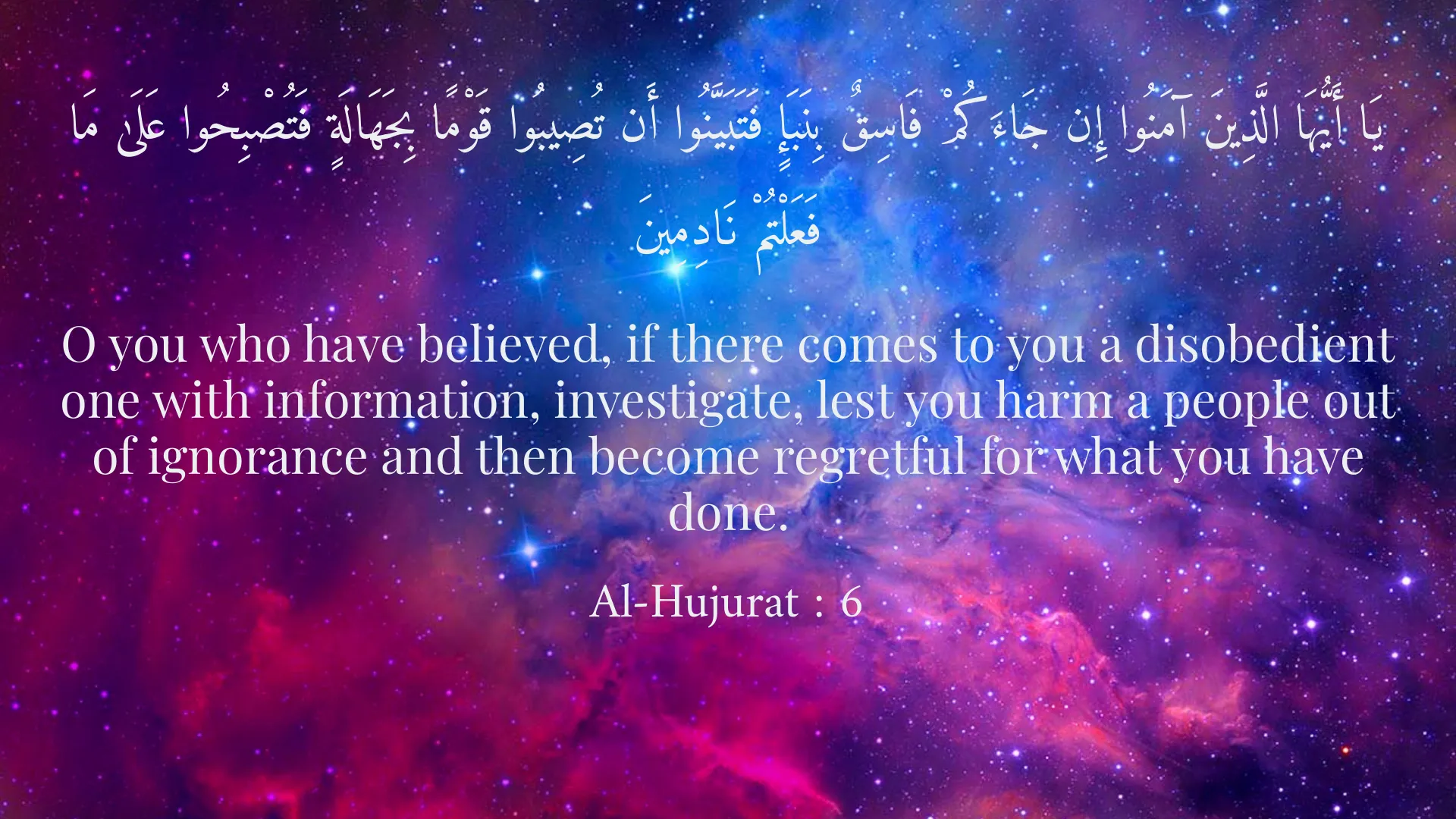
يَا أَيُّهَا الَّذِينَ آمَنُوا إِن جَاءَكُمْ فَاسِقٌ بِنَبَإٍ فَتَبَيَّنُوا أَن تُصِيبُوا قَوْمًا بِجَهَالَةٍ فَتُصْبِحُوا عَلَىٰ مَا فَعَلْتُمْ نَادِمِينَ
O you who have believed, if there comes to you a disobedient one with information, investigate, lest you harm a people out of ignorance and then become regretful for what you have done.
Al-Hujurat : 6
يَا أَيُّهَا الَّذِينَ آمَنُوا اجْتَنِبُوا كَثِيرًا مِّنَ الظَّنِّ إِنَّ بَعْضَ الظَّنِّ إِثْمٌ ۖ وَلَا تَجَسَّسُوا وَلَا يَغْتَب بَّعْضُكُم بَعْضًا ۚ أَيُحِبُّ أَحَدُكُمْ أَن يَأْكُلَ لَحْمَ أَخِيهِ مَيْتًا فَكَرِهْتُمُوهُ ۚ وَاتَّقُوا اللَّهَ ۚ إِنَّ اللَّهَ تَوَّابٌ رَّحِيمٌ
O you who have believed, avoid much [negative] assumption. Indeed, some assumption is sin. And do not spy or backbite each other. Would one of you like to eat the flesh of his dead brother? You would hate it. And fear Allah. Indeed, Allah is Accepting of repentance and Merciful.
Al-Hujurat : 12
مَّا يَلْفِظُ مِن قَوْلٍ إِلَّا لَدَيْهِ رَقِيبٌ عَتِيدٌ
He does not utter any word except that with him is an observer prepared [to record it].
Qaf : 18
Short Story
One day, a king asked a wise vizier: “In your opinion, what is the best and worst thing in a human being?” The vizier thought for a moment and replied: “The best and the worst thing is the tongue.” The king asked with surprise: “How can one thing be both the best and the worst?” The vizier answered: “O King! With the tongue, one can strengthen bonds of love and bring hearts closer, one can learn and impart knowledge and wisdom, and guide towards goodness, one can help the oppressed and distinguish truth from falsehood. This tongue is the best tool for good. But this very tongue, if used recklessly and without restraint, can slander, lie, backbite, ruin reputations, create malice, and sow discord. With one ill-placed word, friendships can turn into enmities, and peace can be shattered. So, a tongue used for truth and goodness is the best, and a tongue used for evil and corruption is the worst.” The king was pleased with this wise saying and learned that every word is a double-edged sword; it must be used with caution and awareness, and this lesson is more valuable than ever in today's world where words travel at the speed of light in the virtual space.