Quranic Answer
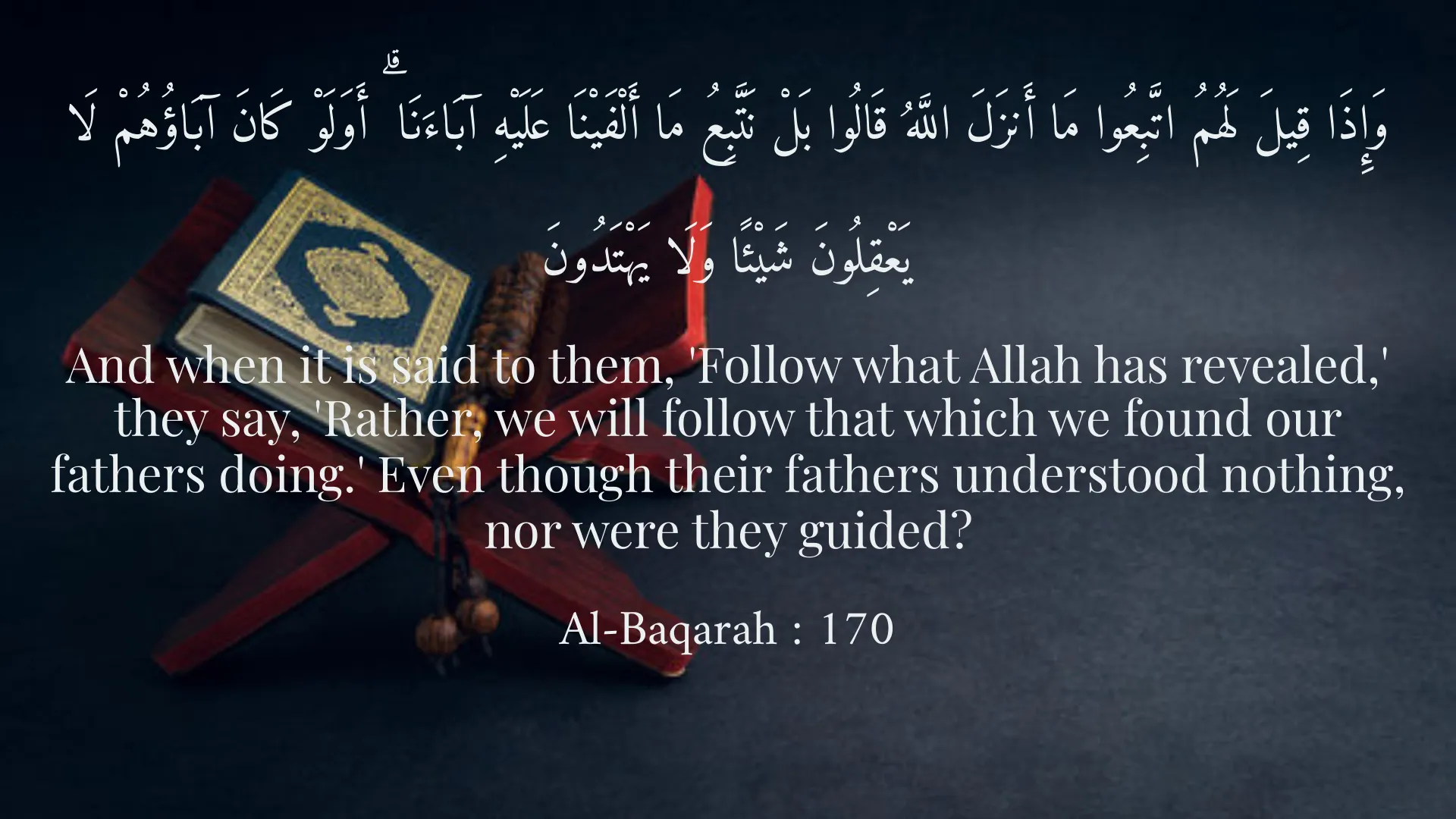
While the exact phrase 'blind fanaticism' is not explicitly used in the Holy Quran, the scripture profoundly and repeatedly warns against concepts that embody its essence. These include unquestioning adherence to ancestral traditions without rational or divine backing, stubborn insistence on false beliefs purely out of habit, tribal or racial prejudice, and the rejection of truth due to arrogance or pride. All these elements collectively form what we understand today as 'blind fanaticism.' The Quran strongly emphasizes the importance of contemplation, reason, reflection upon divine signs, seeking knowledge, and distinguishing between truth and falsehood based on insight and clear evidence. It explicitly warns humanity against following conjecture, personal whims, and anything that lacks scientific or logical foundation. One of the most prominent aspects of this warning is the severe condemnation of blind imitation of ancestors. In numerous verses, the Quran recounts the resistance of past nations to their prophets, whose primary reason for rejecting divine truth was simply, 'We found our forefathers doing thus,' or 'Our fathers practiced this way.' This unthinking imitation served as a major impediment to the guidance of many communities. For instance, in Surah Al-Baqarah, verse 170, Allah states: "And when it is said to them, 'Follow what Allah has revealed,' they say, 'Rather, we will follow that which we found our fathers doing.' Even though their fathers understood nothing, nor were they guided?" This verse unequivocally establishes that the ignorance and lack of guidance of one's ancestors do not justify following them in matters of faith and practice. Similar warnings are reiterated in Surah Al-Ma'idah, verse 104, and Surah Az-Zukhruf, verses 22 and 23. Instead of blind imitation, the Quran places immense emphasis on intellect ('Aql) and the exercise of mental faculties. Many verses invite people to reflect upon the creation of the heavens and the earth, the cycle of day and night, and the divine signs within themselves and in nature. Allah repeatedly urges humans to listen, see, and reason. In Surah Al-Isra, verse 36, it is stated: "And do not pursue that of which you have no knowledge. Indeed, the hearing, the sight and the heart – about all those [one] will be questioned." This verse establishes a fundamental principle for avoiding fanaticism and following baseless assumptions, as fanaticism often stems from a lack of knowledge and reliance on unsubstantiated beliefs. The Quran also closes the door on intellectual fanaticism built on shaky foundations by emphasizing that "conjecture never avails against the truth." Blind fanaticism can also manifest as racism and tribalism, which the Quran vehemently rejects. In Surah Al-Hujurat, verse 13, Allah proclaims: "O mankind, indeed We have created you from male and female and made you peoples and tribes that you may know one another. Indeed, the most noble of you in the sight of Allah is the most righteous of you." This verse explicitly declares piety (taqwa) as the sole criterion for superiority, not race, tribe, or skin color. This teaching stands in direct opposition to any form of racial or class fanaticism and calls for universal brotherhood and equality based on divine criteria. Another facet of blind fanaticism is obstinate adherence to incorrect beliefs and resistance to truth due to arrogance and stubbornness. The story of Iblis, who refused to prostrate before Adam due to his pride and conceit, insisting on his own opinion despite Allah's clear command, serves as a prime example of the consequences of fanaticism rooted in arrogance. Similarly, the rebellion of Pharaoh and his people against Moses' miracles and their insistence on disbelief and oppression demonstrate a form of blind stubbornness that led to their destruction. The Quran cites such fates as lessons for future generations, urging people to avoid falling into the trap of such fanaticisms. In summary, the Holy Quran delivers comprehensive warnings against 'blind fanaticism' by condemning unquestioning imitation, promoting critical thinking and reflection, elucidating the true criteria of superiority (piety, not race), and cautioning against the repercussions of arrogance and stubbornness. These teachings lay the foundations for a rational, just, and unified society where truth is accepted based on evidence and insight, not on baseless customs, racism, or pride. The Quran's ultimate goal is to liberate humanity from the chains of ignorance and fanaticism, guiding them towards a light founded upon knowledge, reason, and divine revelation.
Related Verses
وَإِذَا قِيلَ لَهُمُ اتَّبِعُوا مَا أَنزَلَ اللَّهُ قَالُوا بَلْ نَتَّبِعُ مَا أَلْفَيْنَا عَلَيْهِ آبَاءَنَا ۗ أَوَلَوْ كَانَ آبَاؤُهُمْ لَا يَعْقِلُونَ شَيْئًا وَلَا يَهْتَدُونَ
And when it is said to them, 'Follow what Allah has revealed,' they say, 'Rather, we will follow that which we found our fathers doing.' Even though their fathers understood nothing, nor were they guided?
Al-Baqarah : 170
وَلَا تَقْفُ مَا لَيْسَ لَكَ بِهِ عِلْمٌ ۚ إِنَّ السَّمْعَ وَالْبَصَرَ وَالْفُؤَادَ كُلُّ أُولَٰئِكَ كَانَ عَنْهُ مَسْئُولًا
And do not pursue that of which you have no knowledge. Indeed, the hearing, the sight and the heart – about all those [one] will be questioned.
Al-Isra : 36
يَا أَيُّهَا النَّاسُ إِنَّا خَلَقْنَاكُم مِّن ذَكَرٍ وَأُنثَىٰ وَجَعَلْنَاكُمْ شُعُوبًا وَقَبَائِلَ لِتَعَارَفُوا ۚ إِنَّ أَكْرَمَكُمْ عِندَ اللَّهِ أَتْقَاكُمْ ۚ إِنَّ اللَّهَ عَلِيمٌ خَبِيرٌ
O mankind, indeed We have created you from male and female and made you peoples and tribes that you may know one another. Indeed, the most noble of you in the sight of Allah is the most righteous of you. Indeed, Allah is Knowing and Acquainted.
Al-Hujurat : 13
Short Story
It is said that in ancient times, two friends embarked on a journey together. One was named 'Reason-Acceptor,' who always sought knowledge and clear evidence, and weighed everything he heard with his intellect. The other was named 'Tradition-Bound,' who declared: 'I shall never deviate from what my forefathers have done, even if it goes against logic!' One day, they reached a fork in the road, with two paths. One was smooth and clear, but Tradition-Bound said, 'This path is new, and our ancestors never trod it.' The other was rough and difficult, full of thorns and debris, yet Tradition-Bound insisted with fanaticism, 'This is the path my fathers walked, and I shall follow in their footsteps!' Reason-Acceptor said, 'A path that leads to perdition, no matter how ancient, is worthy of avoidance, and a path that leads to safety, however new, is worthy of being followed.' Tradition-Bound paid no heed to his words and took the difficult path, where he was lost. Reason-Acceptor, taking the smooth path, arrived safely at his destination and thanked God for making reason a guiding light. Sa'di says: 'The wise person sees the straight path with their own intellect, while the ignorant one gets lost by blindly following the customs of their predecessors.'