Quranic Answer
The Holy Quran offers a comprehensive and deeply nuanced perspective on the concepts of good (خير, khair) and evil (شر, sharr), portraying them not merely as abstract philosophical categories but as fundamental realities intrinsic to human existence, divine governance, and ultimate accountability. It intricately weaves these concepts into the fabric of life, viewing every experience—whether perceived as a blessing or a hardship—as a test (fitnah) designed to reveal an individual's true character and faith. This understanding underscores that navigating life's challenges involves constant choices between paths of righteousness and deviation, with profound implications for both this world and the hereafter. At the very heart of the Quranic discourse on good and evil lies the absolute sovereignty and profound wisdom of Allah. The Quran unequivocally asserts that nothing in the cosmos, whether it appears beneficial or detrimental, transpires outside of Allah’s omniscient knowledge and deliberate permission. This divine orchestration does not, however, negate the principle of human free will. Instead, it frames human choice within a grander divine design. Allah, in His infinite wisdom, permits the existence of evil for a multitude of profound reasons. These include: as a crucible for humanity to demonstrate their true faith and resilience; to distinguish between sincere believers and those who are hypocritical or uncommitted; to provide essential opportunities for repentance (tawbah) and profound spiritual growth; and crucially, to manifest the multifaceted attributes of Allah, such as His justice, mercy, and unmatched wisdom. Indeed, the Quran often reminds us that what appears as an affliction or a hardship—a form of sharr from a human perspective—can ultimately lead to a greater khair, and conversely, what might initially seem desirable could harbor hidden perils. This profound truth is beautifully articulated in Surah Al-Baqarah (2:216): "But perhaps you hate a thing and it is good for you; and perhaps you love a thing and it is bad for you. And Allah knows, while you know not." This verse serves as a powerful reminder of the limitations of human perception and knowledge, juxtaposed against Allah’s boundless wisdom and His perfect, all-encompassing plan. A cornerstone of the Quranic narrative is the immense emphasis placed on human responsibility and accountability. Diverging sharply from purely deterministic philosophies, Islam posits that humankind is uniquely endowed with both free will and intellect, faculties that enable individuals to actively discern and choose between right and wrong. To aid in this crucial distinction, Allah has mercifully sent prophets and revealed sacred scriptures—foremost among them the Holy Quran itself—which meticulously define what constitutes good and what precipitates evil. Fundamentally, khair (good) is defined as anything that aligns with Allah’s commands and pleasure, promotes justice and equity, fosters compassion and empathy, and ultimately benefits humanity and the entire creation. Conversely, sharr (evil) encompasses anything that defies Allah’s will, leads to injustice, corruption, oppression, discord, and harm. The Quran identifies shirk, the act of associating partners with Allah, as the most egregious form of evil, as it fundamentally undermines the very essence of monotheism and unreserved submission to the One True God. Other grave evils frequently highlighted include zulm (injustice, wrongdoing, oppression), murder, theft, deceit, slander, backbiting, and all actions that cause decay and corruption on Earth. In contrast, good deeds are broadly understood to encompass sincere faith (iman), righteous actions (amal saleh) such as giving charity (sadaqah, zakat), upholding justice, showing profound kindness to parents and neighbors, maintaining honesty and integrity, exercising patience (sabr) in adversity, and striving diligently in the path of Allah. The Quran reiterates with profound certainty that every single action, regardless of its apparent magnitude, will be meticulously accounted for. This theme of recompense is pervasive, underscoring the perfect and unwavering nature of divine justice. Surah Al-Zalzalah (99:7-8) delivers this powerful message with striking clarity: "So whoever does an atom's weight of good will see it, And whoever does an atom's weight of evil will see it." This illustrates the microscopic precision of divine reckoning and the absolute certainty of receiving the just deserts for one's deeds. Good deeds invariably lead to profound rewards, both in this transient life—manifesting as inner peace, divine blessings, social harmony, and respect—and, more significantly, in the eternal life of the hereafter, culminating in the sublime bliss of Paradise. Conversely, evil deeds inevitably incur punishment, which may surface as distress, a deprivation of blessings in this world, and ultimately, severe chastisement in the afterlife, culminating in the painful reality of Hellfire. Nevertheless, the Quran consistently emphasizes the boundless mercy of Allah, who encourages sincere repentance (tawbah) for evil deeds, promising profound forgiveness to those who genuinely turn back to Him with remorse and earnestly strive to rectify their past wrongs through future good actions. Furthermore, the Quran unequivocally clarifies that both phases of life—those marked by ease, prosperity, and blessings (khair) and those characterized by hardship, adversity, and misfortune (sharr)—are integral components of Allah’s testing process (fitnah). As articulated in Surah Al-Anbiya (21:35): "And We test you with evil and with good as a trial; and to Us you will be returned." This means that wealth, robust health, and worldly success are not merely rewards but profound tests of gratitude, humility, and how judiciously one utilizes divine blessings. Similarly, poverty, illness, and adversity are equally significant tests of patience, steadfastness, and unwavering reliance upon Allah. A believer's authentic piety is thus demonstrated not only through the performance of good deeds during times of comfort but critically, through maintaining resolute faith and unwavering steadfastness during periods of difficulty, and by actively striving to alleviate evil and promote good within society. The Quran passionately calls upon humanity to actively enjoin good (amr bil ma'ruf) and forbid evil (nahi anil munkar). This directive transcends individual piety, establishing a collective responsibility for the Muslim community to uphold justice and righteousness in the world. It cultivates a worldview where faith is not a passive, isolated spiritual journey but an dynamic engagement in establishing a just and compassionate social order. Believers are encouraged to be proactive agents of positive transformation, to courageously stand against oppression and injustice, and to passionately advocate for what is morally upright and beneficial. The Quran firmly asserts that authentic guidance (Al-Huda) originates solely from Allah, and that steadfastly adhering to this divine guidance is the singular pathway to truly distinguish genuine khair from deceptive sharr, thereby leading humanity toward a path of salvation, eternal contentment, and ultimate success in both this ephemeral world and the everlasting Hereafter.
Related Verses
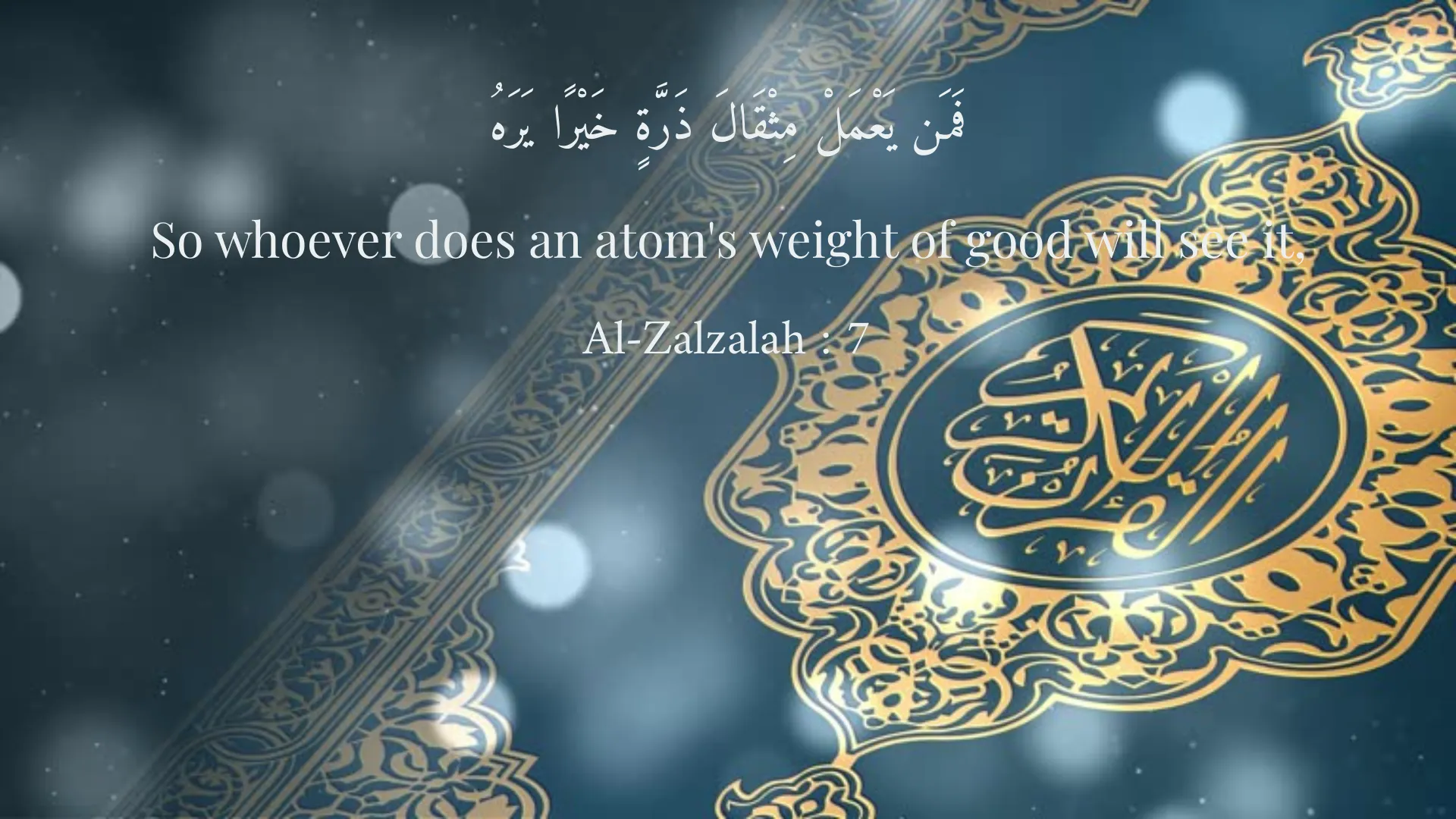
فَمَن يَعْمَلْ مِثْقَالَ ذَرَّةٍ خَيْرًا يَرَهُ
So whoever does an atom's weight of good will see it,
Al-Zalzalah : 7
وَمَن يَعْمَلْ مِثْقَالَ ذَرَّةٍ شَرًّا يَرَهُ
And whoever does an atom's weight of evil will see it.
Al-Zalzalah : 8
كُتِبَ عَلَيْكُمُ الْقِتَالُ وَهُوَ كُرْهٌ لَّكُمْ ۖ وَعَسَىٰ أَن تَكْرَهُوا شَيْئًا وَهُوَ خَيْرٌ لَّكُمْ ۖ وَعَسَىٰ أَن تُحِبُّوا شَيْئًا وَهُوَ شَرٌّ لَّكُمْ ۗ وَاللَّهُ يَعْلَمُ وَأَنتُمْ لَا تَعْلَمُونَ
Fighting has been enjoined upon you, though it is hateful to you. But perhaps you hate a thing and it is good for you; and perhaps you love a thing and it is bad for you. And Allah knows, while you know not.
Al-Baqarah : 216
كُلُّ نَفْسٍ ذَائِقَةُ الْمَوْتِ ۗ وَنَبْلُوكُم بِالشَّرِّ وَالْخَيْرِ فِتْنَةً ۖ وَإِلَيْنَا تُرْجَعُونَ
Every soul will taste death. And We test you with evil and with good as a trial; and to Us you will be returned.
Al-Anbiya : 35
Short Story
One day, a just and benevolent king was hunting in the desert. Overcome by thirst, he arrived at a farm. A simple-hearted farmer brought him a pitcher of cool, refreshing water. The king was amazed by the water's sweetness and thought to himself, "If this farm were mine, I could always drink this sweet water." So, he secretly decided to seize the farm from the farmer by force. An hour later, the king became thirsty again and asked for water from the same spring. But this time, the water was extremely bitter and unpleasant. The king, surprised, asked the farmer, "What is this secret? The water from this spring was so sweet just an hour ago; why has it become so bitter now?" The farmer, unaware of the king's hidden intention, replied, "O King, perhaps your inner intention has changed, and the thought of injustice and tyranny has entered your heart. For the sweetness of water and the blessing of the land come from the justice and goodness of kings. Whenever justice vanishes, blessings also depart." The king was startled by the farmer's words and repented of his evil thought and desire for oppression. His heart was purified, and his intention became righteous. Then he asked for water from the same spring again, and this time the water returned to its initial sweetness. The king understood that good and blessings lie in justice, and evil and destruction in tyranny. This beautiful tale from Sa'di's Bustan or Gulistan teaches us that even our hidden thoughts influence the world and its blessings, and that good and evil never go unrewarded or unpunished, and our intentions are the source of good and evil.