Quranic Answer
Decision-making is an integral part of our daily lives. From minor choices to life-altering decisions, we are constantly faced with multiple options. For a Muslim, the Holy Quran is not merely a book of guidance and light, but a rich source for discovering principles and directives in all aspects of life, including the process of decision-making. The Quran does not provide a precise algorithm for every specific decision, but rather presents a comprehensive framework of values, ethical principles, and spiritual approaches that can assist us in making the best choices. These guidelines help us to choose the right path by relying on Allah, consulting with others, and developing inner discernment. The first and most fundamental principle in Quranic decision-making is Tawakkul (Reliance on Allah). After deep thought and gathering the necessary information, the final step is to entrust the outcome to Almighty Allah. This does not mean inaction or disregarding intellect, but rather that after fulfilling all duties and conducting necessary investigations, we should surrender our hearts to Allah and trust in His wisdom. The Holy Quran emphasizes the importance of Tawakkul in numerous verses. For instance, in Surah Aal-Imran (Chapter 3, Verse 159), we read: "...then when you have decided, then rely upon Allah. Indeed, Allah loves those who rely [upon Him]." This verse clearly indicates that reliance should come after firm resolve and determination. Furthermore, in Surah At-Talaq (Chapter 65, Verse 3), it states: "And whoever relies upon Allah – then He is sufficient for him." This verse grants peace and assurance to the believer that the outcome of their efforts, if accompanied by pure intention and reliance, will unfold in the best possible way. Tawakkul empowers an individual to confront the fear of the unknown with courage and to proceed with tranquility, knowing that a superior and wise power is their support. The second key principle is Istishara (Consultation). The Holy Quran directly advises consultation in important matters of life. In the same verse 159 of Surah Aal-Imran, Allah instructs His Prophet: "And consult them in the matter." Although this address is to the Prophet Muhammad (PBUH), it serves as a lesson for all Muslims that even with divine wisdom, consulting with experienced and knowledgeable individuals is a commendable and essential practice. Consultation allows for various dimensions of an issue to be examined from different angles, revealing strengths and weaknesses that might otherwise remain hidden from an individual's perspective. Consultation prevents self-will and arrogance, fostering a spirit of collectivism and mutual understanding. Of course, consultation does not mean absolute submission to the opinions of others, but rather gathering diverse information and perspectives to arrive at the best decision. The choice of consultants is also crucial; they should be righteous, knowledgeable, compassionate, and experienced individuals. The third principle is Taqwa (God-consciousness/Piety). Taqwa refers to self-restraint and adherence to divine limits in all matters. A person with Taqwa always considers Allah's pleasure in their decisions and avoids what displeases Him. The Holy Quran states: "O you who have believed, if you fear Allah, He will grant you a criterion (Furqan) and remove from you your misdeeds and forgive you. And Allah is the possessor of great bounty." (Surah Al-Anfal, Chapter 8, Verse 29). This "Furqan" is the discernment and insight that helps a person distinguish right from wrong amidst a multitude of options. Taqwa prepares the heart and mind to receive divine guidance and protects against satanic whispers and worldly desires, which often lead to erroneous decisions. When our decisions are based on Taqwa, even if the apparent outcome is not as we wished, it will yield the best spiritual and eternal results. The fourth aspect is Seeking Knowledge and Reflection (Ta'aqqul). The Quran repeatedly invites humanity to reflect, ponder, and acquire knowledge. Decisions should be based on sufficient information and accurate knowledge. Haste and ignorance often lead to regret. The Quran asks: "Are those who know equal to those who do not know?" (Surah Az-Zumar, Chapter 39, Verse 9). This verse emphasizes the importance of knowledge and awareness in all aspects of life. Before any decision, we must strive to gather as much relevant information as possible, weigh its various aspects, and anticipate potential consequences. This process includes research, study, and seeking advice from experts and specialists. Pondering over the verses of the Quran and the Sunnah of the Prophet (PBUH) is also a vast source of knowledge and wisdom for decision-making. The fifth principle is Justice and Fairness (Adl). The Quran strongly emphasizes upholding justice in all matters, even against oneself or one's closest relatives. The decisions we make must be just and must not infringe upon anyone's rights. In Surah An-Nisa (Chapter 4, Verse 135), it states: "O you who have believed, be persistently maintainers of justice, witnesses for Allah, even if it be against yourselves or parents and relatives." This principle teaches us that in our decision-making, we should not prioritize personal or group interests over justice and truth, but always act according to fairness and divine standards. The sixth aspect is Patience and Perseverance (Sabr). Some decisions require time and should not be rushed. Patience in examining aspects, patience in awaiting results, and patience in facing the consequences of decisions are all Quranic teachings. "O you who have believed, seek help through patience and prayer..." (Surah Al-Baqarah, Chapter 2, Verse 153). This verse shows that patience and reliance, combined with worship, are powerful tools for navigating challenges and making sound decisions. Finally, Du'a (Supplication) and Istikhara (Prayer for Guidance) also hold a special place in the Quranic decision-making process. Although the concept of Istikhara is not explicitly detailed in the Quran, the general principle of prayer and seeking guidance from Allah is emphasized in many verses. Istikhara is essentially a form of consultation with Allah; when a person has exhausted all rational efforts and consultations and is still in doubt, by reciting the Istikhara supplication, they ask Allah to reveal the best path for them and to incline their heart towards what is good and beneficial. This act demonstrates ultimate reliance and submission to divine will, providing immense peace of heart. In summary, the Holy Quran is a comprehensive guide for life that transforms the decision-making process into a spiritual journey. This journey begins with reliance on Allah, is enriched by consultation and the acquisition of knowledge, finds its path through Taqwa and justice, proceeds with patience and perseverance, and reaches its completion with supplication and seeking divine guidance. This approach not only helps us make better decisions but also contributes to our spiritual growth and brings forth a life filled with blessings and tranquility. This Quranic framework guides the individual to face even the most complex issues with confidence and peace, knowing that any decision made based on these principles will ultimately lead to Allah's pleasure.
Related Verses
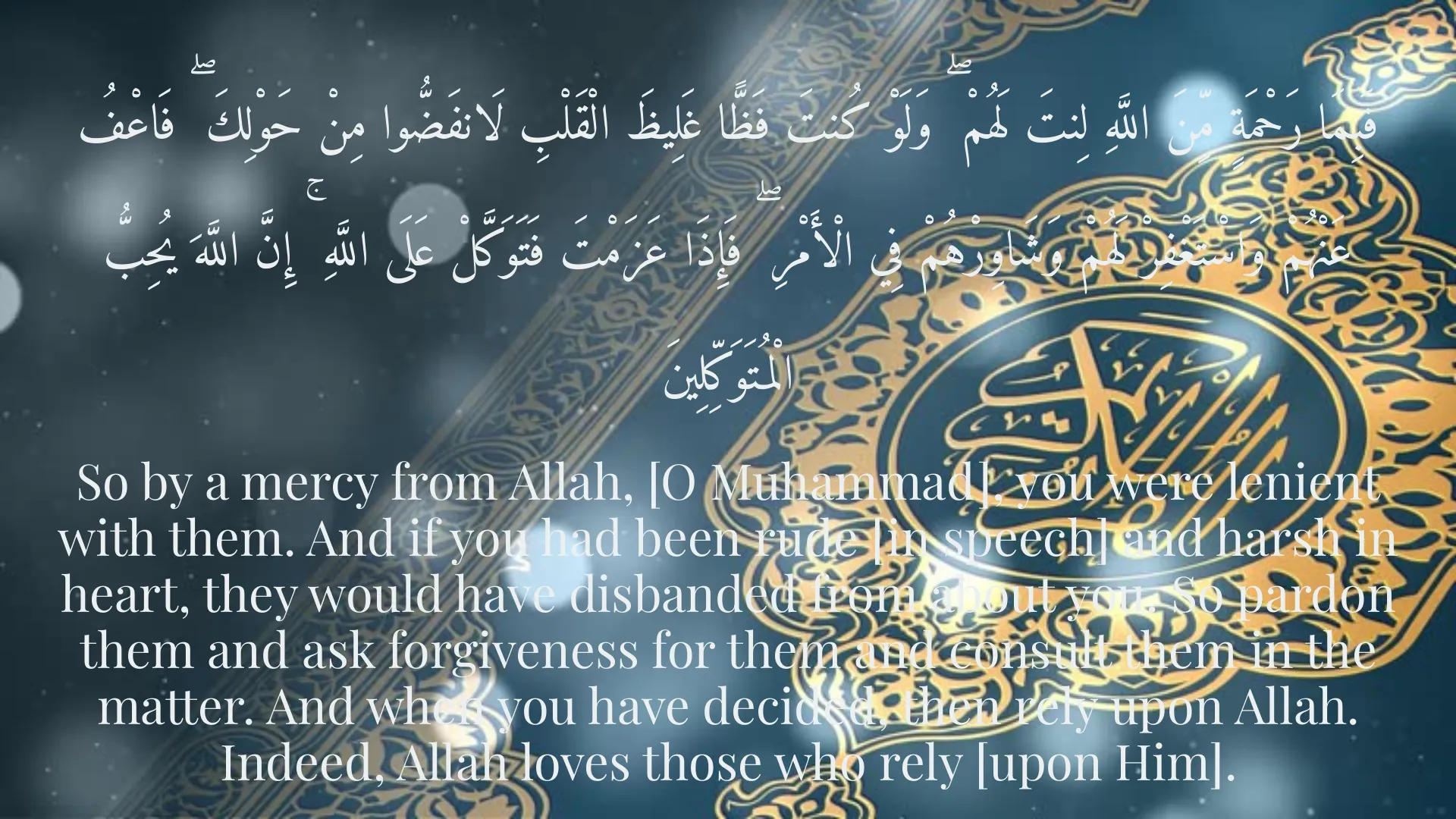
فَبِمَا رَحْمَةٍ مِّنَ اللَّهِ لِنتَ لَهُمْ ۖ وَلَوْ كُنتَ فَظًّا غَلِيظَ الْقَلْبِ لَانفَضُّوا مِنْ حَوْلِكَ ۖ فَاعْفُ عَنْهُمْ وَاسْتَغْفِرْ لَهُمْ وَشَاوِرْهُمْ فِي الْأَمْرِ ۖ فَإِذَا عَزَمْتَ فَتَوَكَّلْ عَلَى اللَّهِ ۚ إِنَّ اللَّهَ يُحِبُّ الْمُتَوَكِّلِينَ
So by a mercy from Allah, [O Muhammad], you were lenient with them. And if you had been rude [in speech] and harsh in heart, they would have disbanded from about you. So pardon them and ask forgiveness for them and consult them in the matter. And when you have decided, then rely upon Allah. Indeed, Allah loves those who rely [upon Him].
Aal-Imran : 159
يَا أَيُّهَا الَّذِينَ آمَنُوا إِن تَتَّقُوا اللَّهَ يَجْعَل لَّكُمْ فُرْقَانًا وَيُكَفِّرْ عَنكُمْ سَيِّئَاتِكُمْ وَيَغْفِرْ لَكُمْ ۗ وَاللَّهُ ذُو الْفَضْلِ الْعَظِيمِ
O you who have believed, if you fear Allah, He will grant you a criterion and remove from you your misdeeds and forgive you. And Allah is the possessor of great bounty.
Al-Anfal : 29
وَيَرْزُقْهُ مِنْ حَيْثُ لَا يَحْتَسِبُ ۚ وَمَن يَتَوَكَّلْ عَلَى اللَّهِ فَهُوَ حَسْبُهُ ۚ إِنَّ اللَّهَ بَالِغُ أَمْرِهِ ۚ قَدْ جَعَلَ اللَّهُ لِكُلِّ شَيْءٍ قَدْرًا
And will provide for him from where he does not expect. And whoever relies upon Allah – then He is sufficient for him. Indeed, Allah will accomplish His purpose. Allah has already set for everything a [decreed] extent.
At-Talaq : 3
Short Story
It is narrated that a wise and intelligent king found himself in doubt regarding a difficult matter that had arisen. This issue could affect the destiny of his people. He could have made a unilateral decision, but he knew that wisdom lay in consultation. So, he summoned his ministers and scholars of his court and sought the opinion of each. Each offered their view, and the king patiently listened to their words. Then, he retired to solitude and pondered with himself and his Lord. In his heart, he sought guidance from God, and relying on the inner discernment he knew stemmed from his piety, and by integrating the consultations and divine wisdom, he made a decision that not only resolved the problem but also benefited everyone and established justice. The people rejoiced at his decision and were amazed by the king's wisdom. The king smiled and said: "This is the result of trusting in God and listening to collective wisdom."