Quranic Answer
Freeing oneself from unhealthy dependency on others is a profound journey with deep psychological and spiritual roots, and the Holy Quran, with its comprehensive and divine teachings, offers fundamental solutions. This dependency often stems from an excessive need for validation, support, or even the mere physical presence of others, which can erode an individual's independence and inner peace. The Quran addresses this issue at its core by emphasizing the concept of 'Tawakkul' (reliance on God), teaching humanity that the primary source of power, sustenance, support, and tranquility is Allah alone. When the human heart is firmly connected to this truth, its needs are managed in a healthier way, and unhealthy attachments to others diminish significantly. The first and most crucial step on this path is to strengthen one's faith and cultivate true Tawakkul in Allah. Tawakkul does not mean passive inaction or simply giving up effort; rather, it implies that after exhausting all possible efforts and planning, one entrusts the outcome to God and places one's heart in His care. In Surah At-Talaq, verse 3, Allah states: "And whoever relies upon Allah – He is sufficient for him." This verse serves as a beacon, assuring individuals that they are never alone and that the inexhaustible source of power and support is always with them. This deep conviction is the foundation for overcoming the fear of loss, the fear of rejection, and the constant need for validation from others. When you know that Allah is the best and most perfect supporter, you no longer need to place the entire burden of your life and expectations upon the shoulders of fallible human beings. Unhealthy dependency often originates from inner weakness and a lack of self-esteem. The Quran, by inviting self-knowledge and recognizing humanity's dignified position as Allah's vicegerent on Earth, helps to strengthen self-esteem. A person must understand that they possess inherent dignity and do not need external validation from others to be valuable. In this regard, strengthening one's connection with Allah through acts of worship, especially prayer (Salat), plays a pivotal role. Prayer is a moment of direct communication with the Creator, where one expresses all their needs and weaknesses before Him and seeks His assistance. Surah Al-Baqarah, verse 153, states: "O you who have believed, seek help through patience and prayer. Indeed, Allah is with the patient." This verse illustrates that seeking refuge in Allah through prayer and patience is the solution to many problems and the cure for many spiritual weaknesses. In addition to Tawakkul and acts of worship, the Quran also emphasizes individual accountability. Each soul is responsible for its own deeds and does not bear the burden of another's sin (Surah Al-An'am, verse 164). This principle grants individuals independence, allowing them to rely on their own capabilities and not to tie their destiny to the decisions and desires of others. Of course, this does not mean neglecting social relationships or mutual assistance; Islam strongly emphasizes cooperation and affection, but there is a subtle difference between healthy mutual support and pathological dependency. Healthy cooperation is reciprocal, with both parties assisting each other while maintaining their independence and capabilities, whereas unhealthy dependency is one-sided and often accompanied by the loss of one's identity and free will. To reduce unhealthy dependency, it is essential for individuals to recognize and develop their personal abilities. Seeking knowledge, acquiring skills, and striving for self-sufficiency to the best of one's ability are Islamic teachings that help foster individual independence. When a person feels more capable and self-efficacious, they will have less need to rely excessively on others. Furthermore, Surah Al-Imran, verse 159, after commanding consultation, states: "And when you have decided, then rely upon Allah. Indeed, Allah loves those who rely [upon Him]." This verse beautifully shows that consultation and seeking others' opinions are good, but after making a final decision, one should rely on Allah and accept responsibility for their own choice, rather than constantly seeking others' approval. In summary, freeing oneself from unhealthy dependency on others hinges on several Quranic principles: absolute reliance on Allah as the sole source of power and sustenance, strengthening faith and a heartfelt connection with the Creator through acts of worship, recognizing one's self-worth and human dignity, embracing individual accountability, and striving to develop personal capabilities. These principles not only grant individuals independence and liberation from destructive dependencies but also instill a deep sense of peace and assurance in their hearts, ensuring they never feel alone or helpless, for they always have the ultimate Supporter, Allah Almighty, by their side. This path leads to the formation of a strong, self-reliant, yet humble and grateful character in the face of divine blessings.
Related Verses
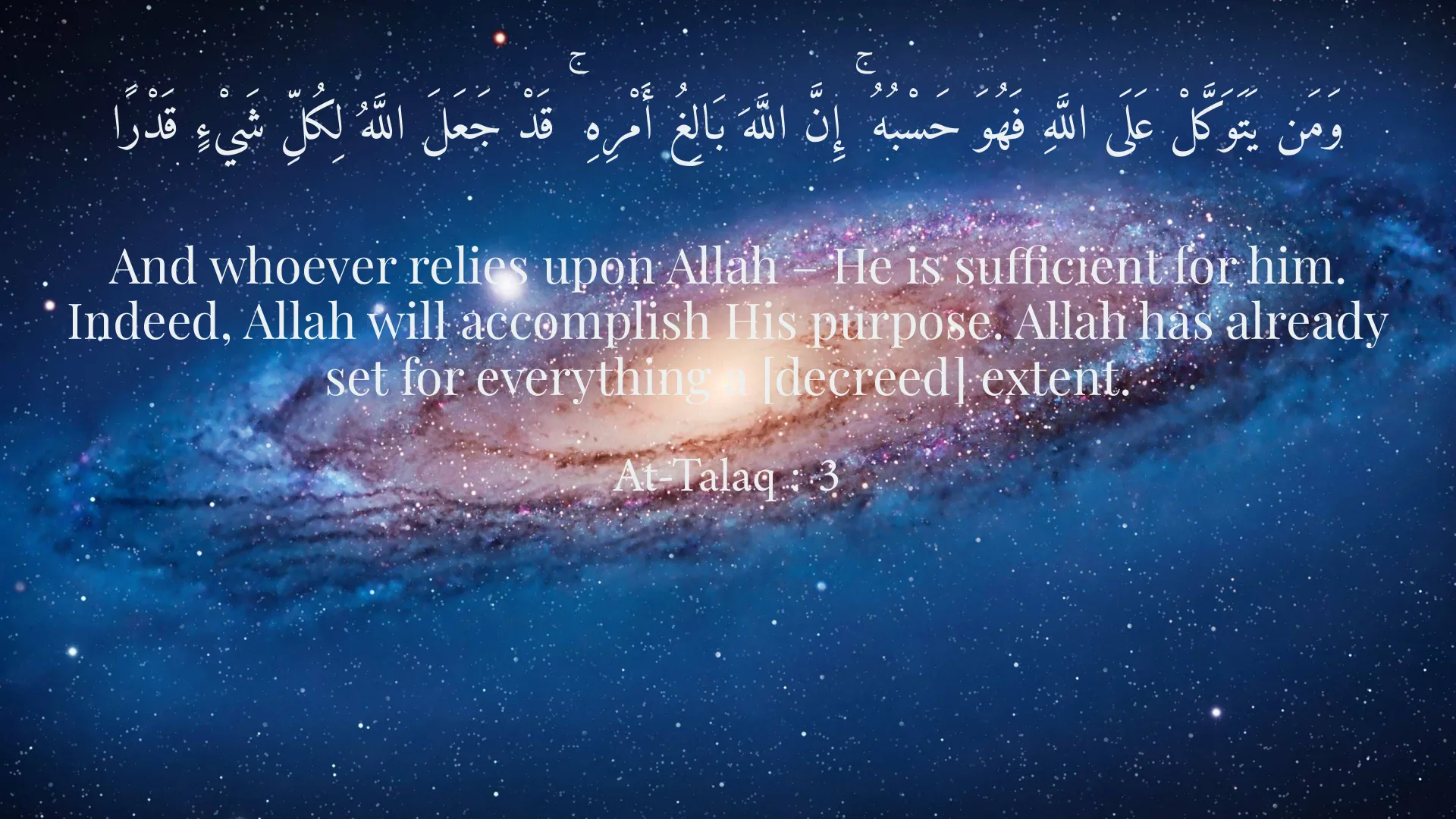
وَمَن يَتَوَكَّلْ عَلَى اللَّهِ فَهُوَ حَسْبُهُ ۚ إِنَّ اللَّهَ بَالِغُ أَمْرِهِ ۚ قَدْ جَعَلَ اللَّهُ لِكُلِّ شَيْءٍ قَدْرًا
And whoever relies upon Allah – He is sufficient for him. Indeed, Allah will accomplish His purpose. Allah has already set for everything a [decreed] extent.
At-Talaq : 3
فَبِمَا رَحْمَةٍ مِّنَ اللَّهِ لِنتَ لَهُمْ ۖ وَلَوْ كُنتَ فَظًّا غَلِيظَ الْقَلْبِ لَانفَضُّوا مِنْ حَوْلِكَ ۖ فَاعْفُ عَنْهُمْ وَاسْتَغْفِرْ لَهُمْ وَشَاوِرْهُمْ فِي الْأَمْرِ ۖ فَإِذَا عَزَمْتَ فَتَوَكَّلْ عَلَى اللَّهِ ۚ إِنَّ اللَّهَ یُحِبُّ الْمُتَوَكِّلِینَ
So by mercy from Allah, [O Muhammad], you were lenient with them. And if you had been rude [in speech] and harsh in heart, they would have disbanded from about you. So pardon them and ask forgiveness for them and consult them in the matter. And when you have decided, then rely upon Allah. Indeed, Allah loves those who rely [upon Him].
Al-Imran : 159
يَاأَيُّهَا الَّذِينَ آمَنُوا اسْتَعِينُوا بِالصَّبْرِ وَالصَّلَاةِ ۚ إِنَّ اللَّهَ مَعَ الصَّابِرِينَ
O you who have believed, seek help through patience and prayer. Indeed, Allah is with the patient.
Al-Baqarah : 153
Short Story
In Saadi's Gulistan, it is narrated that there was a dervish who relied solely on God for his daily sustenance. One day, a friend asked him, "Why don't you beg from this person or that to make your life easier?" The dervish smiled and said, "My dear friend, have you not heard what Saadi says: 'Whoever eats bread from his own labor, will not be indebted to Hatem-e Tai'? I prefer to lay my head at the threshold of the Self-Sufficient King rather than extend my hand of need towards a weak creature. For whoever relies on other than God will be disappointed, and whoever relies on Him, their hopes will be fulfilled. Dependency on people is like a river that sometimes flows and sometimes dries up, but reliance on God is an boundless ocean that never dries." His friend took heed of this saying and understood that true peace lies in independence from people and in being immersed in the boundless ocean of divine self-sufficiency.