Quranic Answer
Overcoming feelings of superiority, often rooted in pride and arrogance (kibr in Arabic), is a profound spiritual journey that the Holy Quran addresses with remarkable depth and clarity. The Quran views arrogance not merely as a personality flaw but as a dangerous spiritual malady that distances an individual from God and leads to destructive consequences in this life and the Hereafter. The essence of the Quranic teaching on this matter is to cultivate profound humility by recognizing one's true place in the universe relative to the infinite power and majesty of Allah, and by understanding the true criteria for honor and worth. Indeed, the Quran teaches us that any claim of superiority based on worldly appearances is an illusion that becomes a veil between an individual and truth, leading them astray from the straight path. This feeling hinders self-awareness of one's weaknesses and needs, thereby blocking the path to true growth and perfection. The Quran repeatedly warns against arrogance and pride, illustrating its perils through various narratives and direct admonitions. One of the earliest and most striking examples is the story of Iblis (Satan). When Allah commanded the angels and Iblis to prostrate before Adam, Iblis refused, saying, “I am better than him. You created me from fire and created him from clay” (Quran 7:12). This act of pride and self-exaltation, believing himself superior based on his origin, led to his expulsion from divine mercy and his eternal damnation. This foundational story teaches us that true superiority is not based on material composition, lineage, wealth, or power, but on obedience and humility before God's command. Arrogance, therefore, is depicted as the very first sin, a root cause of rebellion against the Divine Will, demonstrating how an inner feeling can lead to the greatest disobedience. Another powerful Quranic example is that of Qarun, a man blessed with immense wealth but consumed by his pride. When his people advised him to be grateful and not boast, he replied, “I was only given it because of knowledge I have” (Quran 28:78). He attributed his success solely to his own abilities, ignoring God's grace. Consequently, Allah caused the earth to swallow him and his palace, a stark reminder that worldly possessions and achievements are transient and belong to God. The Quran states, “Indeed, Allah does not like everyone self-deluded and boastful” (Quran 31:18, also 17:37). These verses explicitly condemn those who walk the earth with arrogance, reminding them that they cannot tear the earth or reach the mountains in height, emphasizing human limitations. Furthermore, in Surah An-Nahl, verse 23, it says: “Assuredly, Allah knows what they conceal and what they declare. Indeed, He does not like the arrogant.” These verses show that arrogance is inherently an abhorrent act in the sight of Allah, drawing the individual away from truth and leading them into misguidance. To overcome the feeling of superiority, the Quran offers several transformative principles: 1. Recognizing God's Absolute Majesty (Tawhid): The cornerstone of humility in Islam is the absolute recognition of Allah's Oneness and unparalleled greatness. When a person truly internalizes that Allah is the Creator, Sustainer, and ultimate Power, and all creation is dependent on Him, their own perceived grandeur diminishes. Every blessing, every success, every talent is a gift from Him. This understanding fosters gratitude and shatters any illusion of self-sufficiency or inherent superiority. The constant remembrance of Allah (dhikr), especially through prayer, helps to re-center the individual, reminding them of their servitude to the Most High. This belief in the oneness of God liberates a person from the bondage of ego and vanity, guiding them towards true humility and servitude. When one realizes that every breath they take and every step they make is by the grace and will of Allah, there remains no room for pride and self-admiration. 2. Understanding Human Origin and Purpose: The Quran frequently reminds humans of their humble origins – created from dust, from a mere drop of fluid. This serves as a powerful antidote to pride. “From it [the earth] We created you, and into it We will return you, and from it We will extract you another time” (Quran 20:55). This reminder of our temporary existence and ultimate return to dust highlights the futility of arrogance based on worldly attributes. Our primary purpose, as stated in the Quran, is to worship Allah (Quran 51:56), a purpose that demands humility and submission, not superiority over others. This constant reminder of our earthly origin and mortality prevents undue boasting and guides us towards realism. Understanding that we all come from a common source and will return to the same dust lays the foundation for true equality. 3. Piety (Taqwa) as the True Measure of Worth: The Quran definitively states that true honor and superiority are not found in lineage, race, wealth, beauty, or power, but in piety (taqwa) – consciousness of God. “O mankind, indeed We have created you from male and female and made you peoples and tribes that you may know one another. Indeed, the most noble of you in the sight of Allah is the most righteous of you. Indeed, Allah is Knowing and Acquainted” (Quran 49:13). This verse is a revolutionary declaration of human equality, dismantling all artificial hierarchies based on worldly distinctions. It teaches that the only valid criterion for distinction is one's relationship with God, characterized by reverence, obedience, and good deeds. This shifts the focus from external validation to internal purity and moral excellence. This perspective helps an individual compare themselves against the standard of taqwa rather than worldly appearances, which inherently eliminates feelings of superiority and fosters a spirit of cooperation and empathy. 4. Embracing Gratitude (Shukr) and Self-Correction: A person who feels superior often takes their blessings for granted or attributes them solely to themselves. Cultivating gratitude for every favor from Allah helps dismantle this mindset. Furthermore, true humility involves honest self-assessment and a willingness to acknowledge one's faults and limitations. The Quran encourages constant repentance and seeking forgiveness, which are acts of humility. Regularly reflecting on one's actions and motivations, and seeking guidance from the Quran and Sunnah, helps to identify and rectify any sprouts of arrogance. Understanding that all abilities and successes come from Allah eradicates pride. This continuous practice of self-awareness and gratitude saves a person from the trap of self-superiority and gives them the insight that for everything they possess, they are indebted to divine grace. 5. Service to Others and Forgiveness: Engaging in acts of kindness, charity, and service to fellow human beings, especially those less fortunate, naturally fosters humility. It shifts focus from self to others and reminds us of our shared humanity and vulnerability. The Quran also promotes forgiveness and overlooking the faults of others, which is an act of humility, as it implies letting go of perceived grievances or the desire to assert one's 'rightness' over another. These actions demonstrate that an individual does not see themselves as superior to others and is ready to stand beside them. When one sees themselves as a servant to others, the feeling of superiority gives way to a sense of responsibility and love. In essence, overcoming the feeling of superiority, according to the Quran, requires a complete reorientation of one's worldview, centering it around God's absolute sovereignty and human accountability. It is a continuous process of self-purification, where one constantly strives to embody humility in thought, word, and deed. This journey leads to inner peace, strengthens one's relationship with God, and fosters harmonious interactions with all of creation, leading to a life imbued with true dignity and contentment, rather than fleeting pride. This path is a way that liberates a person from the bondage of the ego and guides them towards freedom and salvation. By practicing these principles, one can escape the cage that pride builds for them and step into the blessed garden of humility and tranquility.
Related Verses
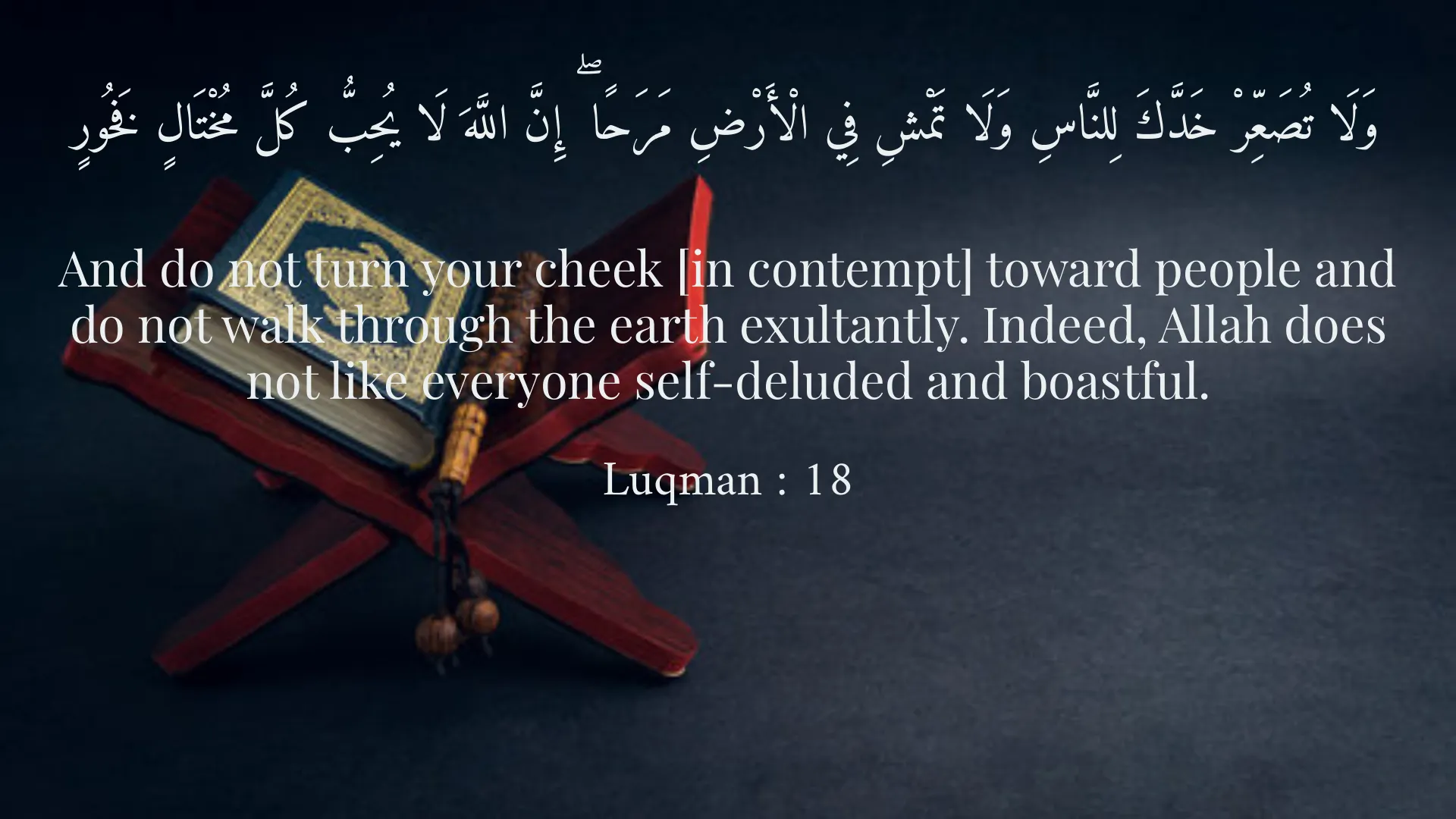
وَلَا تُصَعِّرْ خَدَّكَ لِلنَّاسِ وَلَا تَمْشِ فِي الْأَرْضِ مَرَحًا ۖ إِنَّ اللَّهَ لَا يُحِبُّ كُلَّ مُخْتَالٍ فَخُورٍ
And do not turn your cheek [in contempt] toward people and do not walk through the earth exultantly. Indeed, Allah does not like everyone self-deluded and boastful.
Luqman : 18
يَا أَيُّهَا النَّاسُ إِنَّا خَلَقْنَاكُم مِّن ذَكَرٍ وَأُنثَىٰ وَجَعَلْنَاكُمْ شُعُوبًا وَقَبَائِلَ لِتَعَارَفُوا ۚ إِنَّ أَكْرَمَكُمْ عِندَ اللَّهِ أَتْقَاكُمْ ۚ إِنَّ اللَّهَ عَلِيمٌ خَبِيرٌ
O mankind, indeed We have created you from male and female and made you peoples and tribes that you may know one another. Indeed, the most noble of you in the sight of Allah is the most righteous of you. Indeed, Allah is Knowing and Acquainted.
Al-Hujurat : 13
لَا جَرَمَ أَنَّ اللَّهَ يَعْلَمُ مَا يُسِرُّونَ وَمَا يُعْلِنُونَ ۚ إِنَّهُ لَا يُحِبُّ الْمُسْتَكْبِرِينَ
Assuredly, Allah knows what they conceal and what they declare. Indeed, He does not like the arrogant.
An-Nahl : 23
Short Story
It is narrated that there was once an arrogant and proud king who deemed himself superior to all. One day, as he sat on his palace balcony, he looked down with contempt upon the common folk passing by in the distance. A wise sage happened to pass by. The king, with pride, asked, "O sage, what truly makes a man superior? Is it not this throne, this crown, and my power?" The sage replied, "O King, true superiority lies not in arrogance and self-admiration. He who considers himself superior to others falls from grace in the eyes of truth. All people are from one root and one origin; what brings superiority is neither lineage nor wealth nor status, but humility before the Creator and service to creation. Whoever carries a speck of pride in their heart, even if seated on a golden throne, is lower in the sight of God and among the wise than the beggar who has laid his head on the threshold of humility." The king pondered these words deeply and gradually came to understand that greatness lies in humility, not in seeking superiority, and his life took on a new color.