Quranic Answer
Praying for oneself is a profound and spiritual connection with the Almighty, allowing individuals to communicate their desires, needs, fears, and hopes with the Creator of the universe. It is an acknowledgment of our absolute dependence on Allah and a sign of our humility before His grandeur. However, the concern about how to pray for oneself without falling into the trap of selfishness is a profoundly important and valid question, reflecting a desire for spiritual purity and alignment with Islamic ethics. The Quran provides comprehensive guidance not only on what to ask for, but how to ask, ensuring that our supplications elevate us rather than confine us to narrow self-interest. Firstly, the very essence of Du'a (supplication) in Islam is built upon humility and an acknowledgment of Allah's absolute sovereignty and beneficence. When we raise our hands in prayer, we are essentially admitting our weakness, our needs, and our complete reliance on a power far greater than ourselves. This inherent humility is the first bulwark against selfishness. The Quran teaches us to call upon Allah "in humility and in private. Indeed, He does not like transgressors" (Al-A'raf 7:55). Transgression in prayer can include asking for things that are unlawful, or asking with arrogance, or in a manner that lacks respect for Divine wisdom. A truly humble prayer understands that Allah's knowledge and wisdom far surpass our own, and therefore, even when asking for personal needs, we implicitly submit to His decree and what He deems best for us. This shifts the focus from "my will" to "Your will," inherently detaching the prayer from a purely selfish demand. Secondly, a powerful way to pray for oneself without being selfish is by broadening the scope of one's supplications to include others. The Quran presents numerous examples of prophets and righteous individuals who prayed not just for themselves, but for their parents, their progeny, their communities, and indeed, all believers. Prophet Noah (peace be upon him) prayed, "My Lord, forgive me and my parents and whoever enters my house a believer and the believing men and believing women" (Nuh 71:28). Similarly, Prophet Abraham (peace be upon him) supplicated, "Our Lord, forgive me and my parents and the believers on the Day the account is established" (Ibrahim 14:41). These are profound examples that teach us that our personal well-being is often intertwined with the well-being of others. When we pray for the forgiveness, guidance, health, or prosperity of others – our family, friends, neighbours, the entire Muslim Ummah, and even humanity at large – our own prayers become more expansive, more blessed, and more likely to be answered. The Prophet Muhammad (peace be upon him) said, "The supplication of a Muslim for his brother in his absence is answered. At his head there is an angel, and every time he supplicates for good for his brother, the angel says: 'Ameen, and for you the like thereof.'" This Hadith beautifully illustrates how praying for others directly benefits oneself, removing any trace of narrow selfishness. It transforms personal prayer into an act of community building and universal compassion. Thirdly, ensure your prayers are balanced and holistic, encompassing both worldly good and spiritual well-being. The most frequently recited comprehensive prayer in the Quran is, "Our Lord, give us in this world [that which is] good and in the Hereafter [that which is] good and protect us from the punishment of the Fire" (Al-Baqarah 2:201). This powerful supplication is not selfish because it seeks "good" in its broadest sense, which inherently includes elements that benefit not just the individual but also their interactions with others and their ultimate destiny. "Good in this world" isn't limited to material wealth but extends to good health, righteous spouses, beneficial knowledge, peace, and positive societal impact. "Good in the Hereafter" is the ultimate goal, signifying forgiveness, paradise, and Allah's pleasure, which are the antithesis of fleeting, selfish desires. By praying for comprehensive goodness, one's focus naturally extends beyond immediate, narrow personal gains to a more profound and enduring state of well-being that benefits all aspects of existence. Fourthly, cultivate a mindset of trust (Tawakkul) and contentment (Qana'ah) with Allah's decree. When we pray, we express our desires, but we also acknowledge that Allah knows what is truly best for us. Sometimes, what we perceive as good for ourselves might, in Allah's infinite wisdom, not be so. The Quran states, "...but perhaps you hate a thing and it is good for you; and perhaps you love a thing and it is bad for you. And Allah Knows, while you know not" (Al-Baqarah 2:216). This understanding frees our prayer from the grip of selfish insistence. We ask sincerely, but with an open heart ready to accept Allah's response, whether it's exactly what we asked for, something better, or a prevention of harm. This spiritual detachment from specific outcomes, while maintaining fervent hope, transforms the prayer from a demanding act into an act of humble reliance and surrender, thereby purifying it from selfishness. Finally, focus on praying for internal purification and spiritual growth. Asking Allah to cleanse your heart, to guide you to better character, to forgive your sins, to increase your faith, and to make you a more righteous servant, are all personal prayers that are inherently non-selfish. When a person becomes better, more just, more compassionate, and more virtuous, it benefits not only themselves but also everyone around them. A righteous individual contributes positively to their family, community, and society at large. These types of prayers align one's desires with divine pleasure and societal good, ensuring that even self-directed supplications lead to broader benefits and a more harmonious existence. In conclusion, praying for oneself without being selfish is achieved by approaching Allah with profound humility, encompassing others in one's supplications, seeking comprehensive good in both worlds, cultivating trust in divine wisdom, and focusing on spiritual purification. Such prayers transcend mere personal gain, transforming into powerful acts of worship that bring the individual closer to their Creator, enhance their character, and contribute to the well-being of the entire creation. This holistic approach ensures that our prayers for ourselves are not only permissible and answered but also elevate our spiritual state and make us better instruments of Allah's mercy in the world.
Related Verses
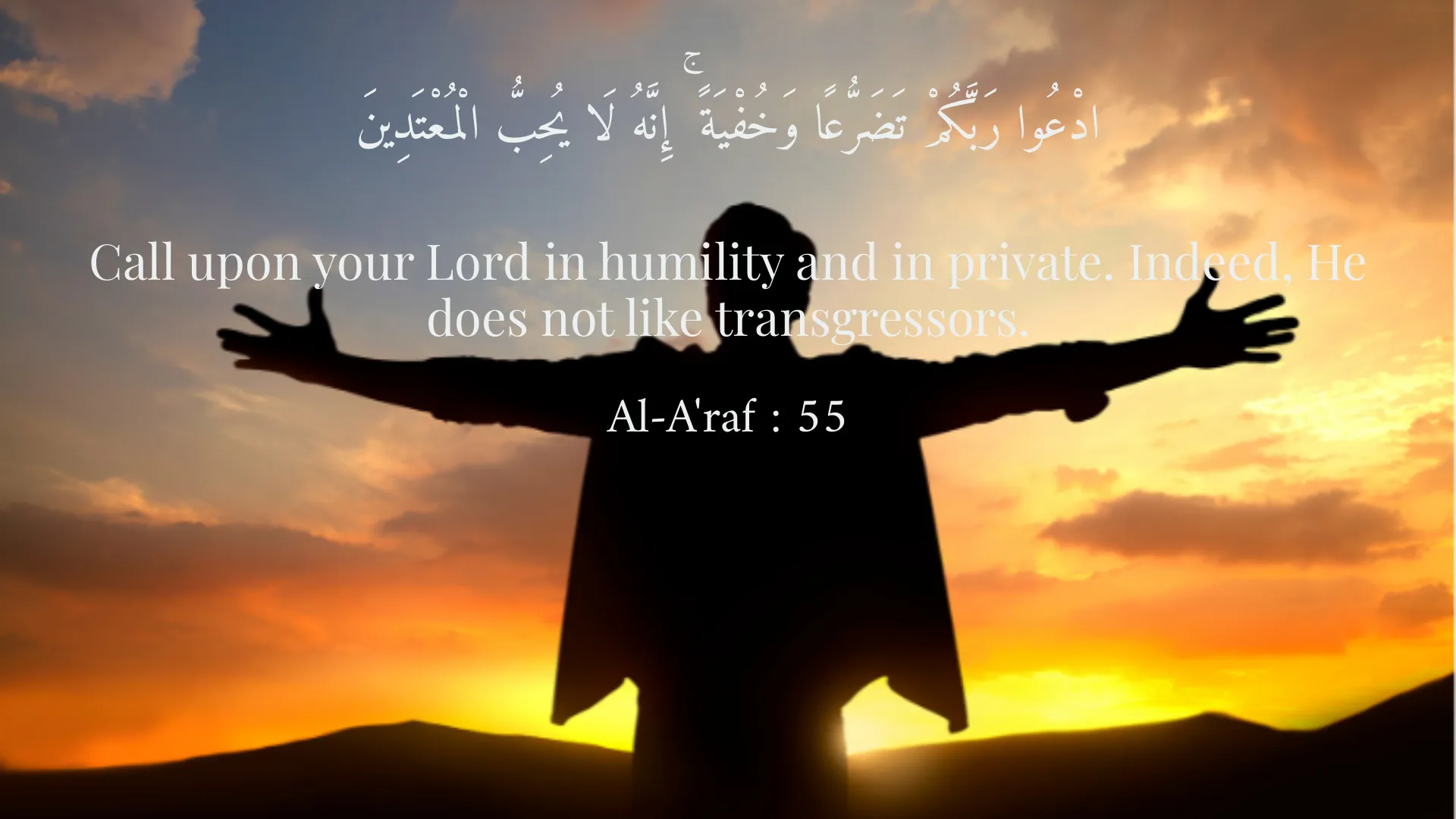
ادْعُوا رَبَّكُمْ تَضَرُّعًا وَخُفْيَةً ۚ إِنَّهُ لَا يُحِبُّ الْمُعْتَدِينَ
Call upon your Lord in humility and in private. Indeed, He does not like transgressors.
Al-A'raf : 55
رَبِّ اغْفِرْ لِي وَلِوَالِدَيَّ وَلِمَن دَخَلَ بَيْتِيَ مُؤْمِنًا وَلِلْمُؤْمِنِينَ وَالْمُؤْمِنَاتِ ۗ وَلَا تَزِدِ الظَّالِمِينَ إِلَّا تَبَارًا
My Lord, forgive me and my parents and whoever enters my house a believer and the believing men and believing women. And do not increase the wrongdoers except in destruction.
Nuh : 28
رَبَّنَا اغْفِرْ لِي وَلِوَالِدَيَّ وَلِلْمُؤْمِنِينَ يَوْمَ يَقُومُ الْحِسَابُ
Our Lord, forgive me and my parents and the believers on the Day the account is established.
Ibrahim : 41
Short Story
Once, a pious seeker, known as Amin, used to spend long hours in prayer, often asking Allah for specific personal advancements and comforts. Though his intentions were pure, a subtle unease lingered in his heart. One tranquil evening, while visiting a small village, he saw an old dervish, whose face radiated peace, praying with profound humility. The dervish’s supplications were not for himself, but for the hungry children, the ailing villagers, and for divine mercy upon all creation. Intrigued, Amin approached him. "O revered one," he asked, "why do your prayers mostly concern others, and rarely your own evident needs?" The dervish smiled warmly. "My dear son," he replied, "Saadi, the wise poet, said, 'If you wish to attain your own desire, desire what is good for others first.' When I extend my heart to the needs of others, Allah, in His boundless generosity, fills my own cup without me even asking. The joy of giving and the beauty of universal compassion are blessings that transcend all personal requests." Amin pondered these words deeply. From that day forward, his prayers became more inclusive, his heart more expansive, and he discovered a profound inner peace and an abundance that far surpassed his earlier, more limited desires.