Quranic Answer
How can one be careful that their good deeds do not lead to arrogance? This is a profoundly important and crucial question, addressing one of the most subtle yet destructive spiritual diseases: arrogance (kibr) and self-admiration (ujb). Performing good and benevolent deeds is a manifestation of pure human nature and leads to the pleasure of Allah. However, if these virtuous acts become tainted with the affliction of arrogance, not only are their true merits diminished, but they can also steer an individual away from the path of truth and righteousness. The Holy Quran, with its unparalleled wisdom, offers numerous solutions and guidelines for preserving sincerity and avoiding arrogance after engaging in good deeds. The first and foremost antidote to arrogance is "sincerity" (ikhlas). The Quran explicitly states that any action is only acceptable to Allah when it is performed purely and solely for His pleasure. In Surah Al-Bayyinah, verse 5, Allah says: "And they were not commanded except to worship Allah, [being] sincere to Him in religion, inclining to truth, and to establish prayer and to give zakah. And that is the correct religion." When the intention (niyyah) is sincere, meaning the action is performed only for Allah and not to gain praise or admiration from people, or to feel superior to others, the ground for arrogance is eliminated. Whenever a person attributes their good deeds to themselves, they fall into ujb and self-conceit. A true believer, however, understands that every good that emanates from them is a divine favor and a success granted by Allah. This perspective, instead of leading to boastfulness, compels a person towards gratitude. The second Quranic guideline is "humility" (tawadu'). Arrogance is a state where an individual perceives themselves as great and superior to others, whereas humility guides a person to understand their true place before Allah's magnificence and their own weaknesses in comparison to His absolute perfection. Luqman the Wise, in his advice to his son, explicitly prohibits arrogance and pride. In Surah Luqman, verse 18, it is stated: "And do not turn your cheek in contempt toward people and do not walk through the earth exultantly. Indeed, Allah does not like every self-deluded and boastful person." This verse clearly indicates that walking with arrogance and self-display, and looking down upon others, is condemned by Allah. A person must always remember that every blessing, whether it be the ability to perform good deeds, intelligence, beauty, or wealth, is a trust from Allah and should not be a cause for boasting. Humility in speech, conduct, and even intentions protects a person from the snare of arrogance. Third, the principle of "continuous gratitude" (shukr) is essential. Whenever a person performs a good deed, they should consider it a grace from Allah and be grateful for this divine enablement. In Surah Ibrahim, verse 7, Allah says: "And [remember] when your Lord proclaimed, 'If you are grateful, I will surely increase you [in favor]; but if you deny, indeed, My punishment is severe.'" This gratitude not only increases blessings but also makes a person constantly feel indebted and reliant upon Allah, rather than feeling entitled or arrogant. Gratitude for the success in doing good prevents a person from considering that good as an inherent personal quality. Fourth, "avoiding self-praise" (tazkiyat al-nafs) is crucial. The Quran teaches us not to consider ourselves pure and faultless and to refrain from self-praise, for only Allah knows our hidden and apparent states and is most knowing of who truly fears Him. In Surah An-Najm, verse 32, it is stated: "So do not purify yourselves; He is most knowing of who fears Him." This verse reminds us that a person may outwardly perform good deeds, but their intention might be impure, or they might become arrogant. Only Allah is aware of the truth of hearts. Therefore, whenever the temptation to self-praise arises, one should remember that Allah is more knowledgeable than them and nothing remains hidden from Him. Fifth, a vital point is "remembering one's own weaknesses and shortcomings." No human being is perfect, and everyone has flaws. Focusing on these weaknesses and striving to overcome them prevents an individual from solely focusing on their good deeds and keeps them on the path of humility. Even if a person has performed numerous good deeds, their actions are still insignificant compared to Allah's infinite greatness and mercy, and there is always room for improvement and atonement. Sixth, "paying attention to Quranic and historical examples" serves as a powerful reminder. The story of Iblis, the first being expelled from Allah's presence due to arrogance and pride, serves as a perpetual warning. He considered himself superior to Adam and refused to prostrate before him. The story of Qarun, who became arrogant due to his wealth and knowledge and was eventually swallowed by the earth, is another example of the dire consequences of pride. In contrast, the lives of prophets and divine saints are full of humility and modesty, despite their high ranks. Prophet Muhammad (peace be upon him), despite being the noblest of creation, always lived with utmost humility and considered himself a servant among Allah's servants. To prevent our good deeds from leading to arrogance, we must constantly examine our intentions. Am I doing this for Allah, or for people to praise me? Am I doing this to prove to myself how good I am? If the answer is Allah's pleasure, then a person should consider themselves merely an instrument for the fulfillment of Divine will. Furthermore, we must understand that the ability to perform any good deed, from the smallest help to a needy person to the greatest social service, is a blessing from Allah. Without His power and will, no action emanates from us. This deep conviction dries up the roots of arrogance. Finally, remembering that the true reward for actions rests with Allah prevents arrogance. If a person aims for worldly rewards and praises, they become susceptible to arrogance. But if they know that the true reward comes only from Allah and that it is He who accepts deeds with His grace and generosity, then they will refrain from self-praise. Good deeds are opportunities for drawing closer to Allah, not tools for boasting or gaining personal credibility. By adhering to these Quranic principles and relying on Allah, we can protect our righteous deeds from the blight of arrogance and ensure that we remain on the correct path of servitude. This path leads to true peace in this world and eternal felicity in the hereafter.
Related Verses
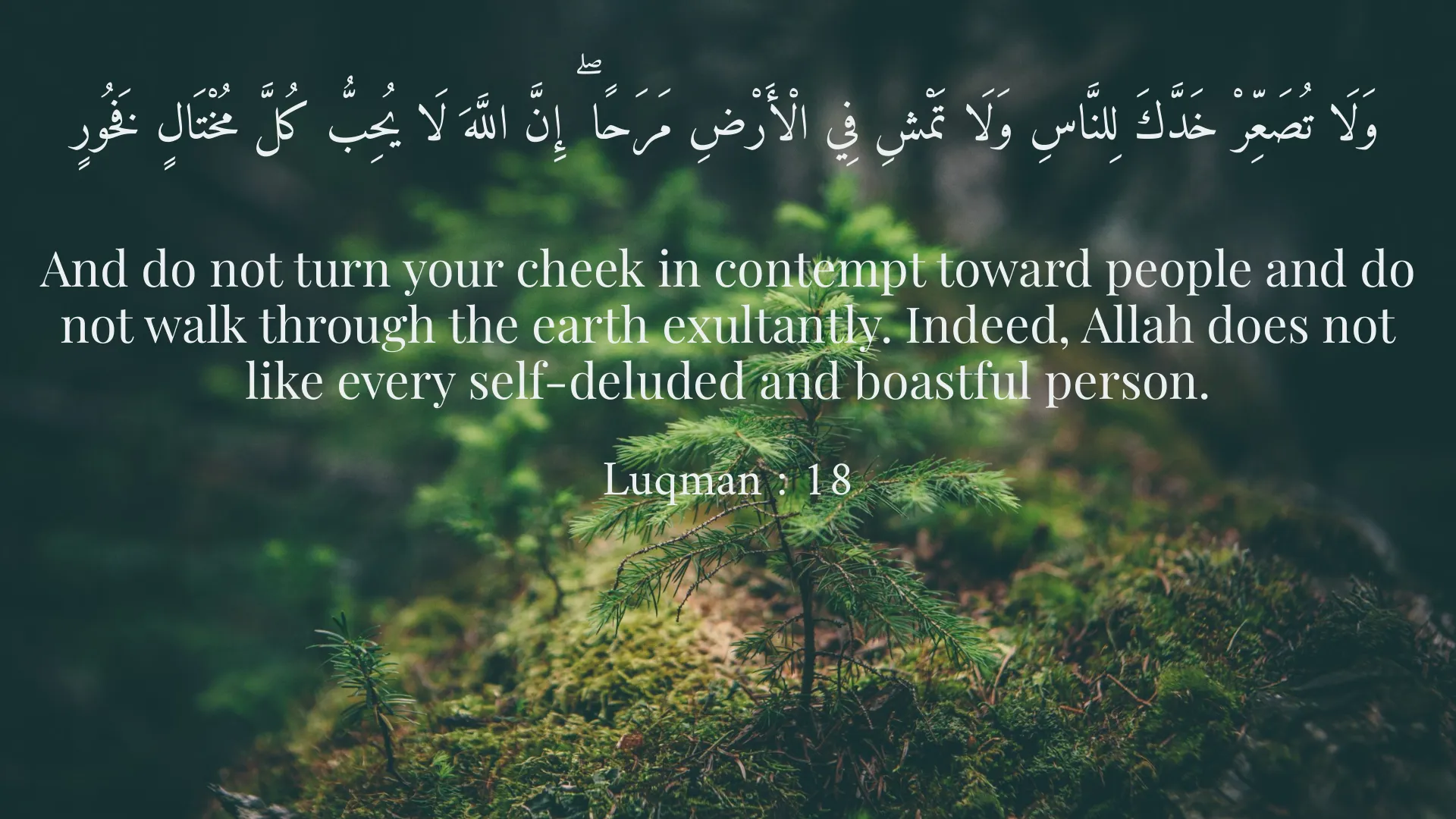
وَلَا تُصَعِّرْ خَدَّكَ لِلنَّاسِ وَلَا تَمْشِ فِي الْأَرْضِ مَرَحًا ۖ إِنَّ اللَّهَ لَا يُحِبُّ كُلَّ مُخْتَالٍ فَخُورٍ
And do not turn your cheek in contempt toward people and do not walk through the earth exultantly. Indeed, Allah does not like every self-deluded and boastful person.
Luqman : 18
وَمَا أُمِرُوا إِلَّا لِيَعْبُدُوا اللَّهَ مُخْلِصِينَ لَهُ الدِّينَ حُنَفَاءَ وَيُقِيمُوا الصَّلَاةَ وَيُؤْتُوا الزَّكَاةَ ۚ وَذَٰلِكَ دِينُ الْقَيِّمَةِ
And they were not commanded except to worship Allah, [being] sincere to Him in religion, inclining to truth, and to establish prayer and to give zakah. And that is the correct religion.
Al-Bayyinah : 5
فَلَا تُزَكُّوا أَنفُسَكُمْ ۖ هُوَ أَعْلَمُ بِمَنِ اتَّقَىٰ
So do not purify yourselves; He is most knowing of who fears Him.
An-Najm : 32
Short Story
In ancient times, there lived a pious and benevolent man who performed many good deeds. However, he sometimes spoke eagerly of his virtues to people, expecting praise. One day, a wise dervish observed him and kindly said, "O seeker of virtue! If your aim in these deeds is the praise of people, know that your reward is found in these fleeting commendations and has no lasting value. But if your heart yearns for the Creator's pleasure, then conceal your good deeds as you would your sins, for God is aware of all things, and His reward is eternal." The pious man was deeply moved by these wise words and understood that true piety lies in humility and sincerity, not in fame and praise. From then on, he performed his good deeds in secret and found profound peace and a true closeness to his Lord.