Quranic Answer
Purifying intention in worship, known in Islamic terminology as 'Ikhlas' (sincerity), is one of the most fundamental and vital pillars of any righteous deed. The Holy Quran repeatedly emphasizes the importance of Ikhlas, for without a pure intention, no act, no matter how grand or impressive, will hold value or acceptance in the sight of Allah Almighty. Allah states in the Quran: "And they were not commanded except to worship Allah, [being] sincere to Him in religion, inclining to truth, and to establish prayer and to give zakat. And that is the correct religion." (Surah Al-Bayyinah, 98:5). This verse clearly demonstrates that the essence and foundation of servitude is sincerity in intention. Ikhlas means that all our actions, whether acts of worship or otherwise, are performed solely and exclusively to gain the pleasure and satisfaction of the Lord, without any taint of ostentation (riya'), showing off, seeking people's attention, or achieving worldly gains. To purify our intention in worship, we must take several practical and spiritual steps that have strong Quranic and Islamic roots. The first step is constant self-awareness and contemplation (muraqabah). Before beginning any act of worship, be it prayer, fasting, charity, or even helping others, we should pause for a moment and ask ourselves: "What is my aim in doing this? Is it merely to fulfill an obligation? Do I want to be praised by others? Or do I truly want to draw closer to my Lord and gain His pleasure?" This internal questioning helps us identify our true motivation and remove any impurity from it. The Quran greatly emphasizes reflection and deliberation, and this contemplation of intention is a deep form of reflection on our own actions. The second step is to focus on the greatness of Allah and our own humility. When a servant stands before the Lord of the worlds, their entire mind and heart should be directed towards Him. This focus eliminates any desire for self-display before creation. The more our knowledge of Allah and His attributes, such as absolute power, infinite knowledge, and boundless mercy, increases, the deeper our sincerity will become. Reminding ourselves that only Allah sees and rewards our deeds helps us avoid showing off to others. Verse 110 of Surah Al-Kahf addresses this: "So whoever hopes for the meeting with his Lord, let him do righteous deeds and not associate anyone in the worship of his Lord." This 'associating no one' signifies absolute sincerity. The third step is to steer clear of 'riya' (showing off) and 'sum'ah' (seeking reputation). 'Riya' means performing good deeds to be seen by people, and 'sum'ah' means performing good deeds to be heard of and become famous among people. Both of these corrupt the intention and nullify the value of the deed. The Prophet Muhammad (peace be upon him) said: "Secrecy in good deeds is better than making them public, except in cases where making them public encourages others." Although this is a Prophetic hadith, its spirit aligns with Quranic teachings about humility and avoiding ostentation. Striving to perform acts of worship secretly, to the extent that it does not infringe upon obligations or the rights of others, can help strengthen sincerity. For example, hidden charity, voluntary prayers in solitude, and remembrance and supplication in private are excellent opportunities to practice sincerity. Allah says in the Quran (Surah Al-Baqarah, 2:271): "If you disclose your charities, it is well; but if you conceal them and give them to the poor, it is better for you." This verse clearly indicates that secrecy in good deeds, especially charity, is closer to pure intention. The fourth step is to seek refuge in Allah and supplicate for sincerity. Humans alone cannot overcome the carnal and satanic temptations that lead them towards 'riya' and self-display. One must humbly ask Allah to purify their heart from all impurities. The supplications that the Prophet (PBUH) used to make for sincerity, such as "O Allah, I seek refuge in You from associating anything with You knowingly, and I seek Your forgiveness for what I do not know," are examples of seeking such help. The Quran is also full of verses of supplication that invite humanity to humble themselves before Allah. Sincerity is a divine gift bestowed upon those who truly seek it and strive for it. The fifth step is to study and reflect upon the lives of the Prophets and righteous predecessors. Their lives are replete with lessons of sincerity. Prophet Muhammad (PBUH), at the peak of his power and popularity, always considered himself a servant and messenger of Allah and performed all his actions solely for Allah's pleasure. Emulating these divine vicegerents and saints, whose very essence was woven with sincerity, can be a great source of inspiration for us. The Quran presents the lives of the prophets as the best role models for humanity. Ultimately, sincerity is a journey, not a destination. It requires continuous effort, self-purification, and struggle against the commanding self (nafs al-ammarah). One should never assume that they have reached the ultimate stage of sincerity. Every moment, one must review their intention and strive to make it purer than before. With practice and persistence, sincerity gradually takes root in one's being, and all their actions acquire a divine essence, which is the very tranquility and felicity that a person seeks in this world and the hereafter. Allah says in Surah Az-Zumar (39:2): "Indeed, We have sent down to you the Book in truth, so worship Allah, [being] sincere to Him in religion." This verse explicitly commands sincere worship and shows that sincerity is the essence of religiosity. Therefore, to purify one's intention, one must always feel in the presence of Allah, avoid ostentation and showing off, seek His help, and through continuous righteous deeds and contemplation of the heart, move towards pure sincerity.
Related Verses
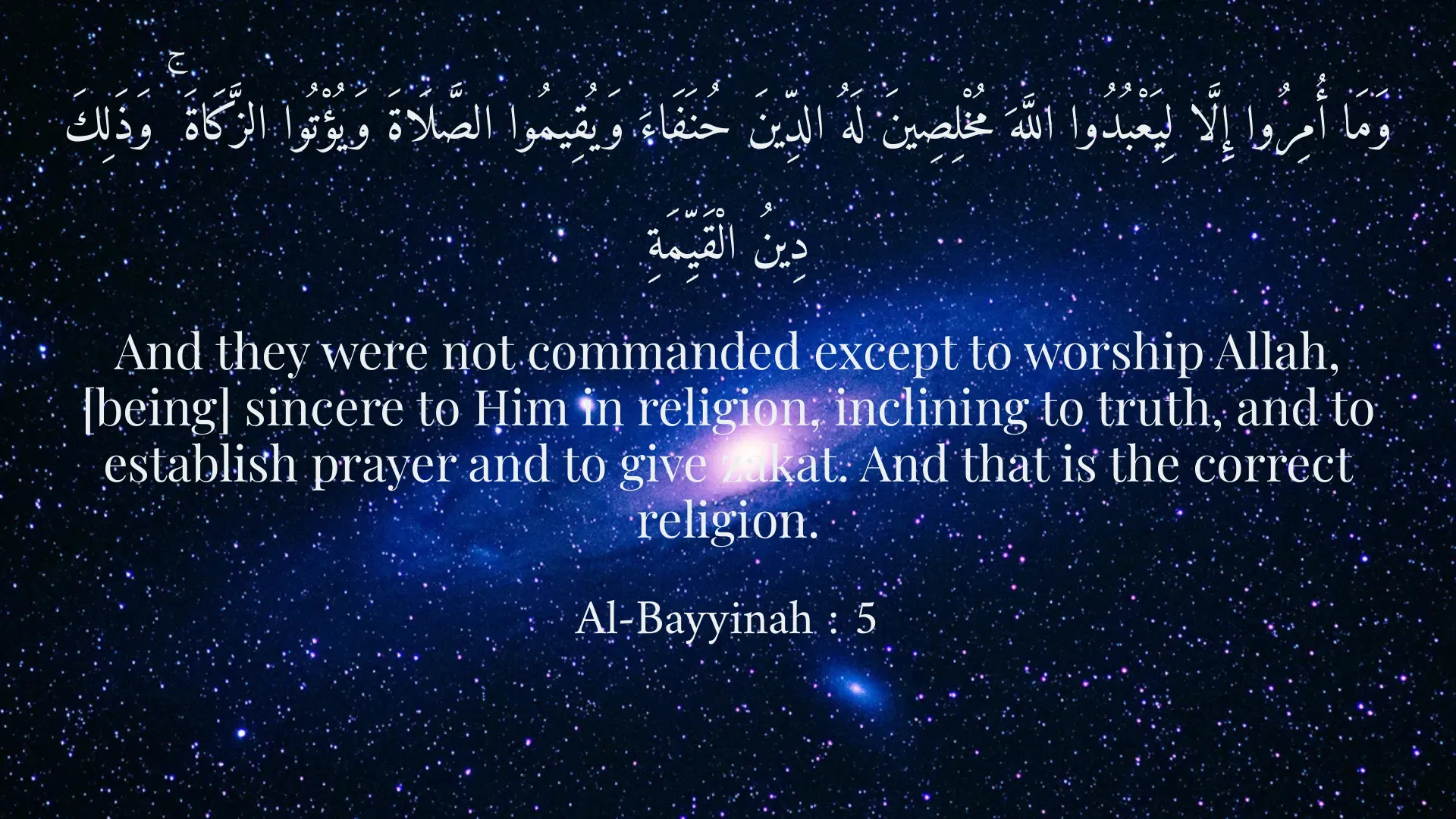
وَمَا أُمِرُوا إِلَّا لِيَعْبُدُوا اللَّهَ مُخْلِصِينَ لَهُ الدِّينَ حُنَفَاءَ وَيُقِيمُوا الصَّلَاةَ وَيُؤْتُوا الزَّكَاةَ ۚ وَذَلِكَ دِينُ الْقَيِّمَةِ
And they were not commanded except to worship Allah, [being] sincere to Him in religion, inclining to truth, and to establish prayer and to give zakat. And that is the correct religion.
Al-Bayyinah : 5
قُلْ إِنَّمَا أَنَا بَشَرٌ مِّثْلُكُمْ يُوحَىٰ إِلَيَّ أَنَّمَا إِلَٰهُكُمْ إِلَٰهٌ وَاحِدٌ ۖ فَمَن كَانَ يَرْجُو لِقَاءَ رَبِّهِ فَلْيَعْمَلْ عَمَلًا صَالِحًا وَلَا يُشْرِكْ بِعِبَادَةِ رَبِّهِ أَحَدًا
Say, 'I am only a human being like you, to whom has been revealed that your God is one God. So whoever hopes for the meeting with his Lord, let him do righteous deeds and not associate anyone in the worship of his Lord.'
Al-Kahf : 110
إِنَّا أَنزَلْنَا إِلَيْكَ الْكِتَابَ بِالْحَقِّ فَاعْبُدِ اللَّهَ مُخْلِصًا لَّهُ الدِّينَ
Indeed, We have sent down to you the Book in truth, so worship Allah, [being] sincere to Him in religion.
Az-Zumar : 2
Short Story
In Saadi's Bustan, it is narrated that a devout king would perform night prayers and fervent supplications every night. One day, his vizier saw him in solitude, humbly engaged in communion with God. The king said, "Keep me hidden from the people, and do not imagine that this worship is so that I may appear good in the eyes of creation. For if all the people of the world praise me and God turns away from me, it is worth nothing." Then he added, "Intention is the king of deeds, and if the intention is not pure, the deed is like a broken vessel: whatever you pour into it spills out, and nothing remains." This saying of the king reminds us that purity of intention is the basis for the acceptance of any worship, and what transpires in the solitude of the heart is more important than any outward appearance.