Quranic Answer
The Holy Quran, the divine revelation, is not merely a book of worship but a comprehensive and complete guide for all aspects of human life. When making decisions, especially when faced with difficult and fateful choices, Muslims can and should draw guidance from this pure spring of divine wisdom. Utilizing the Quran for decision-making goes beyond simply opening it and randomly picking a verse; rather, it requires a comprehensive and profound approach that involves understanding the Quran's principles, objectives, and overall spirit, and then applying them to specific life situations. This multi-stage process leads an individual toward a conscious, responsible, and divinely aligned choice. The first step in deriving guidance from the Quran for decision-making is 'Tadabbur' (deep contemplation) of its verses. Tadabbur means profound reflection, meditation, and a deep understanding of the divine meanings and messages. The Quran itself invites us to Tadabbur, urging us not to suffice with mere recitation but to delve into the essence of its words and sentences, extracting its hidden messages. Allah says: "Then do they not reflect upon the Quran, or are there locks upon [their] hearts?" (Surah Muhammad: Verse 24). This contemplation involves reading reputable translations, consulting authentic commentaries (Tafsir), and understanding the context of revelation (Shan-e-Nuzul) for the verses. Through Tadabbur, an individual gains access to a set of guiding values, ethics, and universal principles that can serve as a solid foundation for any decision. For instance, the Quran strongly emphasizes justice, benevolence (Ihsan), truthfulness, patience (Sabr), reliance on God (Tawakkul), avoidance of oppression, and respect for the rights of others. Any decision that contradicts these fundamental principles is certainly far from the Quran's path. Therefore, before making any decision, one should ask: Is this decision consistent with divine justice? Does it oppress anyone? Are the rights of others being violated? Is it based on honesty and truth? This perspective helps our decisions gain a moral and divine foundation. The second approach is to pay attention to the 'Maqasid al-Shari'ah' (Objectives of Islamic Law), which are derived from the overall spirit of the Quran. Maqasid al-Shari'ah refers to the noble goals that Allah intends through the promulgation of divine laws, such as the preservation of religion (Din), life (Nafs), intellect (Aql), progeny (Nasl), and wealth (Mal). Every decision must be in line with these objectives and should not undermine any of these five essential principles. For example, if a decision helps preserve human lives, it takes precedence from the Quranic perspective. Or if a decision contributes to the intellectual and spiritual growth of an individual or society, it is affirmed by the Quran. This acts as a powerful filter that helps us weigh our decisions against divine criteria and avoid options that lead to corruption, harm, or deviation. In essence, these objectives serve as a general framework for analyzing and evaluating available options, providing profound insight to the decision-maker. The third principle is 'Shura' (Consultation). The Holy Quran commands the Prophet Muhammad (PBUH), despite his infallibility and divine knowledge, to consult with others: "And consult them in the matter. And when you have decided, then rely upon Allah. Indeed, Allah loves those who rely [upon Him]." (Surah Al-Imran: Verse 159). This verse indicates that even after Tadabbur and understanding Quranic principles, consultation with knowledgeable, trustworthy, and expert individuals is an essential principle in decision-making. Consultation illuminates different dimensions of an issue, reveals hidden aspects, and allows one to benefit from the experiences and knowledge of others. The Quran urges believers to conduct their affairs through mutual consultation, because collective wisdom is often superior to individual wisdom. This consultation should not be limited to like-minded individuals but should include those with diverse perspectives, provided they are people of piety and sincerity, so they offer impartial and beneficial advice. The fourth principle is 'Tawakkul' (Reliance on God). After contemplation, consultation, and striving to choose the best option based on Quranic principles, one must place their complete trust in Allah. Tawakkul does not mean abandoning responsibility or being passive; rather, it means exerting all possible efforts, utilizing all rational and consultative capacities, and then entrusting the outcome to Allah, with the faith that Allah desires the best for His servant. Verse 159 of Surah Al-Imran places Tawakkul after 'azm' (making a firm decision). This indicates that Tawakkul complements intellect and effort, and without it, even the best decisions may not yield the desired results. Tawakkul brings peace of mind, removes anxiety, and reduces unnecessary worries, for one knows that the ultimate outcome rests in the hands of the All-Powerful and All-Wise Divine will. Fifth, attention to 'Taqwa' (God-consciousness or piety) is crucial. Taqwa, meaning self-restraint and mindfulness of God, plays a central role in all stages of decision-making. The Quran states: "O you who have believed, if you fear Allah, He will grant you a criterion [to distinguish between right and wrong]" (Surah Al-Anfal: Verse 29). Taqwa illuminates the human heart and strengthens one's ability to distinguish between truth and falsehood. A person with Taqwa is less likely to fall prey to whims, personal gain, or external pressures, and their decisions are more likely to be shaped by divine pleasure. Indeed, Taqwa is an internal compass that guides an individual toward what is right and good, keeping them away from satanic and egoistic temptations. Possessing Taqwa is a fundamental prerequisite for deeply understanding the Quran's messages and applying them correctly in life. Sixth, 'Istikhara' is a form of seeking guidance. Although Istikhara refers to a specific prayer asking Allah for the best choice when faced with indecision and ambiguity (and practices like Istikhara with the Quran are interpretations stemming from the Prophet's Sunnah), its spirit is entirely Quranic. The Quran consistently emphasizes seeking help from Allah and supplication (Dua). When an individual has completed all the aforementioned stages – contemplation, consultation, research, and analysis – yet remains hesitant between several legitimate and good options, they can then humbly beseech Allah for the best outcome. This act demonstrates the ultimate Tawakkul and submission to Allah's will, effectively acknowledging the limitations of human knowledge and the profound need for divine guidance. Istikhara should not replace logical thought and consultation but should be employed after them as a final recourse to resolve bewilderment, especially when all rational and consultative efforts have reached an impasse. Ultimately, using the Quran for decision-making is a dynamic and ongoing process. The Quran provides us with a moral, spiritual, and legal framework by which we can evaluate different options. This framework reminds us that every decision we make has both worldly and eternal consequences and must aim to attain divine pleasure and true success. Let us remember that the Quran is a guiding light that illuminates the path of life in darkness and bestows upon humanity profound insight and wisdom. The deeper one's connection with the Quran, the more their heart is illuminated by divine light, and their ability to make correct and just decisions increases. This not only helps the individual in their personal life but also enables them to play a more constructive role in society and make decisions that benefit the general welfare and uplift divine values. The Holy Quran desires for humans to be thoughtful, responsible, consultative, and reliant on God, and these qualities ultimately help them to make the best and most righteous decisions at every juncture of life and always walk in the path of Allah's pleasure.
Related Verses
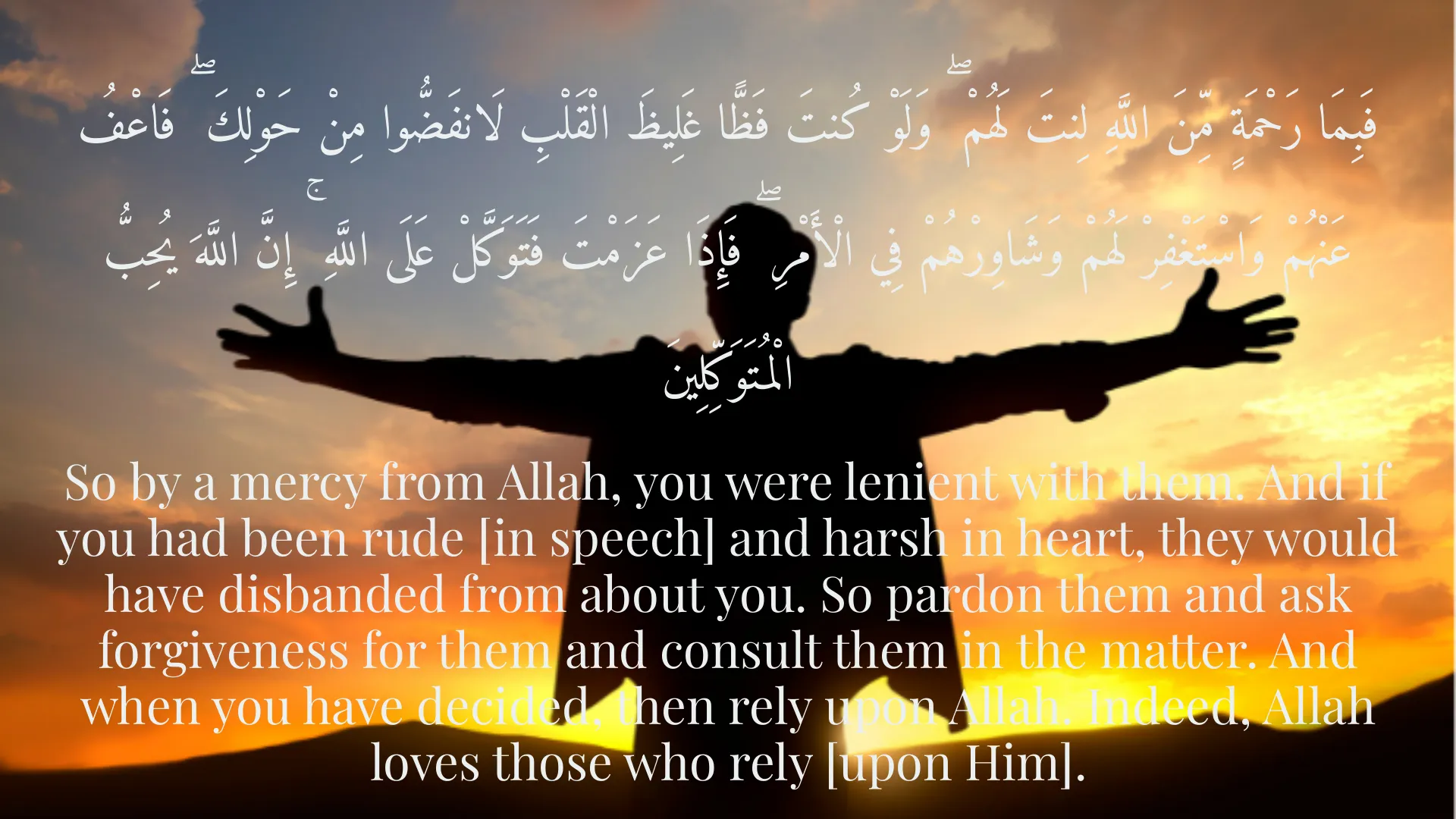
فَبِمَا رَحْمَةٍ مِّنَ اللَّهِ لِنتَ لَهُمْ ۖ وَلَوْ كُنتَ فَظًّا غَلِيظَ الْقَلْبِ لَانفَضُّوا مِنْ حَوْلِكَ ۖ فَاعْفُ عَنْهُمْ وَاسْتَغْفِرْ لَهُمْ وَشَاوِرْهُمْ فِي الْأَمْرِ ۖ فَإِذَا عَزَمْتَ فَتَوَكَّلْ عَلَى اللَّهِ ۚ إِنَّ اللَّهَ يُحِبُّ الْمُتَوَكِّلِينَ
So by a mercy from Allah, you were lenient with them. And if you had been rude [in speech] and harsh in heart, they would have disbanded from about you. So pardon them and ask forgiveness for them and consult them in the matter. And when you have decided, then rely upon Allah. Indeed, Allah loves those who rely [upon Him].
Al-Imran : 159
يَا أَيُّهَا الَّذِينَ آمَنُوا إِنْ تَتَّقُوا اللَّهَ يَجْعَلْ لَكُمْ فُرْقَانًا وَيُكَفِّرْ عَنكُمْ سَيِّئَاتِكُمْ وَيَغْفِرْ لَكُمْ ۗ وَاللَّهُ ذُو الْفَضْلِ الْعَظِيمِ
O you who have believed, if you fear Allah, He will grant you a criterion [to distinguish between right and wrong] and remove from you your evil deeds and forgive you. And Allah is the possessor of great bounty.
Al-Anfal : 29
ذَٰلِكَ الْكِتَابُ لَا رَيْبَ فِيهِ هُدًى لِّلْمُتَّقِينَ
This is the Book about which there is no doubt, a guidance for those conscious of Allah -
Al-Baqarah : 2
Short Story
It is narrated that a king faced a great difficulty and pondered over a solution. He would sleep restlessly every night. His wise vizier, who was a sage and full of foresight, one day said to the king: 'O Monarch, whenever a difficult matter arises, it is fitting that you first consult your own wisdom and ponder well over its consequences. Then, seek counsel from the wise and experienced, for the collective opinion is better than an individual's. After the aspects of the matter become clear and your heart settles upon a decision, then rely upon the Creator of the world, for He is the best Guide.' The king acted upon his vizier's words. He held numerous meetings with his scholars and advisors, weighed every aspect of the problem, and then, with a confident heart and reliance on God, made a decision that not only resolved his issue but also brought comfort and prosperity to his people. From then on, in every matter, the king would first contemplate, then consult, and finally rely upon God, saying: 'The right path depends on these three principles, to which the Holy Quran has guided us.'