Quranic Answer
Today's young generation navigates a rapidly changing world, saturated with information and countless choices. These circumstances, coupled with societal pressures, shifting norms, and a lack of stable values, often lead to a profound identity crisis. Young people find themselves adrift, grappling with fundamental questions: "Who am I?" "What is my place in this world?" and "What is the purpose of my life?" In such an environment, the Holy Quran emerges as a guiding light, offering not only comprehensive and foundational answers but also providing robust pillars for shaping a stable and meaningful identity; an identity that, amidst the turbulence of the modern world, acts as a steadfast anchor, preventing aimlessness and rootlessness. One of the most fundamental contributions of the Quran is its definition of the "purpose of life." In today's world, many young individuals pursue transient and materialistic goals that, after a period, leave them with a sense of emptiness and meaninglessness. The Quran explicitly states that humanity was not created merely for a material existence but for a higher, nobler purpose. Verse 56 of Surah Adh-Dhariyat declares: "And I did not create the jinn and mankind except to worship Me." This worship is not merely confined to outward rituals; rather, it encompasses all aspects of life, from how one interacts with others to striving for the betterment of society. This broad view of servitude helps young people align all their activities with a divine and transcendent goal. The Quran bestows upon humanity a lofty status, as stated in Verse 30 of Surah Al-Baqarah: "And [mention, O Muhammad], when your Lord said to the angels, 'Indeed, I will make upon the earth a successive authority (khalifa).'" This status of "Khalifatullah," or God's vicegerent on Earth, instills in youth a profound sense of responsibility, capability, and purposefulness that transcends individual needs, guiding them towards serving creation and nurturing the Earth. Possessing such a divine and exalted purpose rescues a young person's identity from confusion and instability, imbuing it with depth and meaning. They no longer shatter in the face of environmental turbulence, because the anchor of their identity is firmly rooted in something eternal and immutable, giving them an everlasting sense of intrinsic worth. The Quran, by emphasizing "Tawhid," or the Oneness of God, presents a cohesive and integrated belief framework. In a world where numerous ideologies and philosophies compete for the attention of young minds, each offering a partial truth, Tawhid stands as a singular, unparalleled source of truth and values. This concept helps young people escape intellectual and spiritual fragmentation, enabling them to find a focused and rooted identity in an absolute truth. When a young person embraces the belief that everything originates from a single source and returns to Him, their perspective on life, relationships, and values becomes clear and unified. This unity in the origin of existence also signifies unity in destiny, which itself is comforting and identity-forming, as it reassures them that they are walking on the right, divine path and will ultimately return to their Creator. Furthermore, the Quran provides a comprehensive and timeless "moral and ethical framework" that is essential for building a healthy and functional identity. In a world where moral values have become relative and fluid, and the boundaries between good and evil are blurred, the Quran offers young people a steadfast and reliable compass. Concepts such as justice, honesty, patience, kindness to parents, helping the needy, truthfulness, fulfilling promises, and abstaining from oppression and corruption are all strong ethical foundations in the Quran. Verse 90 of Surah An-Nahl states: "Indeed, Allah enjoins justice and good conduct and giving to relatives and forbids immorality and bad conduct and oppression. He admonishes you that perhaps you will be reminded." Adhering to these commands builds a young person's identity upon human and divine virtues, allowing them to make moral decisions with confidence and to preserve their authenticity and integrity when faced with challenges and social pressures. This framework instills self-confidence in youth and prevents them from blindly following fleeting trends and changing, sometimes unhealthy, societal norms. The sense of "belonging to a community (Ummah)" is another significant benefit the Quran bestows upon young people. In an era witnessing rising social isolation and extreme individualism, where social networks sometimes lead to more loneliness rather than genuine connection, the Quran, by emphasizing the concept of "Ummah Wahidah" (one community), invites youth to solidarity and unity. Verse 103 of Surah Al-Imran proclaims: "And hold firmly to the rope of Allah all together and do not become divided." This sense of belonging to a larger community, built upon shared Islamic values, provides young people with a feeling of support, companionship, and security, alleviating their sense of loneliness and alienation. They are no longer isolated islands in the vast ocean of life but rather part of a unified and grand body that supports one another and shares in joys and sorrows. These spiritual and social connections add important layers to a young person's identity, saving them from feelings of emptiness and rootlessness, and enabling them to progress in both individual and collective growth. The Quran also calls upon young people to engage in "self-reflection and accountability." Verse 18 of Surah Al-Hashr reminds us: "O you who have believed, fear Allah and let every soul look to what it has put forth for tomorrow - and fear Allah. Indeed, Allah is Acquainted with what you do." This verse encourages youth to look inward, evaluate their actions, and plan for a better future, rather than blaming others or dwelling on negative thoughts and despair. This forward-looking perspective and responsibility for one's actions are crucial parts of forming a mature, independent, and dynamic identity that allows young people to actively shape their own destiny. Moreover, the Quran teaches youth "patience and hope." When facing difficulties, setbacks, and despair, which are an inseparable part of life, the Quran, with its divine promises and reminders that "For indeed, with hardship [will be] ease. Indeed, with hardship [will be] ease" (Surah Ash-Sharh, verses 5 and 6), grants them the power of perseverance and resilience. These teachings help young people not to lose their identity in the face of life's challenges, but to continue their path with hope for the future and reliance on God. A strong identity is one that does not bend under hardship, and the Quran provides this firm foundation and an unbreakable spirit. Finally, the Quran places significant emphasis on "seeking knowledge and wisdom." By encouraging contemplation, reflection, and study of divine verses and the signs of creation, the Quran guides young people towards acquiring deep knowledge and insight. This rational and scientific approach helps youth view the world with an open and critical mind, discover truths, and form an identity based on understanding, perception, and insight, rather than blind imitation or superficial acceptance of information. This knowledge and wisdom increase their understanding of themselves and their place in the world, making them resilient against fallacies, misleading information, and intellectual doubts, allowing them to confidently build their intellectual identity. Considering these comprehensive dimensions, the Quran not only resolves the identity crisis but also lays the groundwork for a comprehensive and stable Islamic identity for the young generation; an identity rooted in faith in God, committed to moral and divine values, connected to the community, responsible for oneself and the future, and hopeful for divine grace and mercy. This identity empowers young people to not only find themselves in today's complex world but also to become active, constructive, and influential members of society and to navigate their path with insight.
Related Verses
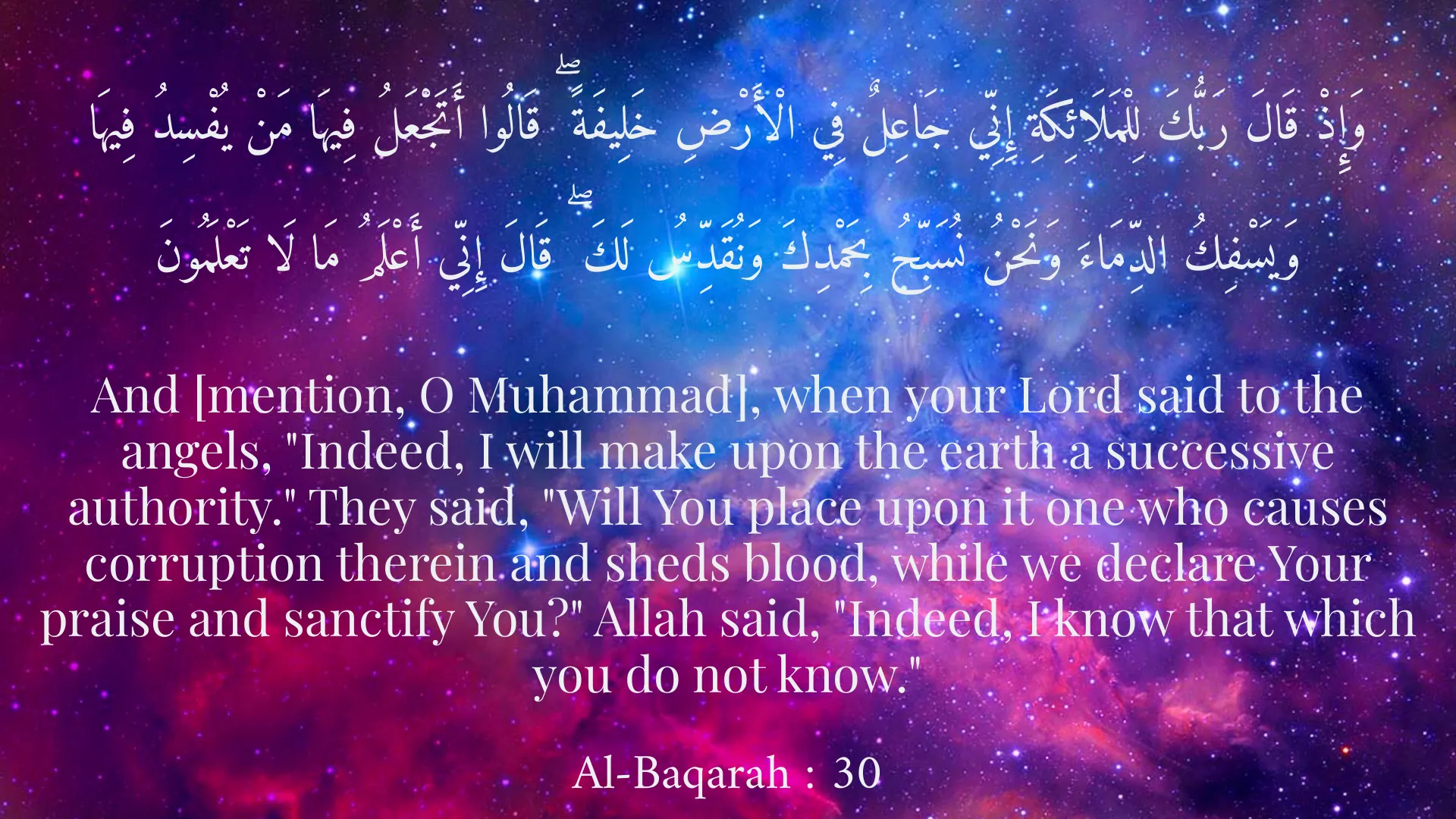
وَإِذْ قَالَ رَبُّكَ لِلْمَلَائِكَةِ إِنِّي جَاعِلٌ فِي الْأَرْضِ خَلِيفَةً ۖ قَالُوا أَتَجْعَلُ فِيهَا مَنْ يُفْسِدُ فِيهَا وَيَسْفِكُ الدِّمَاءَ وَنَحْنُ نُسَبِّحُ بِحَمْدِكَ وَنُقَدِّسُ لَكَ ۖ قَالَ إِنِّي أَعْلَمُ مَا لَا تَعْلَمُونَ
And [mention, O Muhammad], when your Lord said to the angels, "Indeed, I will make upon the earth a successive authority." They said, "Will You place upon it one who causes corruption therein and sheds blood, while we declare Your praise and sanctify You?" Allah said, "Indeed, I know that which you do not know."
Al-Baqarah : 30
وَمَا خَلَقْتُ الْجِنَّ وَالْإِنْسَ إِلَّا لِيَعْبُدُونِ
And I did not create the jinn and mankind except to worship Me.
Adh-Dhariyat : 56
يَا أَيُّهَا الَّذِينَ آمَنُوا اتَّقُوا اللَّهَ وَلْتَنْظُرْ نَفْسٌ مَا قَدَّمَتْ لِغَدٍ ۖ وَاتَّقُوا اللَّهَ ۚ إِنَّ اللَّهَ خَبِيرٌ بِمَا تَعْمَلُونَ
O you who have believed, fear Allah and let every soul look to what it has put forth for tomorrow - and fear Allah. Indeed, Allah is Acquainted with what you do.
Al-Hashr : 18
وَاعْتَصِمُوا بِحَبْلِ اللَّهِ جَمِيعًا وَلَا تَفَرَّقُوا ۚ وَاذْكُرُوا نِعْمَتَ اللَّهِ عَلَيْكُمْ إِذْ كُنْتُمْ أَعْدَاءً فَأَلَّفَ بَيْنَ قُلُوبِكُمْ فَأَصْبَحْتُمْ بِنِعْمَتِهِ إِخْوَانًا وَكُنْتُمْ عَلَىٰ شَفَا حُفْرَةٍ مِنَ النَّارِ فَأَنْقَذَكُمْ مِنْهَا ۗ كَذَٰلِكَ يُبَيِّنُ اللَّهُ لَكُمْ آيَاتِهِ لَعَلَّكُمْ تَهْتَدُونَ
And hold firmly to the rope of Allah all together and do not become divided. And remember the favor of Allah upon you when you were enemies and He brought your hearts together so you became, by His favor, brothers; and you were on the edge of a pit of the Fire, and He saved you from it. Thus does Allah make clear to you His verses that you may be guided.
Al-Imran : 103
Short Story
A restless and searching youth, though living in comfort and luxury, possessed an unquiet heart. One day, he approached a wise old man on the outskirts of the city and spoke of his identity confusion. The wise elder smiled gently and said in a warm tone: "My son, do not imagine your identity lies in outward appearances and worldly possessions, which come and go like the wind. Look at the tree! The deeper its roots are in the earth, the less the strong winds shake it, and its shade is more stable. Your identity, too, lies in your roots of faith and morality, which God has placed within your very nature. The closer you draw to the divine source of light and truth, the brighter and more stable your being will become, and fleeting desires and transient trends will no longer pull you in every direction." With this sagacious advice, the youth found his path and rediscovered inner peace, not in external pursuits, but within himself.