Quranic Answer
Attachment to the world, or 'hubb al-dunya' in Islamic terminology, is a profound concept frequently addressed in Quranic and Islamic teachings. It signifies an excessive inclination towards the transient and perishable aspects of worldly life, prioritizing them over the ultimate goals of the Hereafter and divine pleasure. The Holy Quran repeatedly delves into this topic, offering signs and indicators to help individuals gauge their level of worldly attachment. Understanding these signs can assist us in self-evaluation and guiding our lives towards balance and proximity to Allah. One of the most crucial signs of not being excessively attached to the world is prioritizing the Hereafter over worldly life. The Quran explicitly states that the life of this world is merely play, amusement, adornment, boasting among yourselves, and rivalry in wealth and children, whereas the Hereafter is enduring and superior. A believer who is not bound by worldly attachments, even amidst the peak of worldly successes, keeps their primary goal as attaining divine pleasure and accumulating provisions for the Hereafter. In their decision-making, they prioritize the eternal consequences over fleeting worldly gains. For instance, they would not compromise their faith and piety for illicit gains, nor would they infringe upon others' rights to achieve a worldly position. Such an individual never sacrifices their prayers and acts of worship for work commitments or worldly amusements, knowing that “and the Hereafter is better and more lasting” (Surah Al-A'la, verse 17). This prioritization manifests in all aspects of their life, from social and family relationships to economic and political activities, preventing them from sinking into the quagmire of worldly desires. The second sign is a correct attitude towards wealth and possessions. The Quran considers wealth and children as a 'trial' (fitna) and an 'adornment' of worldly life, not the ultimate purpose. Someone who is not attached to the world views wealth as a trust (amanah) from Allah, to be used in His path and for the service of humanity. They are neither greedy in accumulating wealth nor stingy in spending it. Indeed, spending in the way of Allah (charity) and helping the needy is one of the clearest signs of liberation from the bonds of the world. The Quran encourages believers to spend charitably, stating: “The example of those who spend their wealth in the way of Allah is like a seed [of grain] which grows seven spikes; in each spike is a hundred grains. And Allah multiplies [His reward] for whom He wills. And Allah is all-Encompassing and Knowing” (Surah Al-Baqarah, verse 261). Such an individual never becomes enslaved by excessive materialism or luxury and avoids extravagance and wastefulness, as their goal in earning income is to meet legitimate needs and contribute to societal progress, not to compete in luxuries or hoard endlessly. A third criterion is maintaining inner peace amidst worldly fluctuations. A person not attached to the world does not become arrogant or intoxicated by acquiring wealth and status, nor do they fall into despair or restlessness when losing them. They firmly believe in the Quranic truth that all good comes from Allah and all adversity occurs with His permission. The Quran states: “So that you may not grieve over what has escaped you nor exult [in pride] over what He has given you. And Allah does not like every self-deluded and boastful person” (Surah Al-Hadid, verse 23). These verses explicitly state that we should exercise patience in the face of loss and not become conceited when gaining. Someone whose heart is connected to the Originator of existence knows that everything is perishable, and only Allah's pleasure remains. This inner peace results from being freed from the shackles of worldly desires and relying on the unending power of the Divine, allowing them to continue their path of perfection with patience and gratitude in the face of divine decrees. The fourth sign is insight into the transient nature of the world. The Quran repeatedly refers to the ephemeral and fleeting nature of the world, likening it to rainwater that brings forth lush vegetation, only for it to wither and become dry debris. This insight awakens an individual from heedlessness, prompting them to plan for the Hereafter and gather provisions for the eternal journey. One who understands that worldly life is short does not waste their time on frivolous pursuits, but rather seizes every moment and steps on the path of goodness and righteousness. They know that “what you have will be exhausted, and what is with Allah is lasting” (Surah An-Nahl, verse 96). This deep understanding prevents an individual from becoming attached to the deceptive appearances of the world and forgetting the ultimate purpose of their creation. They see the world as a cultivated field for the Hereafter and strive to yield the best harvest for the other world. Finally, centralizing divine love is the most crucial way to ascertain one's non-attachment to the world. In a warning verse, the Holy Quran states: “Say, 'If your fathers, your sons, your brothers, your wives, your relatives, the wealth which you have obtained, and the commerce wherein you fear decline, and the dwellings with which you are pleased are more beloved to you than Allah and His Messenger and striving in His cause, then wait until Allah executes His command. And Allah does not guide the defiantly disobedient people'” (Surah At-Tawbah, verse 24). This verse provides a clear criterion for measuring true love. If love for the world and its manifestations (family, wealth, job, dwelling) surpasses love for Allah, His Messenger, and striving in His cause, it is a sign of dangerous attachment. One must always free their heart from worldly bonds and make Allah the center of their love. This does not mean disregarding family or wealth, but rather that all love should be in alignment with and subservient to divine love. Non-attachment to the world does not mean denying oneself lawful enjoyment of Allah's blessings, but rather avoiding enslavement to them and always remembering the higher purpose: the pleasure and proximity of the Lord of all worlds. Ultimately, this continuous self-awareness and evaluation is the path to achieving a tranquil heart and a soul liberated from the perishable constraints of worldly existence.
Related Verses
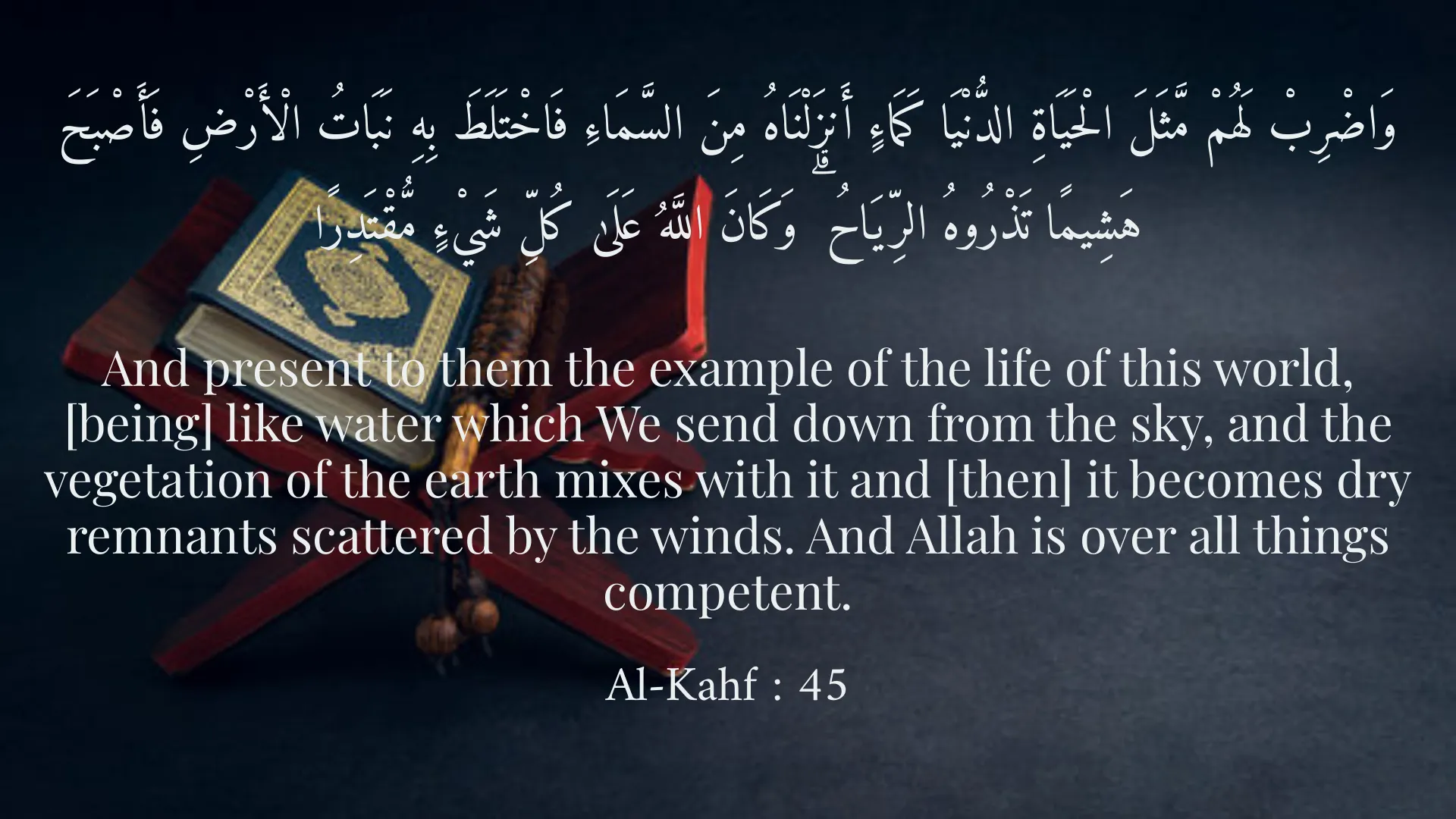
وَاضْرِبْ لَهُمْ مَّثَلَ الْحَيَاةِ الدُّنْيَا كَمَاءٍ أَنزَلْنَاهُ مِنَ السَّمَاءِ فَاخْتَلَطَ بِهِ نَبَاتُ الْأَرْضِ فَأَصْبَحَ هَشِيمًا تَذْرُوهُ الرِّيَاحُ ۗ وَكَانَ اللَّهُ عَلَىٰ كُلِّ شَيْءٍ مُّقْتَدِرًا
And present to them the example of the life of this world, [being] like water which We send down from the sky, and the vegetation of the earth mixes with it and [then] it becomes dry remnants scattered by the winds. And Allah is over all things competent.
Al-Kahf : 45
قُلْ إِن كَانَ آبَاؤُكُمْ وَأَبْنَاؤُكُمْ وَإِخْوَانُكُمْ وَأَزْوَاجُكُمْ وَعَشِيرَتُكُمْ وَأَمْوَالٌ اقْتَرَفْتُمُوهَا وَتِجَارَةٌ تَخْشَوْنَ كَسَادَهَا وَمَسَاكِنُ تَرْضَوْنَهَا أَحَبَّ إِلَيْكُم مِّنَ اللَّهِ وَرَسُولِهِ وَجِهَادٍ فِي سَبِيلِهِ فَتَرَبَّصُوا حَتَّىٰ يَأْتِيَ اللَّهُ بِأَمْرِهِ ۗ وَاللَّهُ لَا يَهْدِي الْقَوْمَ الْفَاسِقِينَ
Say, 'If your fathers, your sons, your brothers, your wives, your relatives, the wealth which you have obtained, and the commerce wherein you fear decline, and the dwellings with which you are pleased are more beloved to you than Allah and His Messenger and striving in His cause, then wait until Allah executes His command. And Allah does not guide the defiantly disobedient people.'
At-Tawbah : 24
اعْلَمُوا أَنَّمَا الْحَيَاةُ الدُّنْيَا لَعِبٌ وَلَهْوٌ وَزِينَةٌ وَتَفَاخُرٌ بَيْنَكُمْ وَتَكَاثُرٌ فِي الْأَمْوَالِ وَالْأَوْلَادِ ۖ كَمَثَلِ غَيْثٍ أَعْجَبَ الْكُفَّارَ نَبَاتُهُ ثُمَّ يَهِيجُ فَتَرَاهُ مُصْفَرًّا ثُمَّ يَكُونُ حُطَامًا ۖ وَفِي الْآخِرَةِ عَذَابٌ شَدِيدٌ وَمَغْفِرَةٌ مِنَ اللَّهِ وَرِضْوَانٌ ۚ وَمَا الْحَيَاةُ الدُّنْيَا إِلَّا مَتَاعُ الْغُرُورِ
Know that the life of this world is only play and amusement, an adornment and boasting among yourselves, and rivalry in [increasing] wealth and children - like the example of a rain whose [resulting] plant growth pleases the tillers; then it dries and you see it [become] yellow; then it becomes [scattered] debris. And in the Hereafter is severe punishment and forgiveness from Allah and approval. And what is the worldly life except the enjoyment of delusion.
Al-Hadid : 20
Short Story
It is narrated in Saadi's Gulistan that a wealthy king would constantly speak of his grandeur and riches. One day, in the presence of his courtiers, he arrogantly proclaimed, "Is there anyone in this world more independent than I?" A wise man present in the assembly smiled and said, "O King, I know a dervish who is more independent than you." The king, surprised, asked, "Who is he and how?" The wise man replied, "That dervish sits in a corner, his heart attached only to the provisions he has gathered for his Hereafter. He is content in having no wealth to account for, and no one asking anything from him. Whereas you are constantly worried about your treasuries and properties, fearing their loss. So, he who is free from all these attachments is more independent than you." The king pondered over these words and realized that freedom from worldly attachments is a serene blessing and a true richness that no wealth can match.