Quranic Answer
Although the exact phrase "enslaved by worldly desires" isn't explicitly mentioned in the Quran, numerous verses address the consequences and signs of excessive attachment to this worldly life (dunya) and heedlessness towards the Hereafter. The Holy Quran consistently calls us to balance and moderation; it neither completely condemns the world nor allows it to consume one's entire being and distract from the ultimate purpose of creation. Therefore, to understand whether we have become enslaved by worldly desires, we must pay attention to the signs that the Quran teaches us. The first and perhaps most significant sign is incorrect prioritization. In Surah At-Tawbah, verse 24, Allah Almighty explicitly states: "Say, 'If your fathers, your sons, your brothers, your wives, your relatives, the wealth which you have obtained, and the commerce in which you fear decline, and the dwellings in which you delight are more beloved to you than Allah and His Messenger and jihad in His cause, then wait until Allah executes His command. And Allah does not guide the defiantly disobedient people.'" This verse clearly indicates that if love for any worldly manifestation (family, wealth, trade, dwelling) surpasses love for Allah, His Messenger, and striving in His cause, then this itself is a sign of being enslaved by dunya. A person enslaved by worldly desires might neglect their obligatory religious duties such as prayer, zakat, and Hajj for the sake of greater material gain, or even infringe upon the rights of others. They might sacrifice family and social relationships for financial benefits, prioritizing worldly profit over divine pleasure in their decisions. Another sign is heedlessness towards the Hereafter and forgetting death and resurrection. In Surah Al-Hadid, verse 20, Allah describes the nature of worldly life as follows: "Know that the life of this world is only play and amusement, a show and boasting among yourselves, and a rivalry in [increasing] wealth and children – like the example of a rain whose [resulting] plant growth pleases the tillers; then it dries and you see it [become] yellow; then it becomes [scattered] debris. And in the Hereafter is severe punishment and forgiveness from Allah and approval. And what is the worldly life except the enjoyment of delusion?" Someone who is enslaved by dunya often gets caught up in the useless games and amusements of this world, dedicating all their efforts to accumulating adornments and showing off, becoming oblivious to death and accountability. They become so engrossed in transient worldly pleasures that they fail to prepare provisions for their Hereafter and eternal life. Their focus is solely on the present and enjoying material comforts, without thinking about tomorrow or the Day of Judgment. This forgetfulness can lead them towards sins and unethical behaviors, as their belief in the ultimate consequences of their actions diminishes. Furthermore, excessive desires and insatiable greed are another symptom. The Quran states in Surah Al-A'la, verses 16 and 17: "But you prefer the worldly life, while the Hereafter is better and more enduring." A person enslaved by dunya is never content with what they have and is constantly seeking to increase their wealth, status, and fame. Their greed and covetousness have no end, and this trait keeps them far from peace and contentment. They might perpetually be anxious and worried about losing their possessions or failing to achieve their worldly aspirations. This anxiety and greed prevent them from being grateful for existing blessings and cause them to constantly dwell on their shortcomings and what they lack, instead of being content with what they possess. In general, the signs of being enslaved by worldly desires can be summarized as follows: 1. Preferring worldly interests over divine commands and the rights of others. 2. Neglecting the remembrance of Allah and the Hereafter. 3. Being constantly preoccupied with accumulating wealth and status, without regard for spiritual goals. 4. Envy, unhealthy competition, and boasting based on material achievements. 5. Lack of inner peace and continuous anxiety stemming from the fear of losing possessions or failing to achieve desires. To free oneself from this enslavement, the Quran offers solutions: continuous remembrance of the Hereafter (as in Surah Al-Ghashiyah: "Do they not look at the camels – how they are created? And at the sky – how it is raised? And at the mountains – how they are erected? And at the earth – how it is spread out? So remind, for you are only a reminder!"), spending in the way of Allah (which reduces attachment to wealth), contentment and gratitude, and most importantly, strengthening faith and connection with Allah through prayer and remembrance (dhikr). Through self-awareness and re-evaluation of priorities, one can gradually break free from the bonds of dunya and live a balanced life that encompasses both worldly success and ultimate salvation.
Related Verses
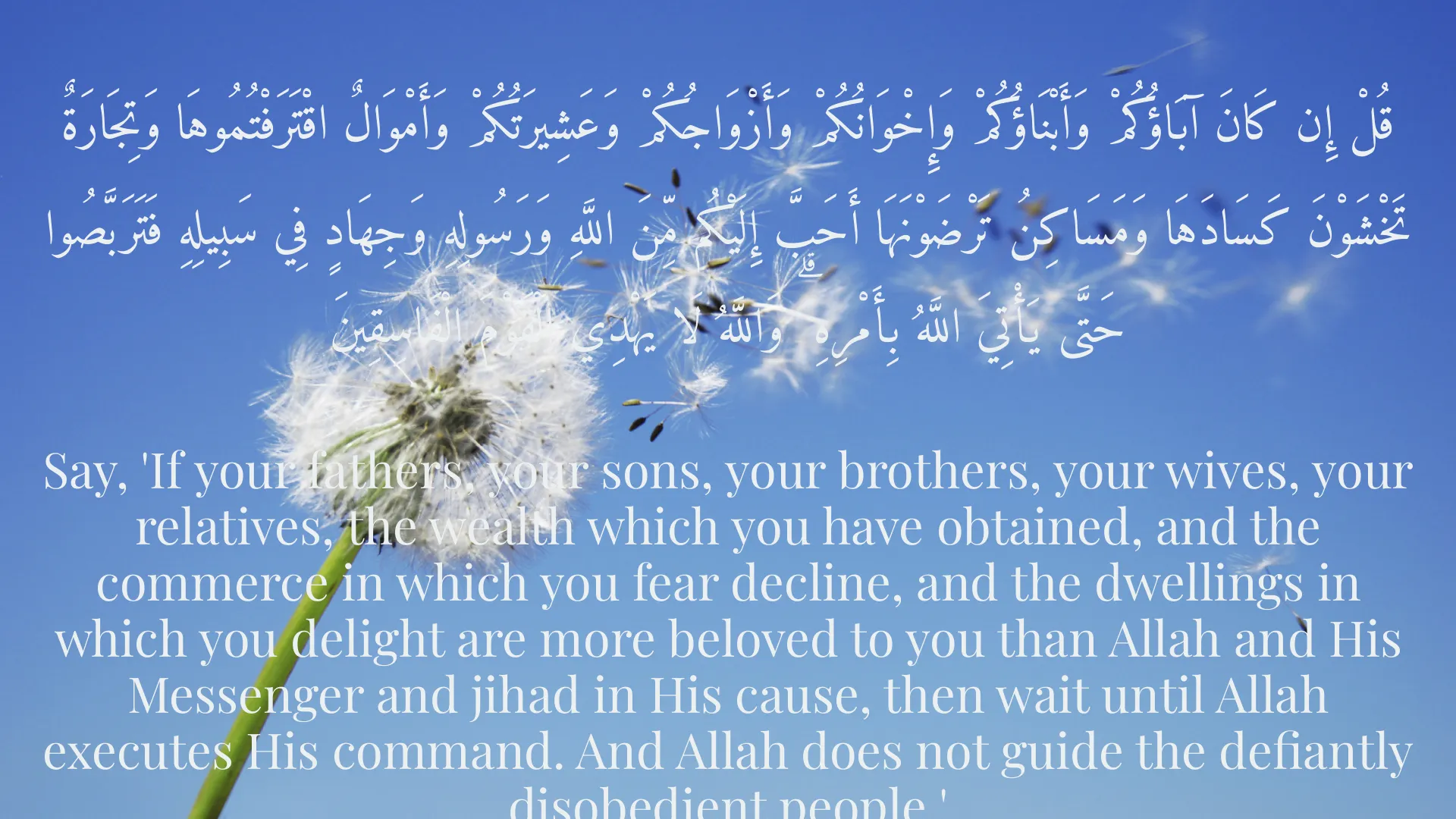
قُلْ إِن كَانَ آبَاؤُكُمْ وَأَبْنَاؤُكُمْ وَإِخْوَانُكُمْ وَأَزْوَاجُكُمْ وَعَشِيرَتُكُمْ وَأَمْوَالٌ اقْتَرَفْتُمُوهَا وَتِجَارَةٌ تَخْشَوْنَ كَسَادَهَا وَمَسَاكِنُ تَرْضَوْنَهَا أَحَبَّ إِلَيْكُم مِّنَ اللَّهِ وَرَسُولِهِ وَجِهَادٍ فِي سَبِيلِهِ فَتَرَبَّصُوا حَتَّى يَأْتِيَ اللَّهُ بِأَمْرِهِ ۗ وَاللَّهُ لَا يَهْدِي الْقَوْمَ الْفَاسِقِينَ
Say, 'If your fathers, your sons, your brothers, your wives, your relatives, the wealth which you have obtained, and the commerce in which you fear decline, and the dwellings in which you delight are more beloved to you than Allah and His Messenger and jihad in His cause, then wait until Allah executes His command. And Allah does not guide the defiantly disobedient people.'
At-Tawbah : 24
اعْلَمُوا أَنَّمَا الْحَيَاةُ الدُّنْيَا لَعِبٌ وَلَهْوٌ وَزِينَةٌ وَتَفَاخُرٌ بَيْنَكُمْ وَتَكَاثُرٌ فِي الْأَمْوَالِ وَالْأَوْلَادِ ۖ كَمَثَلِ غَيْثٍ أَعْجَبَ الْكُفَّارَ نَبَاتُهُ ثُمَّ يَهِيجُ فَتَرَاهُ مُصْفَرًّا ثُمَّ يَكُونُ حُطَامًا ۖ وَفِي الْآخِرَةِ عَذَابٌ شَدِيدٌ وَمَغْفِرَةٌ مِّنَ اللَّهِ وَرِضْوَانٌ ۚ وَمَا الْحَيَاةُ الدُّنْيَا إِلَّا مَتَاعُ الْغُرُورِ
Know that the life of this world is only play and amusement, a show and boasting among yourselves, and a rivalry in [increasing] wealth and children – like the example of a rain whose [resulting] plant growth pleases the tillers; then it dries and you see it [become] yellow; then it becomes [scattered] debris. And in the Hereafter is severe punishment and forgiveness from Allah and approval. And what is the worldly life except the enjoyment of delusion?
Al-Hadid : 20
بَلْ تُؤْثِرُونَ الْحَيَاةَ الدُّنْيَا
But you prefer the worldly life,
Al-A'la : 16
وَالْآخِرَةُ خَيْرٌ وَأَبْقَىٰ
while the Hereafter is better and more enduring.
Al-A'la : 17
Short Story
It is narrated that a man, in pursuit of wealth and fortune, worked day and night, neglecting the remembrance of God and his family. His riches grew daily, but his heart found no peace. One day, he met a wise man and complained about his restlessness. The wise man took him to a river and said, 'Look at this flowing water. If you drink only enough to quench your thirst, it is sweet and beneficial. But if you try to collect the entire river within yourself, you will not only remain thirsty, but you might also be deprived of life-giving water and perhaps even drown.' The man realized that his greed for the world had alienated him from true peace and happiness. From then on, he adopted moderation, spent a portion of his wealth in the way of God, and used the rest for a lawful and good life, and his heart found tranquility in the remembrance and gratitude to the Lord.