Quranic Answer
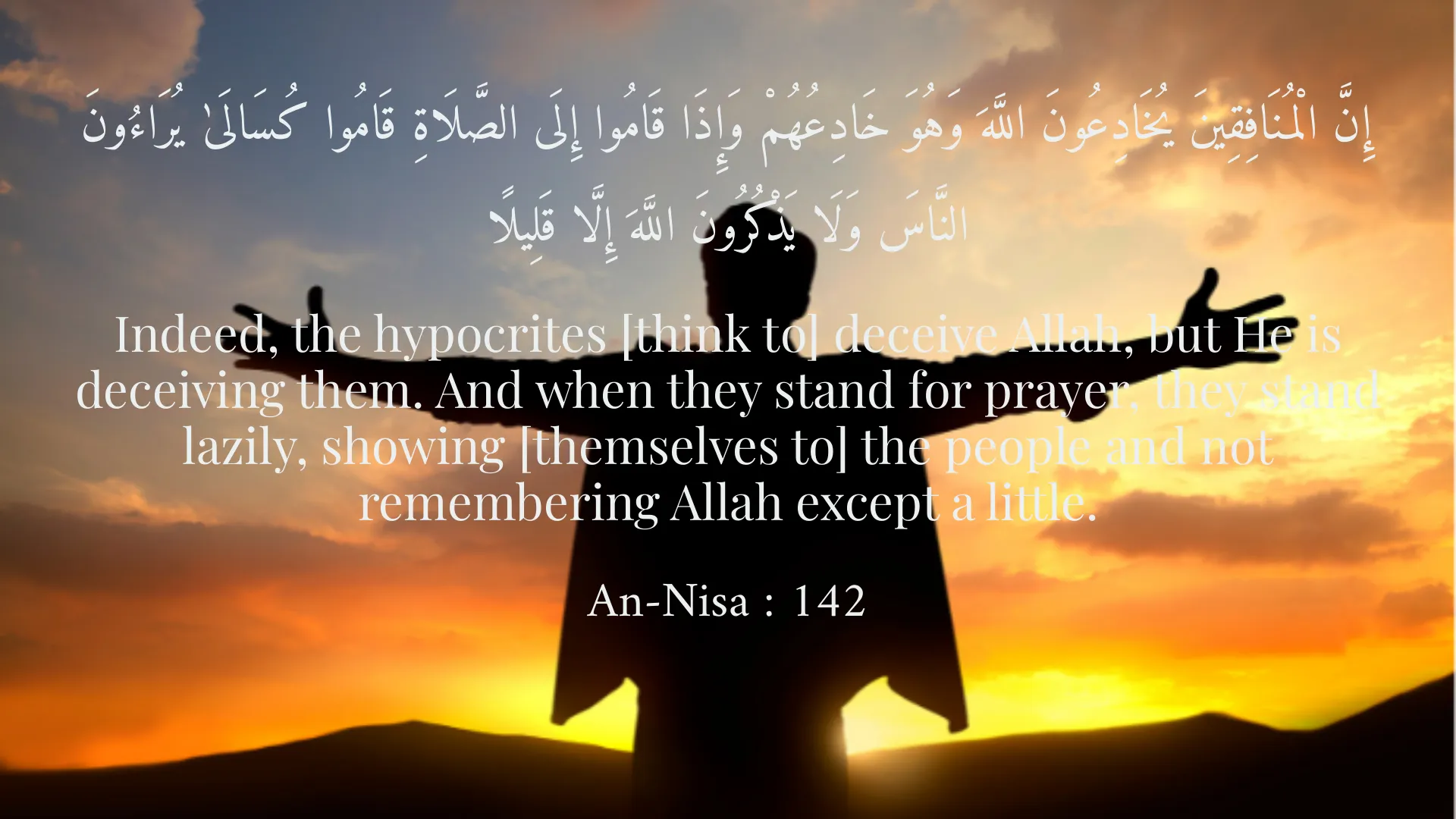
My dear brother or sister, your question about Riya (showing off) addresses one of the most subtle yet critical topics in the spiritual journey. Riya, meaning performing good deeds to be seen by people and to gain their praise and admiration, rather than solely for the pleasure of God, is a hidden disease of the heart that can nullify the reward of all our righteous actions. The Holy Quran and the Sunnah of the Prophet Muhammad (PBUH) have strongly warned against Riya, because the foundation of our religion is sincerity (Ikhlas) and monotheism in intention. Understanding whether one has fallen into Riya requires deep self-knowledge, continuous self-monitoring (muraqabah), and honesty with oneself. This is not an overnight process but a continuous journey of self-awareness and purification of the soul. One of the most significant indicators mentioned in the Quran is the difference in the quality of action and spiritual presence (khushu') when in public versus when in private. In Surah An-Nisa, verse 142, Allah says: “Indeed, the hypocrites [think to] deceive Allah, but He is deceiving them. And when they stand for prayer, they stand lazily, showing [themselves to] the people and not remembering Allah except a little.” This verse clearly indicates that one of the characteristics of hypocrites and those afflicted by Riya is their reluctance in performing worship and their effort to show off in front of others. If you observe that your enthusiasm and devotion during worship or performing good deeds are greater when others are present compared to when you are alone and unseen, this could be a warning sign. For instance, are your voluntary prayers longer and performed with more concentration in a group than your obligatory prayers in private? Is giving charity and helping the needy easier and more appealing when you are seen than when no one knows about it? Another sign of Riya is dependence on the praise and commendation of others. If, after performing a good deed, you find yourself expecting appreciation and praise, and if you feel disappointment, sadness, or even anger when you don't receive it, this can also be an indication of Riya. In essence, your heart, instead of being solely dependent on divine pleasure, has become attached to the satisfaction of creation. A sincere person performs their actions solely for Allah and entrusts the reward and judgment to Him. They do not deviate from their path even if they are criticized, nor do they become arrogant if praised. Furthermore, in Surah Al-Ma'un, verses 4-7, Allah refers to those who pray, but “Woe to those who pray [but] who are heedless of their prayer - those who make show [of their deeds] and withhold [common] necessities.” These verses indicate that even seemingly good deeds like prayer, if performed with the intention of Riya, are not only unacceptable but may lead to punishment. This illustrates that Riya can infiltrate even fundamental acts of worship and render them void. If you feel that you perform every action to enhance your social status, or to gain respect in a specific group, you should ask yourself: Would I still perform this act with the same quality if these people were never present? To understand this concept further, let us look at verse 110 of Surah Al-Kahf: “Say, 'I am only a mortal like you; it has been revealed to me that your God is one God. So whoever would hope for the meeting with his Lord, let him do righteous work and not associate anyone in the worship of his Lord.'” This verse emphasizes ‘not associating anyone’ in worship, which Riya directly contradicts, as in Riya, you direct your intention towards others besides Allah. The criterion for pure intention is this: if this action were never to be known by anyone, and no one would ever hear about it, would you still perform it with the same quality and eagerness? Practical steps to combat Riya include: strengthening faith in the Day of Judgment and the understanding that the only true reward comes from God, performing good deeds in secret whenever possible, supplicating earnestly to Allah for sincerity, reflecting on one's own weaknesses and needs which helps to avoid arrogance and self-admiration, and continuously practicing the purification of intentions. Remember that Riya is a spiritual illness whose cure requires continuous attention and seeking refuge in Allah. The ultimate goal is to achieve a heart that, in every action and word, seeks only and solely the pleasure of the Almighty. Constant self-evaluation and asking yourself questions like: "Am I doing this for Allah or for people?", "If no one saw me, would I still do this with the same enthusiasm?", "Is my happiness from people's praise greater than my happiness from closeness to God?" can help you purify your intentions. Always remember that Allah looks at intentions and hearts, not at the outward appearance of deeds. Therefore, always strive to purify your heart from the impurities of Riya through repentance and seeking forgiveness, and present your deeds sincerely to the Almighty. Battling Riya is the greater jihad, as you engage with your own soul, and this struggle holds an immense reward with your Lord.
Related Verses
إِنَّ الْمُنَافِقِينَ يُخَادِعُونَ اللَّهَ وَهُوَ خَادِعُهُمْ وَإِذَا قَامُوا إِلَى الصَّلَاةِ قَامُوا كُسَالَىٰ يُرَاءُونَ النَّاسَ وَلَا يَذْكُرُونَ اللَّهَ إِلَّا قَلِيلًا
Indeed, the hypocrites [think to] deceive Allah, but He is deceiving them. And when they stand for prayer, they stand lazily, showing [themselves to] the people and not remembering Allah except a little.
An-Nisa : 142
فَوَيْلٌ لِّلْمُصَلِّينَ
So woe to those who pray,
Al-Ma'un : 4
الَّذِينَ هُمْ عَن صَلَاتِهِمْ سَاهُونَ
[But] who are heedless of their prayer -
Al-Ma'un : 5
الَّذِينَ هُمْ يُرَاءُونَ
Those who make show [of their deeds]
Al-Ma'un : 6
قُلْ إِنَّمَا أَنَا بَشَرٌ مِّثْلُكُمْ يُوحَىٰ إِلَيَّ أَنَّمَا إِلَٰهُكُمْ إِلَٰهٌ وَاحِدٌ ۖ فَمَن كَانَ يَرْجُو لِقَاءَ رَبِّهِ فَلْيَعْمَلْ عَمَلًا صَالِحًا وَلَا يُشْرِكْ بِعِبَادَةِ رَبِّهِ أَحَدًا
Say, 'I am only a mortal like you; it has been revealed to me that your God is one God. So whoever would hope for the meeting with his Lord, let him do righteous work and not associate anyone in the worship of his Lord.'
Al-Kahf : 110
Short Story
It is narrated in Saadi's Golestan that a just king secretly helped the poor every night. One night, his vizier said: "O King, how excellent it would be if the people knew of all your generosity, so they might appreciate you and praise you!" The king replied: "O Vizier, are you not ashamed that a servant should hope for the praise of other servants instead of his Lord? An act done for God, what need does it have for the commendation of creation? I am ashamed before my God to do good for the sake of people's praise, for my reward is from Him, not from them." And in this way, he kept Riya away from his heart and chose pure intention, for he knew that God is most knowing of intentions.