Quranic Answer
Understanding that the sufferings and hardships we endure in life are not in vain or meaningless requires a profound insight and complete reliance on Divine wisdom, as illuminated by the Holy Quran. The Quran repeatedly emphasizes that this worldly life is a realm of trial and divine testing, and no believer is exempt from these tests. Pains, afflictions, and calamities are an integral part of Allah's decree for human growth and elevation. They are never purposeless; rather, they serve noble objectives, the comprehension of which assures us that no suffering endured for the sake of Allah, with patience and reliance, will ever go unrewarded. One of the most significant reasons our suffering is not in vain is that trials and tribulations serve as a crucible for faith and human sincerity. Allah Almighty states in Surah Al-Baqarah, verse 155: "And We will surely test you with something of fear and hunger and a loss of wealth and lives and fruits, but give good tidings to the patient." This verse clearly establishes that divine tests involve various forms of deprivation and hardship. The purpose of these tests is not merely to inflict pain, but to distinguish the truthful from the false claimants. As stated in Surah Al-Ankabut, verses 2 and 3: "Do people think that they will be left to say, 'We believe,' and they will not be tried? But We have certainly tried those before them, and Allah will surely make evident those who are truthful, and He will surely make evident the liars." When we exercise patience in the face of difficulties and do not abandon our faith, we are, in essence, proving the sincerity of our belief, and this itself is the greatest outcome. Another immense benefit of suffering is the expiation of sins and the purification of the human soul. Numerous narrations from Prophet Muhammad (peace be upon him) state that every sorrow, illness, or even the prick of a thorn that befalls a believer, Allah expiates some of his sins by it. This means that every pain and suffering we endure, if accompanied by the intention of seeking Allah's pleasure and patience, acts like water washing away the rust of sins from our souls, making us purer and more prepared for the encounter with Allah. From this perspective, sufferings are not only not in vain but are a means of inner purification and refinement, the value of which surpasses any worldly gain. Furthermore, sufferings are tools for spiritual growth and drawing closer to Allah. Often, in comfort and prosperity, humans become heedless of Allah and become attached to worldly possessions. However, when hardships strike, one realizes their weakness and helplessness and finds true refuge only in Allah's infinite power. It is in these moments of extreme vulnerability that supplications emanate from the depths of the soul, reliance (tawakkul) reaches its peak, and the connection with the Creator strengthens. This experience of deepening one's relationship with Allah is a treasure that might only be attained through passing through difficulties. Surah Az-Zumar, verse 10, states: "...Indeed, the patient will be given their reward without account." This immeasurable reward signifies the immense and boundless recompense for enduring calamities patiently. Knowing that every moment of patience is an investment in a fruitful afterlife is a strong affirmation that suffering is never in vain. Sufferings also lead to increased insight and wisdom in a person. Experiencing hardships changes one's perspective on life and leads them to a deeper understanding of reality. By going through difficulties, a person appreciates blessings more, becomes more patient, kinder, and distances themselves from arrogance and pride. This personal and spiritual growth is among the valuable fruits of hardship that transform both one's worldly and eternal life. What appears as a calamity today might, in the near future, be the key to great breakthroughs or a reason to avert a greater evil. The Quran in Surah Al-Baqarah, verse 216, says: "...And perhaps you dislike a thing and it is good for you; and perhaps you love a thing and it is bad for you. And Allah Knows, while you know not." This verse points to the hidden divine wisdom behind all occurrences in the universe. Signs that your suffering is not in vain are discernible both within and outside of you. If with every hardship, your reliance on Allah increased, your patience grew, your prayers became more sincere, your heart drew closer to Allah, and you learned lessons that transformed you into a better person, then know that your suffering has borne fruit. If after enduring hardships, your sins decreased and you repented from past mistakes, this is also a sign of the fruitfulness of your suffering. Additionally, witnessing the ease and relief that comes by Allah's permission after difficulties is itself a testament to the fact that "with hardship comes ease," as emphasized twice in Surah Al-Inshirah, verses 5 and 6: "For indeed, with hardship [will be] ease. Indeed, with hardship [will be] ease." These verses promise not only that ease follows hardship but that within the very essence of difficulty, there is hidden relief and breakthrough. Therefore, to know that your suffering is not in vain, you only need to look at your intention and reaction to it. If it is accompanied by patience, submission to Allah's will, and hope for His reward and wisdom, it will never be fruitless. Rather, every tear shed out of awe of Allah, every pain and suffering endured with hope in His grace, will be placed in the scale of good deeds and added to the price of your eternal bliss in the Hereafter. This profound belief not only eases the suffering but transforms it into a ladder for ascending to higher spiritual stations and a bridge to lasting contentment and peace.
Related Verses
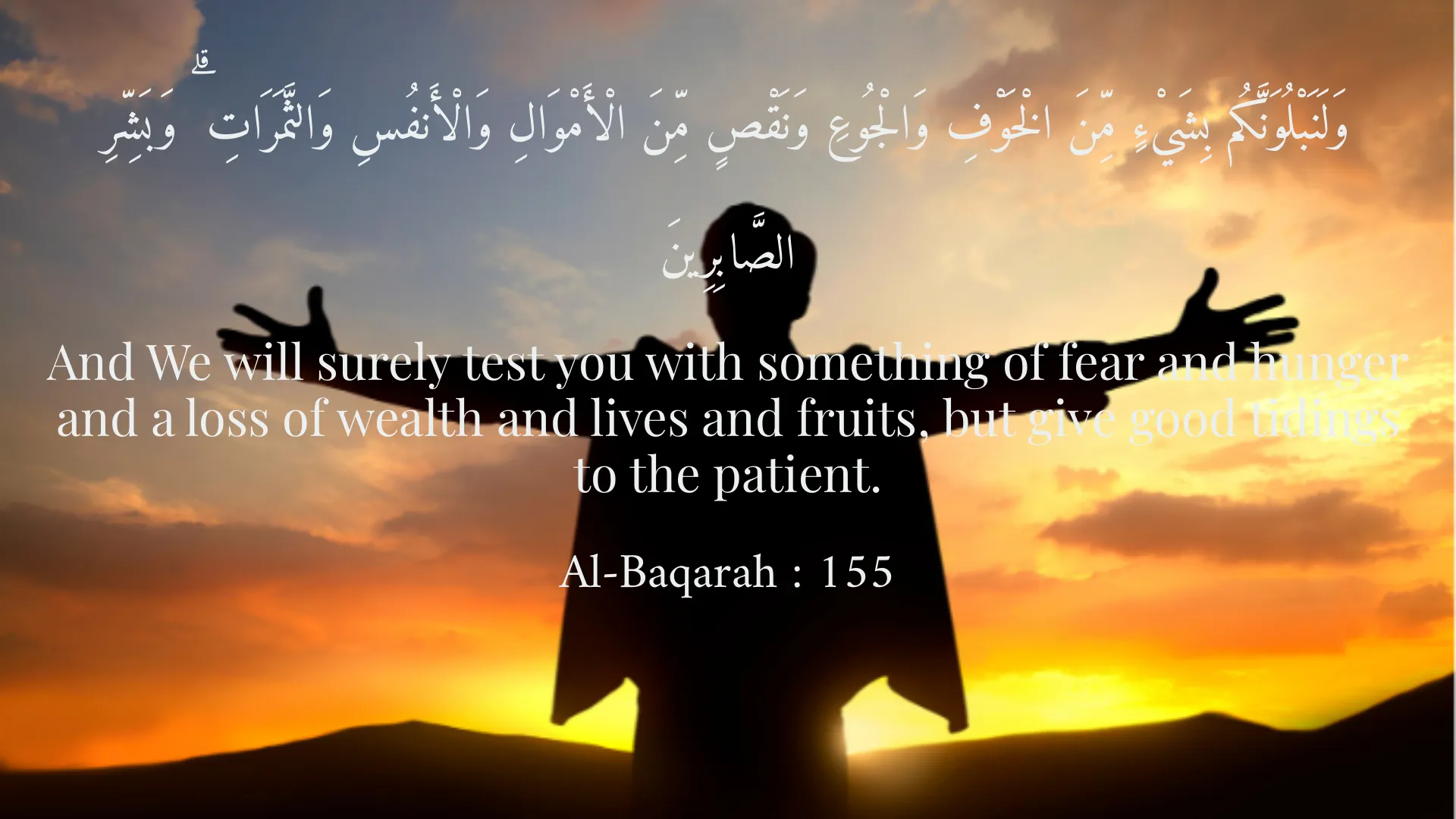
وَلَنَبْلُوَنَّكُم بِشَيْءٍ مِّنَ الْخَوْفِ وَالْجُوعِ وَنَقْصٍ مِّنَ الْأَمْوَالِ وَالْأَنفُسِ وَالثَّمَرَاتِ ۗ وَبَشِّرِ الصَّابِرِينَ
And We will surely test you with something of fear and hunger and a loss of wealth and lives and fruits, but give good tidings to the patient.
Al-Baqarah : 155
أَحَسِبَ النَّاسُ أَن يُتْرَكُوا أَن يَقُولُوا آمَنَّا وَهُمْ لَا يُفْتَنُونَ
Do people think that they will be left to say, 'We believe,' and they will not be tried?
Al-Ankabut : 2
وَلَقَدْ فَتَنَّا الَّذِينَ مِن قَبْلِهِمْ ۖ فَلَيَعْلَمَنَّ اللَّهُ الَّذِينَ صَدَقُوا وَلَيَعْلَمَنَّ الْكَاذِبِينَ
But We have certainly tried those before them, and Allah will surely make evident those who are truthful, and He will surely make evident the liars.
Al-Ankabut : 3
قُلْ يَا عِبَادِ الَّذِينَ آمَنُوا اتَّقُوا رَبَّكُمْ ۚ لِلَّذِينَ أَحْسَنُوا فِي هَٰذِهِ الدُّنْيَا حَسَنَةٌ ۗ وَأَرْضُ اللَّهِ وَاسِعَةٌ ۗ إِنَّمَا يُوَفَّى الصَّابِرُونَ أَجْرَهُم بِغَيْرِ حِسَابٍ
Say, 'O My servants who have believed, fear your Lord. For those who do good in this world is good, and the earth of Allah is spacious. Indeed, the patient will be given their reward without account.'
Az-Zumar : 10
فَإِنَّ مَعَ الْعُسْرِ يُسْرًا
For indeed, with hardship [will be] ease.
Al-Inshirah : 5
إِنَّ مَعَ الْعُسْرِ يُسْرًا
Indeed, with hardship [will be] ease.
Al-Inshirah : 6
Short Story
It is said that one day, a moaning and disheartened dervish, burdened by the hardships of life, sought refuge with a wise sage. The sage asked, "My brother, what troubles you so much that you appear so distraught?" The dervish sighed deeply and said, "For years, I have been struggling in the chains of suffering and poverty, yet I see no relief. I fear that all this hardship is in vain, and nothing but regret will remain of my life." The sage smiled and, with a calm and comforting voice, said: "My friend, consider a seed hidden beneath the soil. It remains in darkness and under pressure, but is its suffering in vain? Never! It is from this very struggle and pressure that it germinates, sends down roots, and eventually grows branches and yields sweet fruit. If that seed had escaped the hardship of the soil, it would never have transformed into a mighty tree. You are like that seed. Your present hardships are the seeds of your future blossoming. If you endure them with patience and hope, they will never be fruitless. Perhaps Allah has hidden a great opening and countless blessings for you behind the veil of these difficulties, which you cannot reach except by passing through this narrow passage. So be patient, for patience is the key to the treasure of tranquility, and whoever adopts patience will ultimately find good." The dervish found peace in the sage's words and understood that his sufferings were a prelude to divine ease and blessings, and that no effort made for the sake of Allah goes unrewarded, and indeed, after every dark night, there is the dawn of a new day.