Quranic Answer
Learning how to perform our deeds solely for the pleasure of God, and not to gain the admiration or approval of people, is a cornerstone of faith and moral excellence in Islam. This profound concept is deeply intertwined with the principle of 'Ikhlas,' which means purity of intention and performing actions purely for the sake of Allah Almighty. The Holy Quran repeatedly emphasizes the importance of Ikhlas, making it the central criterion for the acceptance of deeds. In Surah Al-Bayyinah (verse 5), Allah states: "And they were not commanded except to worship Allah, [being] sincere to Him in religion, inclining to truth, and to establish prayer and to give zakah. And that is the correct religion." This verse clearly indicates that the primary purpose of creation and the message of the prophets is pure worship of Allah, free from any form of polytheism or ostentation. When our actions are performed with a sincere intention for Allah, even the smallest deeds can transform into acts of worship and acquire eternal value. To learn to work for God, not for people, one must look deep within oneself and constantly review one's intentions. This process is an inner journey that requires continuous self-awareness, introspection, and self-purification. Intention (Niyyah) is the primary motivator that gives meaning and direction to our actions. The Prophet Muhammad (peace be upon him) said: "Deeds are based on intentions, and for everyone is what he intended." This noble Hadith clearly illustrates the unparalleled importance of intention in determining the value and acceptance of deeds. If our intention is to gain people's attention, achieve fame, or receive worldly rewards, that action, no matter how grand it may appear outwardly, will lack spiritual value in the sight of Allah. However, if our sole aim is to please Allah, even a small, hidden act can lead to salvation and eternal bliss. One of the greatest obstacles to Ikhlas is 'Riya' or showing off. Riya means performing good deeds so that people may see and praise us. The Holy Quran explicitly warns against those who spend (in charity) but whose intention is to show off to people, as stated in Surah Al-Baqarah (verse 264): "O you who have believed, do not invalidate your charities with reminders [of it] or [other] injury, like one who spends his wealth [only] to be seen by the people and does not believe in Allah and the Last Day." Riya corrupts the deed and strips it of its spirit. To combat Riya, it is essential: firstly, to review our intention before every action and ask ourselves: "Am I doing this for Allah or for people to praise me?" Secondly, to strive to perform some good deeds secretly. Giving charity in secret, performing night prayers (Tahajjud), or helping those in need without anyone knowing, can greatly strengthen sincerity. This secrecy demonstrates that we seek the true reward only from Allah and not from His creation. Another way to cultivate sincerity is to focus on the rewards of the afterlife. When a person deeply believes that the true and lasting reward is only with Allah, and whatever people can give is trivial and fleeting, they will be less inclined to seek human praise. The Quran promises great and everlasting rewards in numerous verses for those who perform righteous deeds with sincere intentions. For instance, in Surah Al-Insan (verse 9), describing the righteous, it says: "[Saying], 'We feed you only for the countenance of Allah. We wish not from you reward or gratitude.'" This verse is a manifestation of pure Ikhlas; an action performed solely for the sake of Allah's Countenance. Furthermore, strengthening one's reliance on Allah (Tawakkul) is highly effective in the path of sincerity. When a person knows that their Sustainer, Protector, and ultimate Supporter is Allah, they attach less importance to people's opinions and judgments. Fear of people, or hope from them, are factors that can undermine sincerity. With complete reliance on Allah, a person is freed from the bondage of seeking human validation and thinks only of the satisfaction of their Creator. Accepting the truth that all power and influence are in the hands of Allah distances a person from the temptation of showing off and seeking the attention of others, leading them towards performing actions purely for the Lord. Ultimately, Ikhlas is a continuous process that is strengthened with every action, every intention, and every thought. Learning to work for God, not for people, means cultivating a heart where only love and awe of Allah flow, preferring His satisfaction above all else. This path leads to inner peace, eternal happiness, and closeness to the Divine presence.
Related Verses
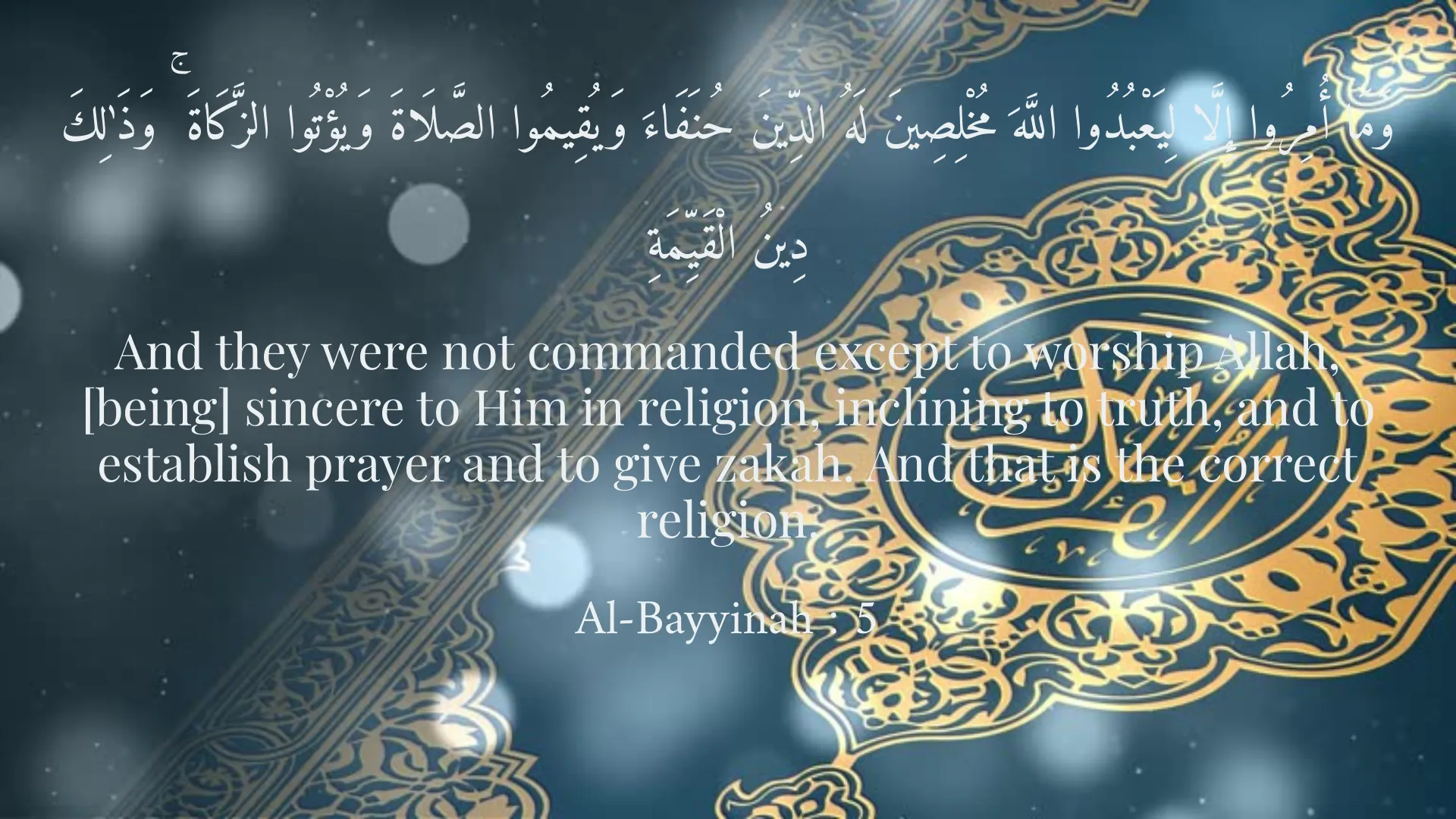
وَمَا أُمِرُوا إِلَّا لِيَعْبُدُوا اللَّهَ مُخْلِصِينَ لَهُ الدِّينَ حُنَفَاءَ وَيُقِيمُوا الصَّلَاةَ وَيُؤْتُوا الزَّكَاةَ ۚ وَذَٰلِكَ دِينُ الْقَيِّمَةِ
And they were not commanded except to worship Allah, [being] sincere to Him in religion, inclining to truth, and to establish prayer and to give zakah. And that is the correct religion.
Al-Bayyinah : 5
إِنَّا أَنزَلْنَا إِلَيْكَ الْكِتَابَ بِالْحَقِّ فَاعْبُدِ اللَّهَ مُخْلِصًا لَّهُ الدِّينَ
Indeed, We sent down to you the Book with the truth, so worship Allah, [being] sincere to Him in religion.
Az-Zumar : 2
إِنَّمَا نُطْعِمُكُمْ لِوَجْهِ اللَّهِ لَا نُرِيدُ مِنكُمْ جَزَاءً وَلَا شُكُورًا
[Saying], 'We feed you only for the countenance of Allah. We wish not from you reward or gratitude.'
Al-Insan : 9
Short Story
It is narrated that in a distant time, in a bustling city, lived two merchants. One was wealthy and renowned, the other poor and unknown. The wealthy merchant would give charity daily in the marketplace, but always did so publicly with fanfare, so that people would admire him and speak well of his name. In his heart, he hoped this fame and praise would elevate his status among the people. One day, a wise mystic passed through that city. People praised the wealthy merchant, saying, "How benevolent and generous he is!" The mystic smiled and asked, "Is there no one else who truly practices benevolence?" The people pointed to the poor merchant, who always secretly and without any expectation, even with a piece of bread, helped the needy, and no one but God ever knew of his deeds. The mystic said: "He who gives openly, perhaps seeks the gratitude of people; but he who gives in secret, surely seeks the pleasure of God. The value of every deed lies in its intention. One works for creation, and the other for the Creator. And in the Divine presence, a speck of sincerity holds more worth than a hundred mountains of ostentation."