Quranic Answer
To see oneself in the mirror of the Quran is a profound and meaningful metaphor, signifying self-knowledge based on the divine teachings and values of this heavenly book. The Holy Quran is not merely a legal code; it is a comprehensive guide for life, a clear mirror that reflects human existence in all its dimensions—from our innate nature and purpose of creation to our responsibilities, strengths, weaknesses, and ultimate destiny. This perspective on the Quran offers an unparalleled opportunity for self-discovery, self-improvement, and attaining the true, ideal self that God has ordained for humanity. The first aspect the Quran reveals in its mirror is our divine nature and fitra (innate disposition). The Quran emphasizes that humanity was created with a 'pure nature,' a fitra that inclines us towards monotheism, goodness, and truth. In this mirror, we see ourselves not as accidental beings, but as God's vicegerents on Earth, entrusted with noble purposes such as worshipping and knowing the Lord, and cultivating the Earth. Verse 56 of Surah Adh-Dhariyat, which states: "And I did not create the jinn and mankind except to worship Me," clearly illustrates the ultimate purpose of our existence. Seeing ourselves from this perspective means understanding our glorious yet responsible position in the universe. This mirror reminds us that within each of us lies a seed of goodness and a yearning for perfection, which, with Quranic nurturing, can blossom into a mighty tree. The second image presented by the Quranic mirror is the dimension of human responsibility and free will. The Quran places great emphasis on humanity's freedom of choice between the path of truth and falsehood. In this mirror, we see ourselves as beings with agency, constantly making decisions and choices, and bearing responsibility for our actions. Verse 14 of Surah Al-Qiyamah, which says: "Rather, man, against himself, will be a witness," highlights that a person is their own best witness to their deeds and intentions, even if they try to make excuses. This mirror invites us to self-accountability and honest examination of our behavior. When we look into this mirror, not only our outward actions but also our inner thoughts and intentions are revealed; it is here that we understand that even a bad intention or an impure thought originates within us and needs rectification. This image directs us towards deeper self-knowledge and purposeful self-development. The third aspect reflected in this divine mirror is our moral and spiritual condition. The Quran not only specifies ethical standards but also elaborates on the characteristics of the pious (muttaqin), the righteous (muhsinin), the patient, the grateful, those who trust in God, and so on. When we look into this mirror, we can see how close or far we are from these descriptions. Verses 7 to 10 of Surah Ash-Shams beautifully express this point: "And [by] the soul and [by] Him who proportioned it and inspired it [with discernment of] its wickedness and its righteousness, He has succeeded who purifies it, and he has failed who corrupts it." These verses indicate that God has given humanity the ability to distinguish between good and evil, and success depends on the purification of the self. In this regard, the Quranic mirror not only reveals moral flaws such as pride, envy, malice, and stinginess but also offers practical solutions for overcoming them and cultivating moral virtues. This mirror teaches us that an individual's happiness and misery depend, more than anything else, on the quality of their relationship with their own soul and how they nurture it. The fourth image the Quran shows us is the state of our relationship with God and with other human beings. This mirror tells us whether our hearts are filled with monotheism and reliance on God, or submerged in polytheism and reliance on others. Do we uphold the rights of others and treat them with kindness and justice? Are we patient in the face of adversity and grateful for blessings? The Quran contains verses on the rights of parents, neighbors, orphans, and the needy, which serve as a comprehensive mirror to gauge our level of benevolence and social responsibility. By looking at these verses, we discover whether love for the world and its manifestations has made us forget God and the Hereafter. This mirror not only exposes our shortcomings in relation to the Creator and creation but also shows us practical ways to improve these relationships, from prayer and seeking forgiveness to helping the needy and forgiving others. This self-reflection provides a more comprehensive and humane view of our existence. To see oneself in the mirror of the Quran, practical steps must be taken: First, recitation and reflection (Tadabbur) on the verses. Merely reading without understanding and contemplation is like looking into a dusty mirror. One must approach the verses with an open heart and mind and apply their messages in one's life. Second, continuous self-accountability (Muhasabah) and introspection. After every action and at the end of each day, one should measure oneself against Quranic standards and identify strengths and weaknesses. Third, acting upon the teachings. The Quran is not just for knowing, but for acting. Whenever we implement a Quranic recommendation, it is as if we see a more beautiful and complete image of ourselves in its mirror. And fourth, seeking forgiveness and repentance (Istighfar and Tawbah). When our flaws are revealed in the Quran's mirror, we must return to God with repentance and seek His help to assist us on the path of purification and growth. Ultimately, the Quranic mirror shows us not just a picture of who we are now, but a picture of who we can be; an image of a transcendental, committed human being, at peace with oneself and one's Creator. This mirror is our guide on an inner journey towards divine proximity and eternal felicity. Each time we look into the Quran with pure intention, a layer of veils is removed, bringing us closer to our truer selves, so that in the light of divine guidance, we may become the best version of our being.
Related Verses
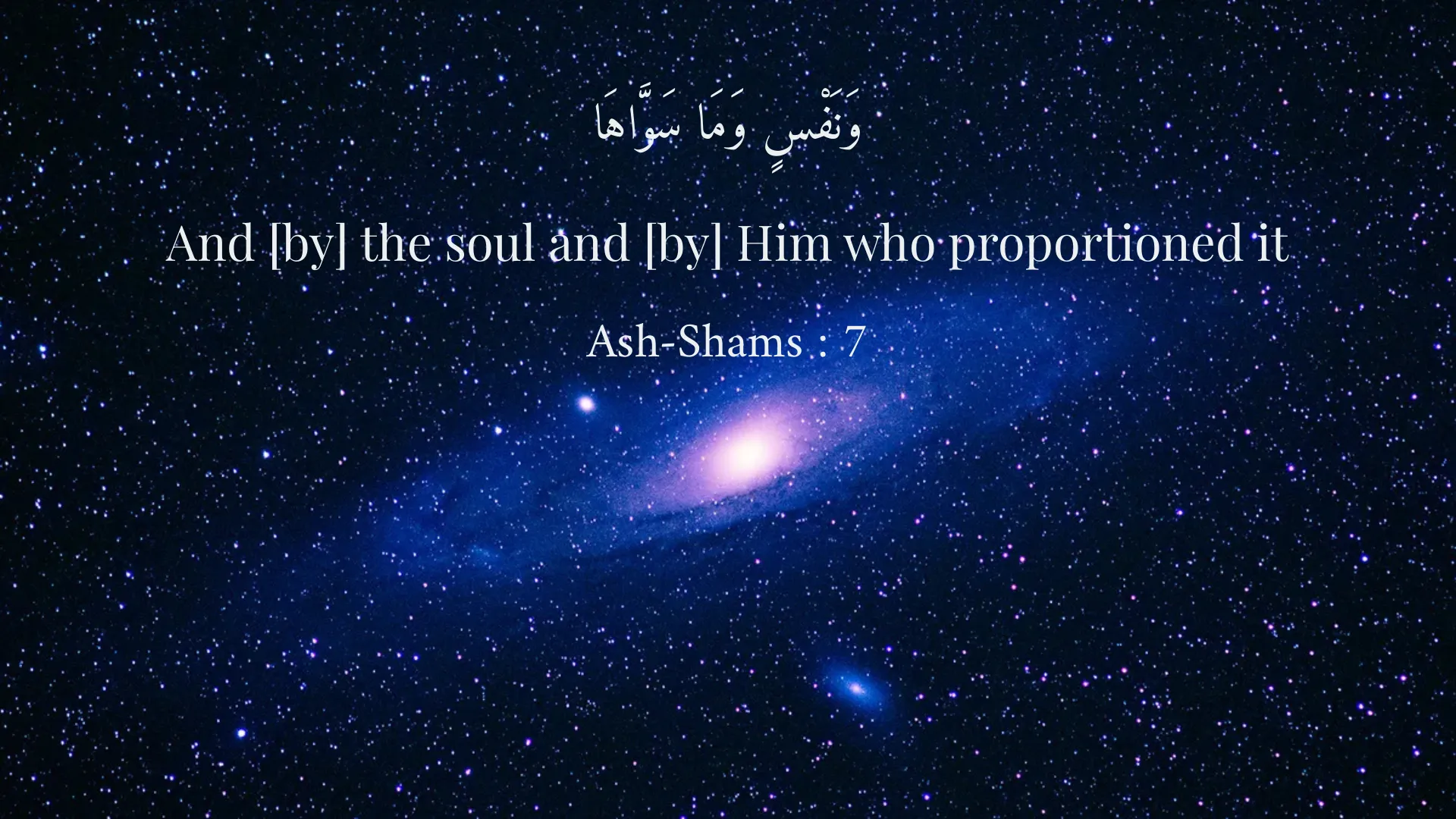
وَنَفْسٍ وَمَا سَوَّاهَا
And [by] the soul and [by] Him who proportioned it
Ash-Shams : 7
فَأَلْهَمَهَا فُجُورَهَا وَتَقْوَاهَا
And inspired it [with discernment of] its wickedness and its righteousness,
Ash-Shams : 8
قَدْ أَفْلَحَ مَن زَكَّاهَا
He has succeeded who purifies it,
Ash-Shams : 9
وَقَدْ خَابَ مَن دَسَّاهَا
And he has failed who corrupts it.
Ash-Shams : 10
بَلِ الْإِنسَانُ عَلَىٰ نَفْسِهِ بَصِيرَةٌ
Rather, man, against himself, will be a witness,
Al-Qiyamah : 14
وَلَوْ أَلْقَىٰ مَعَاذِيرَهُ
Even if he presents his excuses.
Al-Qiyamah : 15
وَمَا خَلَقْتُ الْجِنَّ وَالْإِنسَ إِلَّا لِيَعْبُدُونِ
And I did not create the jinn and mankind except to worship Me.
Adh-Dhariyat : 56
Short Story
It is said that a just king had a habit, every night before sleeping, of placing a large mirror before himself and looking into it. A vizier asked him, 'My Lord, what need do you have for this mirror? Your handsome face is apparent to all.' The king smiled and said, 'O vizier, this mirror is not for seeing the outward appearance, but for gazing within. Every day I strive to make my deeds and words so pure and untainted that when I look into this mirror, I see no ugliness nor any dust on the face of my conscience. This mirror reminds me to make myself better than I am, every single moment.' This Saadi-esque tale teaches us that the true mirror for seeing ourselves is our inner being and our actions, not merely our outward appearance.