Quranic Answer
The Holy Quran, a profound source of divine guidance, masterfully navigates the multifaceted nature of human knowledge, drawing a clear yet interconnected distinction between apparent (ظاهری) and inner (باطنی) understanding. This nuanced approach is fundamental to comprehending reality, one's purpose, and the divine order of the universe. The Quran doesn't dismiss apparent knowledge; rather, it places it within a broader framework, urging believers to transcend superficial perception and delve into deeper, unseen truths. Apparent knowledge, often referred to as "ilm" in its general sense, pertains to what can be perceived through the senses, observed empirically, and understood through rational inquiry and worldly experience. The Quran actively encourages the acquisition of this type of knowledge. It invites humanity to reflect upon the wonders of creation – the intricate design of the heavens and earth, the cycles of day and night, the diversity of life, the flow of rivers, and the growth of plants. Verses like those in Surah Al-Ghashiyah (88:17-20) urge contemplation on camels, the sky, mountains, and the earth, implicitly promoting empirical observation that forms the basis of sciences like biology, astronomy, geology, and geography. Similarly, the Quran refers to historical events and the rise and fall of nations, prompting the study of history and sociology to derive lessons. This worldly knowledge is crucial for practical life, building civilizations, managing resources, and understanding the observable laws governing the physical universe. It enables humans to innovate, develop, and harness the bounties of the earth, as long as it is pursued with awareness of its ultimate source and purpose. However, the Quran also cautions against the limitations of this knowledge. In Surah Ar-Rum (30:7), it states: "They know what is apparent of the worldly life, but they are heedless of the Hereafter." This powerful verse highlights a critical point: while people may possess extensive knowledge of the tangible world, their focus on only the outward appearance can lead to a fundamental blindness regarding ultimate realities and their spiritual destination. This superficiality can manifest as materialism, an excessive preoccupation with worldly gains, or a neglect of moral and ethical dimensions that extend beyond immediate sensory gratification. In contrast, inner knowledge (Batin) transcends the realm of mere observation and reason. It refers to the understanding of the unseen (Al-Ghayb), divine truths, spiritual insights, the essence and wisdom behind apparent phenomena, and the ultimate purpose of existence. This knowledge is not merely accumulated data but a profound wisdom (Hikmah) that illuminates the heart and soul. The Quran repeatedly emphasizes the supremacy of this inner understanding. In Surah Al-Hajj (22:46), it unequivocally states: "Have they not traveled through the land, so that they may have hearts by which to reason and ears by which to hear? For indeed, it is not eyes that are blinded, but hearts which are in the breasts." This verse draws a stark distinction between physical sight and hearing, which are tools for apparent knowledge, and the "hearts" (qulub) that possess the capacity for true comprehension and spiritual insight. A heart veiled by heedlessness or spiritual impurity cannot perceive the deeper truths, even if the eyes behold the most evident signs. The quintessential example of this interplay between apparent and inner knowledge is found in the captivating narrative of Prophet Moses and Khidr in Surah Al-Kahf (18:60-82). Moses, with his prophetic knowledge and understanding of divine law, was perplexed by Khidr's actions: scuttling a boat, killing a seemingly innocent boy, and rebuilding a wall for no apparent reward. From Moses's perspective, these actions were outwardly unjust or illogical. However, Khidr possessed a special, divinely bestowed inner knowledge (khubran), as he explains in verse 18:68: "And how can you have patience for what you have not encompassed in [inner] knowledge?" Khidr's explanations later revealed the profound wisdom and divine command behind each seemingly inexplicable act – the boat was saved from confiscation by a tyrannical king, the boy was a disobedient future tyrant whose parents would be granted a righteous child, and the wall protected an orphan's treasure. This story powerfully illustrates that appearances can be deceptive, and true understanding often requires insight into the hidden dimensions of divine decree and ultimate outcomes. It teaches humility before the vastness of divine wisdom, reminding us that our limited human perception of justice and causality may not grasp the full, intricate tapestry of God's plan. Therefore, the Quran encourages a holistic approach to knowledge, where apparent facts serve as gateways to deeper spiritual contemplation. Observation of the natural world should lead to 'tadabbur' (deep pondering) and 'tafakkur' (reflection) on God's signs, thereby transforming empirical knowledge into spiritual insight. The physical wonders of the universe are not ends in themselves but pointers to the Creator's grandeur and wisdom. The pursuit of inner knowledge requires purification of the heart, humility, sincere seeking of divine guidance, and constant remembrance of God. It is through this inner illumination that one can truly grasp the meaning of life, the reality of the Hereafter, and the essence of divine commands. In essence, the Quran portrays apparent knowledge as a necessary but incomplete facet of understanding, a tool for navigating the physical world. Inner knowledge, on the other hand, is the spiritual compass, guiding humanity towards ultimate truth, wisdom, and proximity to the Divine. A balanced life, according to the Quran, integrates both, allowing the outward to inform the inward, and the inward to elevate the outward, leading to a profound, holistic perception of reality and a purposeful existence. This integrated understanding is what truly distinguishes those who are merely "aware" from those who are truly "wise."
Related Verses
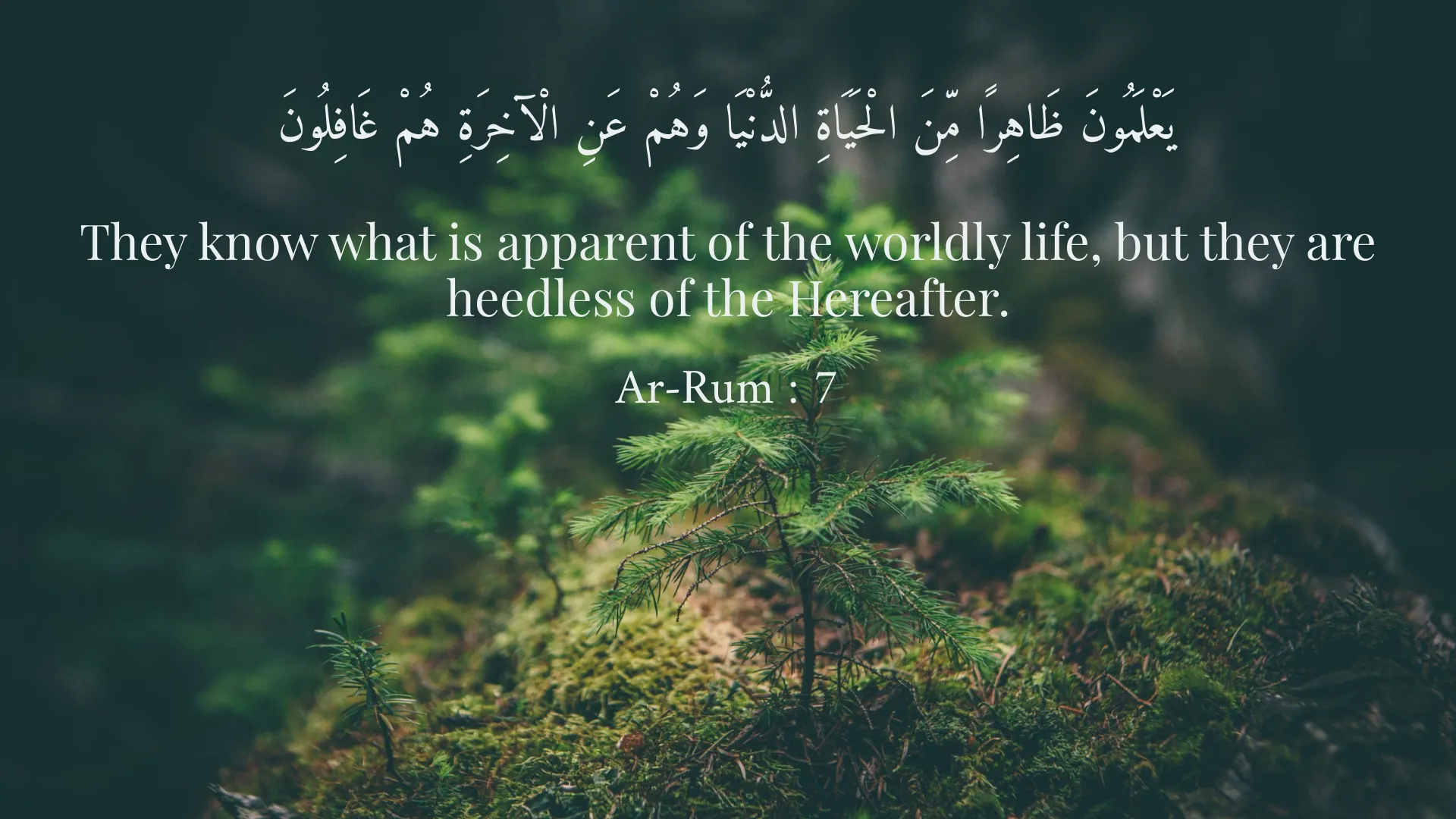
يَعْلَمُونَ ظَاهِرًا مِّنَ الْحَيَاةِ الدُّنْيَا وَهُمْ عَنِ الْآخِرَةِ هُمْ غَافِلُونَ
They know what is apparent of the worldly life, but they are heedless of the Hereafter.
Ar-Rum : 7
وَكَيْفَ تَصْبِرُ عَلَىٰ مَا لَمْ تُحِطْ بِهِ خُبْرًا
And how can you have patience for what you have not encompassed in [inner] knowledge?
Al-Kahf : 68
أَفَلَمْ يَسِيرُوا فِي الْأَرْضِ فَتَكُونَ لَهُمْ قُلُوبٌ يَعْقِلُونَ بِهَا أَوْ آذَانٌ يَسْمَعُونَ بِهَا ۖ فَإِنَّهَا لَا تَعْمَى الْأَبْصَارُ وَلَكِن تَعْمَى الْقُلُوبُ الَّتِي فِي الصُّدُورِ
Have they not traveled through the land, so that they may have hearts by which to reason and ears by which to hear? For indeed, it is not eyes that are blinded, but hearts which are in the breasts.
Al-Hajj : 46
Short Story
It is narrated that in ancient times, there lived an ascetic worshiper who would go to a nearby hill every day to pray beside a clear spring. One day, a zealous and curious young man, who had recently joined the circle of his disciples, accompanied him. On their way back, they saw a poor man diligently patching his old clothes, sighing with every stitch he made. The young man's heart was moved by this sight, and he thought to himself, "Why should this man, despite all his effort and poverty, suffer such hardship?" The ascetic, aware of the young man's state, smiled and said: "My son, you saw the outward appearance of the deed, but you did not grasp its inner reality. That sigh is not a sigh of regret, but a sigh of gratitude that God has given him hands to earn his sustenance with dignity and effort, not with humiliation and begging. He is content with God's decree, and in his contentment, he is the richest man." The young man pondered over these words and realized that sometimes wisdom is hidden behind the veil of appearances, and to understand the truth, one must open the eye of the heart.