Quranic Answer
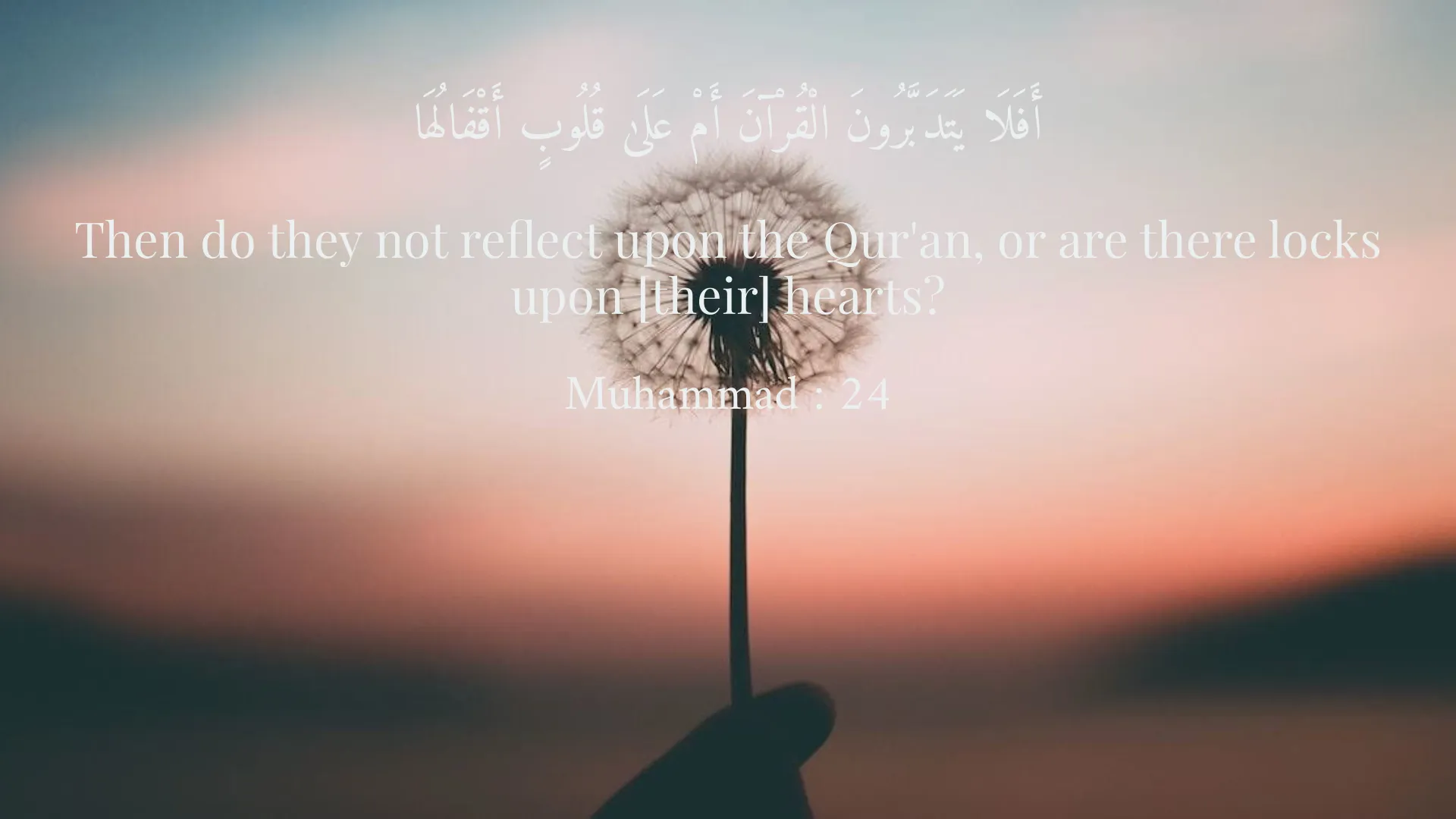
The Holy Quran, as a divine guide, not only invites humanity to faith and righteous deeds but also profoundly and consistently encourages critical thinking, deep contemplation, and an relentless pursuit of truth. This call to reflection is one of the most prominent features of Quranic teachings, warning people against blind imitation and reminding them of their inherent status as 'thinking beings.' In numerous verses, directly or indirectly, the Quran urges humanity to employ their intellect, insight, and discernment, indeed considering this very capacity for thought and reasoning as the fundamental difference between humans and other creatures, a capacity that prepares them to assume the responsibility of God's vicegerency on Earth. One of the central concepts in this regard is 'Tadabbur' (contemplation or deep reflection). In Surah Muhammad, verse 24, Allah asks: 'Do they not then contemplate the Qur'an, or are there locks upon [their] hearts?' This rhetorical question is a powerful rebuke, indicating that a failure to contemplate the Quran is a sign of sealed hearts, preventing the light of guidance from penetrating within. 'Tadabbur' signifies profound reflection on the various dimensions of something, moving beyond its superficial appearance to uncover hidden truths and implications. This concept encompasses pondering over divine signs, both the 'Ayat al-Takwiniyyah' (signs in creation, like the universe) and the 'Ayat al-Tashri'iyyah' (legislative signs, i.e., the Quran itself). By contemplating the majestic creation of the heavens and the earth, the orderly alternation of night and day, the intricate movement of stars, and the cycles of life, death, and plant growth, one comes to appreciate the Creator's grandeur, His infinite wisdom, and the purposeful nature of creation. This intellectual process guides humanity toward recognizing truth and affirming monotheism, compelling them to humility and submission before the majesty and order of creation, thereby deepening their faith. Furthermore, the Quran strongly discourages blind imitation (Taqlid), an action that deprives individuals of their intellectual capabilities. In Surah Al-Baqarah, verse 170, we read: 'And when it is said to them, 'Follow what Allah has revealed,' they say, 'Rather, we will follow that which we found our fathers doing.' Even though their fathers understood nothing, nor were they guided?' This verse explicitly demonstrates that the Quran demands rational and logical proofs, even when confronting ancestral traditions and beliefs that might have deep roots in society. Blindly following predecessors without thought or reason is condemned, and human value is intricately tied to their ability to reason and distinguish truth from falsehood using intellect and sound argumentation. This approach forms the cornerstone of critical thinking: refusing to accept anything merely because it is old or widely accepted, but instead weighing it against the criteria of reason and divine revelation. This instills intellectual freedom and personal responsibility for one's choices and beliefs, urging individuals to arrive at truth through personal conviction rather than passive acceptance. Simultaneously, the call to 'Tafakkur' (reflection) and 'Ta'aqqul' (reasoning) permeates the entire Quran. For instance, in Surah Al-Imran, verses 190-191, Allah states: 'Indeed, in the creation of the heavens and the earth and the alternation of the night and the day are signs for those of understanding. Who remember Allah while standing or sitting or [lying] on their sides and reflect upon the creation of the heavens and the earth, [saying], 'Our Lord, You did not create this in vain; exalted are You [above such a thing]; then protect us from the punishment of the Fire.'' These verses identify divine signs in creation for 'Ulul Albab' (people of profound understanding, intellect, and active minds) who remember Allah in all states and reflect on the creation of the heavens and the earth with precision and depth. This reflection logically leads to the conclusion that creation is not futile or purposeless; rather, every part of it holds meaning and wisdom. This forms the basis of a purposeful, responsible, and profound worldview that guides humanity towards recognizing divine perfections. Through numerous challenging questions, the Quran actively engages the reader's mind, compelling them to think. Phrases such as 'Afa la ta'qilun?' (Do you not reason?), 'Afa la tatafakkarun?' (Do you not reflect?), 'Afa la yatadabbarun?' (Do they not contemplate?), and 'La'allakum tatafakkarun' (So that you may reflect) are examples of this intelligent intellectual stimulation. This method does not merely dictate answers in an authoritative manner but entrusts the process of discovery and arriving at conclusions, through reason and intellect, to the individual. This approach helps individuals achieve a deep faith rooted in research, certainty, and insight, rather than superficial or imposed beliefs, by embracing their intellectual responsibility. Moreover, the Quran seeks 'Yaqin' (certainty) and rigorously eschews 'Zann' (conjecture or baseless speculation). Many verses emphasize the necessity of following knowledge and 'Bayyinah' (clear proof and evidence). This forms the very foundation of the scientific method and a critical approach to knowledge, as every claim must be supported by strong evidence, logical reasoning, and well-substantiated arguments, not merely assumptions or unsubstantiated rumors. This perspective encourages curiosity, research, investigation, and experimentation to achieve a correct and profound understanding of truths. The Quran teaches us to always seek evidence and proof and to view anything presented without logical or scientific backing, based solely on guesswork, with skepticism. This outlook is the cornerstone of truth-seeking, avoiding undue biases, and liberation from superstitions. Ultimately, the Quran asks individuals to carefully weigh, analyze, and judge everything they hear or read. This spirit of inquiry, questioning, and analysis paves the way for intellectual and spiritual growth and helps individuals walk on the path of correct guidance and avoid deviation. This comprehensive call to reflection and rationality transforms the Quran into an unparalleled source for nurturing truth-seeking, critical, and flourishing minds.
Related Verses
أَفَلَا يَتَدَبَّرُونَ الْقُرْآنَ أَمْ عَلَىٰ قُلُوبٍ أَقْفَالُهَا
Then do they not reflect upon the Qur'an, or are there locks upon [their] hearts?
Muhammad : 24
وَإِذَا قِيلَ لَهُمُ اتَّبِعُوا مَا أَنزَلَ اللَّهُ قَالُوا بَلْ نَتَّبِعُ مَا أَلْفَيْنَا عَلَيْهِ آبَاءَنَا ۗ أَوَلَوْ كَانَ آبَاؤُهُمْ لَا يَعْقِلُونَ شَيْئًا وَلَا يَهْتَدُونَ
And when it is said to them, 'Follow what Allah has revealed,' they say, 'Rather, we will follow that which we found our fathers doing.' Even though their fathers understood nothing, nor were they guided?
Al-Baqarah : 170
إِنَّ فِي خَلْقِ السَّمَاوَاتِ وَالْأَرْضِ وَاخْتِلَافِ اللَّيْلِ وَالنَّهَارِ لَآيَاتٍ لِّأُولِي الْأَلْبَابِ
Indeed, in the creation of the heavens and the earth and the alternation of the night and the day are signs for those of understanding.
Al-Imran : 190
Short Story
It is narrated that in ancient times, a wise master taught wisdom to his students, expecting them to accept everything they learned without question. However, among them was a thoughtful boy who, whenever the master spoke, would humbly ask: "Revered master, what is the reason and proof for this statement, and where in knowledge does its root lie?" The other students, who were only focused on memorization, sometimes reproached him for these questions, saying, "Do you not trust the master's wise words?" But that student, with a smile, replied: "My trust in the master is boundless, but I wish for his words to settle not just in my ears, but in my soul and intellect, and to be embraced by complete certainty." Years passed, and with this very spirit of inquiry, questioning, and not settling for superficialities, that student delved so deeply into various fields of knowledge that he surpassed all his peers and himself became a great master and a reference for truth-seekers. Indeed, the path to truth is through conscious questions and relentless contemplation, for only with the light of reason and inquiry can one be freed from the darkness of ignorance and blind imitation, and reach the fount of certainty.