Quranic Answer
The Holy Quran, as the guiding scripture for Muslims, provides timeless and universal principles for individual and social life. Although the concepts of 'digital space' or 'internet' did not exist at the time of the Quran's revelation, its teachings regarding honesty, truthfulness, accountability in speech and actions, and avoiding falsehood and slander, are entirely and profoundly applicable to our interactions in today's world, including the digital realm. The Quran invites us to six fundamental principles for maintaining honesty in this new medium, which we will discuss in detail. First and perhaps the most crucial principle is 'Sidq,' or truthfulness. The Quran repeatedly calls believers to be truthful in all aspects of life. Honesty in the digital space means that we must be entirely truthful when publishing information, expressing opinions, and even in presenting our identity. This includes refraining from fake news, baseless rumors, and distorted information. Fabricating lies, creating fake identities, or spreading misleading content are all considered acts of falsehood and hypocrisy in the Quranic timeline. In Surah At-Tawbah, verse 119, Allah says: “O you who have believed, fear Allah and be with the truthful.” This verse indicates that truthfulness is a core characteristic for a believer and must be adhered to on any platform, whether in a gathering of friends or in the virtual space. Truthfulness not only preserves one’s credibility but also significantly contributes to creating a safe and trustworthy environment in the digital space. Second is the principle of 'Tabayyun,' or verification and investigation. In today's world, where information spreads at an astonishing speed, the Quran invites us to reflect and verify the authenticity of news before spreading or believing it. This principle is explicitly stated in Surah Al-Hujurat, verse 6: “O you who have believed, if there comes to you a disobedient one with information, investigate, lest you harm a people out of ignorance and become over the wrong you have done, regretful.” This verse is a direct command to combat false news, fake news, and rumors in the virtual space. Before resharing a message, photo, or video, we must ensure its authenticity, because any false information spread by us can lead to irreparable consequences for individuals or society. In essence, this verse forms the backbone of media literacy from a Quranic perspective. Third is avoiding 'Gheebah' (backbiting), 'Buhtan' (slander), and 'Iftira' (defamation). The digital space, due to its relative anonymity and ease of expression, provides a fertile ground for backbiting, accusing, and speaking ill of others. The Quran strongly condemns these actions. In Surah Al-Hujurat, verse 12, it states: “And do not backbite each other. Would one of you like to eat the flesh of his brother when dead? You would detest it.” This shocking analogy illustrates the abhorrence of this act, whether in physical or virtual space. Any dissemination of private information, rumors, or insults about others, even if anonymously, is considered unlawful and destructive in the eyes of the Quran. Honesty in the digital space means respecting the privacy and reputation of others and refraining from anything that leads to their dishonor or distress. Fourth is 'Qawlan Sadeed,' or upright and truthful speech. The Quran calls believers to use firm, logical, and meaningful language, far from idle talk. In Surah Al-Ahzab, verse 70, it says: “O you who have believed, fear Allah and speak a word of appropriate gravity (or straightforwardly).” In the digital space, this verse means that we should use thoughtful and responsible words in our writing and speech, whether in comments, posts, or private messages. Avoiding insults, profanity, incitement to violence, and the use of harsh or impolite language are all requirements of 'Qawlan Sadeed' in the virtual space. Speech that embodies honesty and respect for the audience leads to more constructive interactions and a healthier virtual environment. Fifth is 'Accountability' and awareness of judgment. The Quran explicitly states that every word and action originating from us is recorded and will be questioned on the Day of Judgment. In Surah Qaf, verse 18, we read: “He does not utter any word except that with him is an observer prepared [to record it].” This awareness must also prevail in the digital space. Many assume that behind the veil of anonymity or a pseudonym, they can say or publish whatever they want. However, the Quran reminds us that Allah is aware of everything, and nothing is hidden from Him. This moral accountability compels individuals to observe honesty, fairness, and etiquette in every interaction, even if with an unknown audience. In essence, the virtual space serves as an open ledger for recording our words and actions. Sixth and final principle is 'Justice' and fairness. The Quran consistently calls believers to establish justice in all aspects of life, even if it is against themselves or their close relatives. In Surah An-Nisa, verse 135, it states: “O you who have believed, be persistently just, witnesses for Allah, even if it be against yourselves or parents and relatives.” This principle means that we must also uphold fairness in the digital space. In critiques and reviews, in judgments, and when encountering opposing views, we must avoid any prejudice, malice, or injustice. Honesty here means presenting viewpoints with fairness and respect, and avoiding hasty or destructive judgments. Even when encountering others' mistakes, we should act with a corrective, rather than a destructive, approach. In summary, the Holy Quran, by providing these fundamental ethical principles, offers a comprehensive framework for believing behavior in any medium, including the digital space. Honesty in the digital space not only means speaking the truth but also includes accountability in judgments, accuracy in disseminating information, respect for others, and abstaining from any action that leads to falsehood, deception, or harm. These teachings guide us to build a healthier, more humane, and trust-based virtual world, where every click and every word is performed with awareness of divine oversight and its ethical consequences.
Related Verses
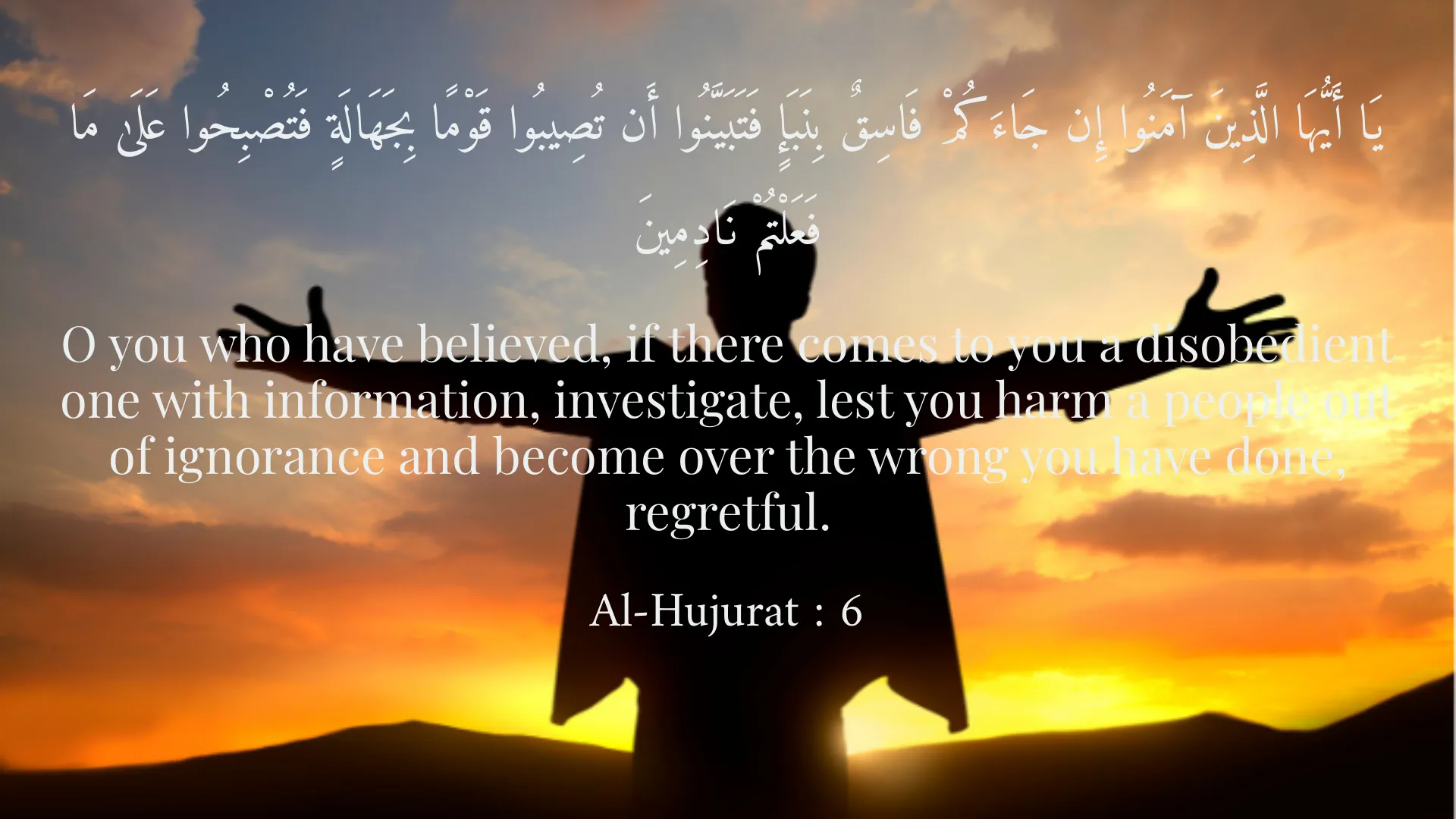
يَا أَيُّهَا الَّذِينَ آمَنُوا إِن جَاءَكُمْ فَاسِقٌ بِنَبَإٍ فَتَبَيَّنُوا أَن تُصِيبُوا قَوْمًا بِجَهَالَةٍ فَتُصْبِحُوا عَلَىٰ مَا فَعَلْتُمْ نَادِمِينَ
O you who have believed, if there comes to you a disobedient one with information, investigate, lest you harm a people out of ignorance and become over the wrong you have done, regretful.
Al-Hujurat : 6
يَا أَيُّهَا الَّذِينَ آمَنُوا اتَّقُوا اللَّهَ وَقُولُوا قَوْلًا سَدِيدًا
O you who have believed, fear Allah and speak a word of appropriate gravity (or straightforwardly).
Al-Ahzab : 70
مَّا یَلْفِظُ مِن قَوْلٍ إِلَّا لَدَیْهِ رَقِیبٌ عَتِیدٌ
He does not utter any word except that with him is an observer prepared [to record it].
Qaf : 18
Short Story
In Saadi's Golestan, it is narrated that a king, renowned for his justice and fairness, heard a false rumor spreading in his kingdom that his vizier was secretly collaborating with enemies. People quickly spread this news, without investigation, through the streets and markets, adding to its scope daily. The innocent vizier fell under suspicion before the king and was dismissed from his position. One day, a wise dervish, aware of this injustice, told the king: “O King, know that falsehood is like fire; if a spark of it falls upon the souls of people, it will burn everything, consuming both the dry and the wet. A tongue that spreads baseless news is like a hidden dagger.” Upon hearing these words, the king investigated, and the truth became clear that the vizier was innocent. The king regretted his actions and restored the vizier to his position, commanding the people never to spread news without verification, for “what reaches the ear from the mouth is not all true; and truth, sometimes, lies hidden in silence, not in the clamor of lies.” This story reminds us that in today's news-filled world, we should never simply believe and disseminate everything we hear or see, for words, whether spoken or written, can inflict deeper wounds than swords upon others, and we bear the responsibility for them.