Quranic Answer
The Holy Quran, as the divine revelation and a comprehensive guide to life, is far more than a mere book of individual worship; it is a complete program for cultivating human beings who are spiritually elevated and, at the same time, socially aware, responsible, and active members of their communities. This divine book intricately links personal piety with social responsibility, fostering a worldview where an individual's well-being is inextricably tied to the well-being of society. The foundational teachings of the Quran systematically transform human beings into individuals deeply conscious of their social environment, emphasizing core concepts such as unity, justice, compassion, collective responsibility, and accountability. Firstly, the Quran establishes the fundamental principle of Tawhid, the Oneness of God. This concept, while seemingly theological, carries profound social implications. If all humanity originates from a single Creator and a unified source, it inherently implies equality and brotherhood among all people, irrespective of their race, gender, wealth, or social status. The Quran states in Surah Al-Hujurat (49:13), “O mankind, indeed We have created you from male and female and made you peoples and tribes that you may know one another. Indeed, the most noble of you in the sight of Allah is the most righteous of you. Indeed, Allah is Knowing and Acquainted.” This verse eloquently dismantles superficial distinctions and actively promotes mutual understanding, respect, and peaceful coexistence. It forms the bedrock of social awareness, where diversity is celebrated as a means of enrichment and connection, rather than a cause for division or discord. Secondly, justice (Adl and Qist) is a paramount and recurring theme throughout the Quran. It rigorously mandates that believers uphold justice in all their dealings – whether in personal interactions, economic transactions, legal judgments, or social affairs – even if doing so goes against their own interests, their parents, or their closest relatives. In Surah An-Nisa (4:135), Allah commands, “O you who have believed, be persistently maintainers of justice, witnesses for Allah, even if it be against yourselves or parents and relatives. Whether one is rich or poor, Allah is more worthy of both. So follow not [personal] inclination, lest you deviate. And if you distort [justice] or turn away, then indeed Allah is ever, with what you do, Acquainted.” This unwavering emphasis on impartial justice aims to create a societal fabric built on fairness, integrity, and equity. Furthermore, it inherently implies a crucial social responsibility: to stand firmly for the oppressed, to protect the rights of the vulnerable, and to ensure that justice is accessible to all, which is a vital component of a truly socially conscious individual. Thirdly, the Quran deeply instills principles of compassion and empathy (Rahmah and Ihsan). It consistently calls upon believers to embody kindness, mercy, forgiveness, and generosity, especially towards the most vulnerable segments of society, including orphans, the poor, the needy, travelers, and neighbors. Acts of voluntary charity (Sadaqah) and the obligatory annual almsgiving (Zakat) are not depicted as mere optional good deeds; rather, they are presented as integral components of true righteousness and spiritual fulfillment. Surah Al-Baqarah (2:177) elaborates on the essence of true righteousness, stating that it encompasses giving wealth, despite one's love for it, to relatives, orphans, the needy, the traveler, those who ask for help, and for freeing slaves. These teachings actively encourage individuals to transcend self-interest and engage proactively in alleviating suffering and fostering collective well-being within their communities, thus promoting a profound sense of shared humanity. Fourthly, the concept of the Ummah, or the global Muslim community, fosters an exceptionally strong sense of collective responsibility and solidarity. Muslims are encouraged to function as a unified body, supporting one another and collaboratively working towards the common good. The principle of Amr bil Ma'ruf wa Nahi anil Munkar (enjoining what is right and forbidding what is wrong), as highlighted in Surah Aal-Imran (3:104), is a communal obligation that transforms believers into active agents of social reform and moral vigilance. This means that individuals are not solely concerned with their personal salvation but also feel a profound responsibility for the moral health and overall welfare of their society, actively promoting virtue and diligently striving to eradicate injustice, corruption, and societal ills. Fifthly, the Quran meticulously outlines a clear framework of rights and duties for various social relationships. It delineates the reciprocal rights of parents, children, spouses, relatives, and neighbors, thereby providing a comprehensive blueprint for harmonious and respectful social interaction. By understanding, respecting, and diligently fulfilling these mutual rights and duties, individuals become more attuned to the needs, expectations, and boundaries of those around them. This comprehensive understanding naturally enhances their social awareness and cultivates responsible citizenship, leading to stronger, more stable, and more considerate communities. The emphasis on good conduct, mutual respect, and honoring agreements further solidifies social bonds. Finally, the belief in the Day of Judgment (Akhirah) and divine accountability serves as an incredibly powerful motivator for ethical and responsible social conduct. The Quran emphatically teaches that every action, no matter how small, will be meticulously weighed and accounted for in the hereafter. This profound awareness of ultimate accountability to God encourages individuals to be deeply mindful of their interactions with others, ensuring they consistently uphold justice, demonstrate compassion, and contribute positively and constructively to society. Knowing that their worldly deeds carry eternal consequences inspires them to move beyond superficial concerns for reputation or immediate gain, fostering a deeper, intrinsic motivation for genuine righteousness and communal well-being. In conclusion, the Quran systematically constructs a socially aware human being by instilling core values of unity, justice, compassion, and collective responsibility, all underpinned by a profound sense of accountability to the Creator. It transforms faith from a private, introspective matter into a dynamic, outward-looking force that compels individuals to engage actively and positively with their communities, fostering a just, equitable, and harmonious society. Through its comprehensive and profound teachings, the Quran ensures that a believer's spiritual journey is always intricately intertwined with their social consciousness, thereby creating individuals who are not only devout but also active, constructive participants in shaping a better world for all.
Related Verses
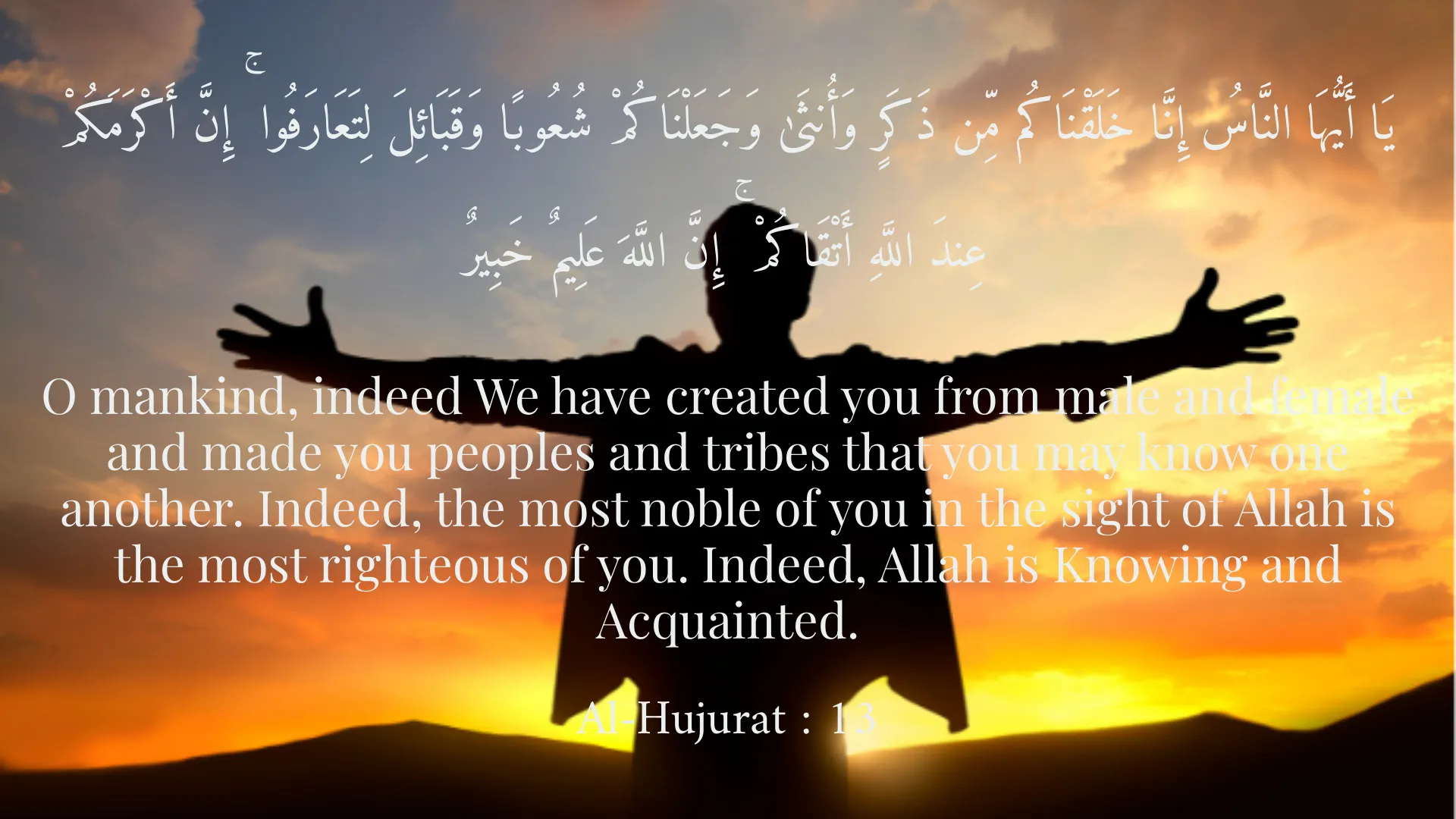
يَا أَيُّهَا النَّاسُ إِنَّا خَلَقْنَاكُم مِّن ذَكَرٍ وَأُنثَىٰ وَجَعَلْنَاكُمْ شُعُوبًا وَقَبَائِلَ لِتَعَارَفُوا ۚ إِنَّ أَكْرَمَكُمْ عِندَ اللَّهِ أَتْقَاكُمْ ۚ إِنَّ اللَّهَ عَلِيمٌ خَبِيرٌ
O mankind, indeed We have created you from male and female and made you peoples and tribes that you may know one another. Indeed, the most noble of you in the sight of Allah is the most righteous of you. Indeed, Allah is Knowing and Acquainted.
Al-Hujurat : 13
يَا أَيُّهَا الَّذِينَ آمَنُوا كُونُوا قَوَّامِينَ بِالْقِسْطِ شُهَدَاءَ لِلَّهِ وَلَوْ عَلَىٰ أَنفُسِكُمْ أَوِ الْوَالِدَيْنِ وَالْأَقْرَبِينَ ۚ إِن يَكُنْ غَنِيًّا أَوْ فَقِيرًا فَاللَّهُ أَوْلَىٰ بِهِمَا ۖ فَلَا تَتَّبِعُوا الْهَوَىٰ أَن تَعْدِلُوا ۚ وَإِن تَلْوُوا أَوْ تُعْرِضُوا فَإِنَّ اللَّهَ كَانَ بِمَا تَعْمَلُونَ خَبِيرًا
O you who have believed, be persistently maintainers of justice, witnesses for Allah, even if it be against yourselves or parents and relatives. Whether one is rich or poor, Allah is more worthy of both. So follow not [personal] inclination, lest you deviate. And if you distort [justice] or turn away, then indeed Allah is ever, with what you do, Acquainted.
An-Nisa : 135
لَّيْسَ الْبِرَّ أَن تُوَلُّوا وُجُوهَكُمْ قِبَلَ الْمَشْرِقِ وَالْمَغْرِبِ وَلَٰكِنَّ الْبِرَّ مَنْ آمَنَ بِاللَّهِ وَالْيَوْمِ الْآخِرِ وَالْمَلَائِكَةِ وَالْكِتَابِ وَالنَّبِيِّينَ وَآتَى الْمَالَ عَلَىٰ حُبِّهِ ذَوِي الْقُرْبَىٰ وَالْيَتَامَىٰ وَالْمَسَاكِينَ وَابْنَ السَّبِيلِ وَالسَّائِلِينَ وَفِي الرِّقَابِ وَأَقَامَ الصَّلَاةَ وَآتَى الزَّكَاةَ ۗ وَالْمُوفُونَ بِعَهْدِهِمْ إِذَا عَاهَدُوا ۖ وَالصَّابِرِينَ فِي الْبَأْسَاءِ وَالضَّرَّاءِ وَحِينَ الْبَأْسِ ۗ أُولَٰئِكَ الَّذِينَ صَدَقُوا ۖ وَأُولَٰئِكَ هُمُ الْمُتَّقُونَ
Righteousness is not that you turn your faces toward the east or the west, but [true] righteousness is [in] one who believes in Allah, the Last Day, the angels, the Book, and the prophets and gives wealth, in spite of love for it, to relatives, orphans, the needy, the traveler, those who ask for help, and for freeing slaves; [and who] establishes prayer and gives zakat; [those who] fulfill their promise when they promise; and [those who] are patient in poverty and hardship and during battle. Those are the ones who have been true, and it is those who are the righteous.
Al-Baqarah : 177
Short Story
It is narrated that a just king was once seated among his courtiers when a devout and reclusive dervish entered. The king asked him, 'O Dervish, in this bustling world, which deed earns the greatest reward from God and leads one to true felicity?' The dervish bowed his head and, after a moment of contemplation, said, 'O King! Prayer, fasting, and individual worship are good, but superior to all of these is serving God's creation. Helping the needy, seeking justice for the oppressed, and easing the burdens of people – these are what truly demonstrate devotion and make a person socially aware and responsible.' The king was delighted by this saying and understood that the value of social actions transcends individual worship, for serving people is the mirror of true piety and brings hearts together.