Quranic Answer
The Holy Quran, with its profound and comprehensive perspective, portrays the relationship between humanity and the universe not as a simple connection, but as a sacred, dynamic, and responsible bond. This divine book does not merely consider the cosmos as a collection of material elements; rather, it introduces it as a grand stage displaying the signs (ayat) of Allah’s infinite power, wisdom, knowledge, and mercy. Every part of it serves as a mirror for human contemplation and reflection. From this viewpoint, humanity, as the noblest of creation and God’s vicegerent on Earth, plays a central and irreplaceable role in this grand system. This role is not merely that of an observer; it encompasses understanding, responsibility, proper utilization, and the preservation of this divine trust. The first and most prominent aspect of this relationship is the concept of “Divine Signs” (Ayatullah). The Quran repeatedly calls upon humans to observe their surroundings: the regular orbits of the sun and moon, the alternation of night and day, the creation of the heavens and the earth, the life-giving descent of rain and the sprouting of plants, the astonishing diversity of living creatures, and even the creation of humanity itself. Each of these phenomena is an “Ayah,” a clear sign pointing to the existence of a wise and powerful Creator. These signs are not only material but also carry deep spiritual meanings. By reflecting on these signs, humans come to realize the Creator's greatness, their faith is strengthened, and a sense of awe and humility before the inexhaustible divine power arises within them. This invitation to contemplation and reflection guides humanity towards science and the discovery of the laws governing nature, presenting science not as being in conflict with religion, but as complementary to it. In essence, every new scientific discovery unveils another layer of divine wisdom, bringing humanity closer to the source of creation. The second aspect is the role of “Khilafah” or vicegerency of humanity on Earth. In Surah Al-Baqarah, verse 30, Allah Almighty states: “And [mention, O Muhammad], when your Lord said to the angels, 'Indeed, I will make upon the earth a successive authority.'” This position is a great honor that also comes with heavy responsibilities. Humanity, as a Khalifa, is a trustee and agent of God on Earth, not an absolute owner. This means that humans do not have the right to abuse, destroy, or waste the environment and natural resources. The duty of a Khalifa involves developing the Earth (Imran al-Ard), establishing justice, maintaining balance and moderation, and preventing corruption (fasad). This perspective lays the foundation for environmental ethics in Islam; an ethic where nature is not merely a tool for exploitation, but a living and respected entity that glorifies God and has a right to exist. Humans must treat all creatures with compassion and responsibility, utilizing resources in a way that benefits future generations as well. Thirdly, the principle of “Mizan,” or balance and order in creation, is emphasized. The Quran highlights that Allah has created the universe with precise and calculated order. Everything has a specific measure and place, and every element is perfectly positioned. Surah Ar-Rahman, verses 7 and 8, state: “And the heaven He raised and set the balance * That you may not transgress [due to] the balance.” This “Mizan” is not only present in the physical structure of the universe but also pervades all aspects of existence, including human interactions and social systems. Humanity is obligated to maintain this balance and avoid excess or transgression in any field. Environmental destruction, excessive consumption of resources, and oppression of other creatures are all considered violations of this divine balance. The relationship between humans and the universe is built upon this harmony and peaceful coexistence. Ultimately, the profound purpose of this relationship is “worship” (Ibadah) and drawing closer to Allah. The universe, with all its wonders, serves as a platform and means for humans to approach their Creator by knowing Him. Surah Adh-Dhariyat, verse 56, explicitly states: “And I did not create the jinn and mankind except to worship Me.” Worship here does not merely mean rituals but includes any activity, thought, or action performed with divine intention that guides humanity towards perfection and knowledge (Ma'rifah). Observing the grandeur of the cosmos instills humility in humans, reminding them that they are but a small part of this infinite system and must always place themselves in the presence of the Creator and in alignment with His will. This deep and responsible understanding leads humanity to peace, insight, and purpose in life, guiding them towards establishing peace and prosperity on Earth.
Related Verses
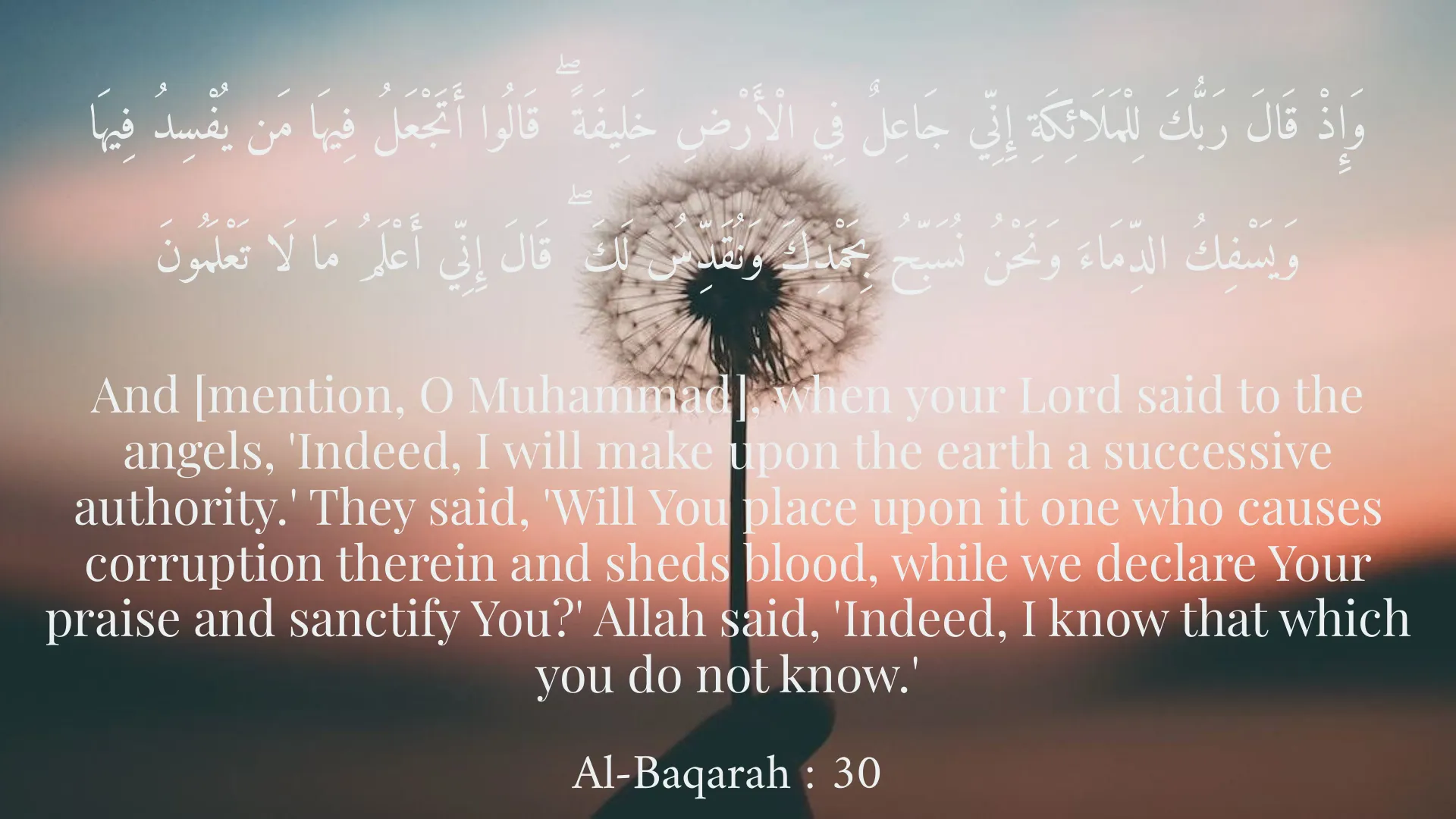
وَإِذْ قَالَ رَبُّكَ لِلْمَلَائِكَةِ إِنِّي جَاعِلٌ فِي الْأَرْضِ خَلِيفَةً ۖ قَالُوا أَتَجْعَلُ فِيهَا مَن يُفْسِدُ فِيهَا وَيَسْفِكُ الدِّمَاءَ وَنَحْنُ نُسَبِّحُ بِحَمْدِكَ وَنُقَدِّسُ لَكَ ۖ قَالَ إِنِّي أَعْلَمُ مَا لَا تَعْلَمُونَ
And [mention, O Muhammad], when your Lord said to the angels, 'Indeed, I will make upon the earth a successive authority.' They said, 'Will You place upon it one who causes corruption therein and sheds blood, while we declare Your praise and sanctify You?' Allah said, 'Indeed, I know that which you do not know.'
Al-Baqarah : 30
وَالسَّمَاءَ رَفَعَهَا وَوَضَعَ الْمِيزَانَ
And the heaven He raised and set the balance.
Ar-Rahman : 7
أَلَّا تَطْغَوْا فِي الْمِيزَانِ
That you may not transgress [due to] the balance.
Ar-Rahman : 8
وَمَا خَلَقْتُ الْجِنَّ وَالْإِنسَ إِلَّا لِيَعْبُدُونِ
And I did not create the jinn and mankind except to worship Me.
Adh-Dhariyat : 56
سَنُرِيهِمْ آيَاتِنَا فِي الْآفَاقِ وَفِي أَنفُسِهِمْ حَتَّىٰ يَتَبَيَّنَ لَهُمْ أَنَّهُ الْحَقُّ ۗ أَوَلَمْ يَكْفِ بِرَبِّكَ أَنَّهُ عَلَىٰ كُلِّ شَيْءٍ شَهِيدٌ
We will show them Our signs in the horizons and in themselves until it becomes clear to them that it is the truth. But is it not sufficient concerning your Lord that He is, over all things, a Witness?
Fussilat : 53
Short Story
It is narrated that in Saadi Shirazi's time, there was a ruler who constantly boasted of his own greatness and power, never paying attention to the world around him. One day, Saadi saw him in a garden, engrossed in war plans and territorial expansion, instead of admiring the flowers and trees or listening to the birds' songs. Saadi, with a kind smile, said to him, 'O King, do you not see how a tiny seed in the ground, by the grace of the Lord, transforms into a mighty tree and bears fruit? And how a small bird, without any greed other than lawful sustenance, flies freely in the sky? These are all signs of an order far greater than what we perceive. If we look at this world with insight, we will understand that true power belongs to the One who created all this, and nothing in this universe is in vain or without measure. A king who comprehends this order will not only have a more enduring reign but also find his heart filled with peace and humility.' The ruler pondered these words and from that day forward, viewed the universe with a different perspective, adopting justice and moderation in his affairs.